Example: barber
Acid-Base Practice Problems - Minnesota State University ...
Acid Strength Base Base Strength 1 Strong Acids H-Cl, H 2SO 4 10 2 2 Hydronium H 3O +, ROH+ cationic 100 H 2O, HOR neutral 3 Carboxylic Acid R 10-5 R 4 Ammonium Ion (Charged) 10-12 C 5 Water HOH 10-16 6 Alcohol ROH 10-17 7 Ketones and Aldehydes H 10-20 O 8 Amine (N-H) (iPr) 2N-H 10-33 9 Alkane (C-H) 10-50 3 Quick Checklist of Acid/Base Factors 1.
Tags:
Information
Domain:
Source:
Link to this page:
Documents from same domain
Standardization of a Hydrochloric Acid Solution
web.mnstate.eduPage 1 Spring 2011 Standardization of a Hydrochloric Acid Solution The purpose of this experiment is to test your lab technique and examine potential sources of error in
Chapter 4: Energy from Combustion The primary …
web.mnstate.eduChapter 4: Energy from Combustion The primary means of generating energy for human endeavors is the combustion of fuels. Fuels: Coal -burned in power plants Gasoline -burned in automobiles
Mass Spectroscopy
web.mnstate.edu1 Mass Spectroscopy Mass Spectroscopy is a technique causing the formation of the gaseous ions with or without fragmentation; the gas phase ions are then

African Environmental Issues - Minnesota State …
web.mnstate.eduAfrican Environmental Issues . Environment in Africa: continuity & change. •Important to consider geological age of Africa & its tropical location. •Both affect
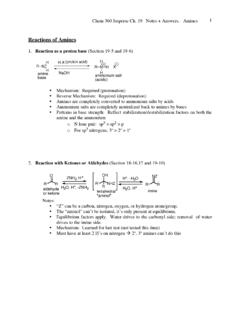
Reactions of Amines - Minnesota State University …
web.mnstate.eduChem 360 Jasperse Ch. 19 Notes + Answers. Amines 1 Reactions of Amines 1. Reaction as a proton base (Section 19-5 and 19-6) RN H H N H R H H X …

Test3 ch17b Buffer-Titration-Equilibrium Practice …
web.mnstate.edu4 Preparation and Recognition of Buffer Systems 14. Which of the following is not a buffer system? A solution containing roughly equal concentrations of _____ a.

Some Arrow-Pushing Guidelines (Section 1.14)
web.mnstate.eduOrganic Chemistry I Review: Highlights of Key Reactions, Mechanisms, and Principles 1 Some Arrow-Pushing Guidelines (Section 1.14) 1. Arrows follow electron movement.

Recrystallization I 9 Chem 355 Jasperse RECRYSTALLIZATION
web.mnstate.eduRecrystallization I 9 Chem 355 Jasperse RECRYSTALLIZATION Background: Impurities often contaminate organic compounds, whether they have been synthesized in

1. Given the relation R (1 1) (1 3) (1 4) (2 2) (3 1) (3 4 ...
web.mnstate.edu9. For each of the following collections of subsets of A= {1,2,3,4,5}, determine whether of not the collection is a partition. If it is, list the ordered pairs in the equivalence relation determined by the partition.
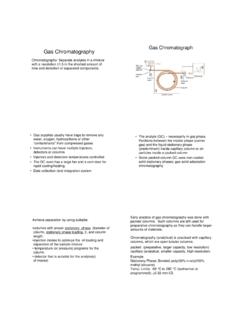
Gas Chromatograph Gas Chromatography
web.mnstate.eduColumn selection GC: Select a stationary phase that would retain (‘dissolve’) the analytes of interest. Stationary phase polarity ~ analyte polarity; (like dissolves like). Selectivity to individual analytes determines the quality of separation (ability to discern the
Related documents
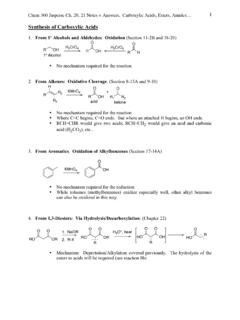
Synthesis of Carboxylic Acids - Minnesota State University ...
web.mnstate.edu• Carboxylic acids are completely converted to carboxylate salts by base • Carboxylate salts are completely neutralized back to carboxylic acids by strong acid • The resonanance stabilization makes carboxylates much more stable than hydroxide or alkoxide anions, which is why the parents are carboxylic “acids”
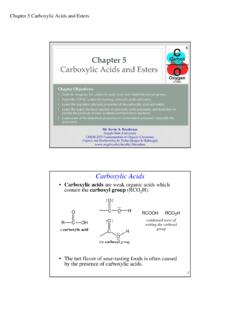
Ch 05 Carboxylic Acids and Esters - Angelo State University
www.angelo.edu• As the number of carbons in a carboxylic acid series becomes greater, the boiling point increases and the solubility in water decreases. • Many carboxylic acids that are liquids at room temperature have characteristically sharp or unpleasant odors. – Ethanoic acid/acetic acid is the main ingredient in vinegar.

24. CARBOXYLIC ACID AND DERIVATIVES - MasterJEE Classes
masterjeeclasses.comFeb 08, 2019 · Chemistry | 24.5 (c) Melting Points: (i) Carboxylic acid with more than 8 carbon atom and a double bond have low melting point due to the inability to form a stable lattice. High m.p. HC 3 COOH Lie on opposite side Low m.p. CH 3 COOH Lie on same side (ii) Structures with even number of C atoms have a higher melting point as compared to structures having odd …

Acid-Base Extraction - University of Massachusetts Amherst
people.chem.umass.educarboxylic acid - high solubility in ether - low solubility in water salt of carboxylic acid - low solubility in ether - high solubility in water In the experiment done in this lab, a mixture of a carboxylic acid (stronger acid), a phenol (weaker acid), and a neutral compound will be separated by acid-base extractions. The separated compounds
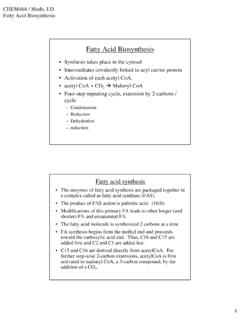
Fatty Acid Biosynthesis - California State University ...
www.csun.eduFatty Acid Biosynthesis 4 Fatty Acid Synthase (FAS) • FAS is a polypeptide chain with multiple domains, each with distinct enzyme activities required for fatty acid biosynthesis. •ACP: Recall that CoA is used as an activator for β-oxidation. For fatty acid biosynthesis, the activator is a protein called the acyl carrier protein (ACP).

Carboxylic Acid Structure and Chemistry - Auburn University
webhome.auburn.eduThe carboxylic acid moiety is considered to be a highly polar organic functional group. This polarity results from the presence of a strongly polarized carbonyl (C=O) group and hydroxyl (O-H) group. Recall that oxygen is a relatively electronegative atom and when