Transcription of Your Role in Managing Assaultive Behavior - RN.com
1 Material Protected by Copyright Your Role in Managing Assaultive Behavior Contact Hours:2 First Published: April 25,2013 Revised: May 21, 2017 Course Expires: May 31, 2020 Copyright 2017 by All Rights Reserved. Reproduction and distribution of these materials are prohibited without the express written authorization of Material Protected by Copyright Acknowledgments acknowledges the valuable contributions ..Suzan R. Miller-Hoover DNP, RN, CCNS, CCRN-K Disclaimer strives to keep its content fair and unbiased. The author(s), planning committee, and reviewers have no conflicts of interest in relation to this course.
2 Conflict of Interest is defined as circumstances a conflict of interest that an individual may have, which could possibly affect Education content about products or services of a commercial interest with which he/she has a financial relationship. There is no commercial support being used for this course. Participants are advised that the accredited status of does not imply endorsement by the provider or ANCC of any commercial products mentioned in this course. You may find that both generic and trade names are used in courses produced by The use of trade names does not indicate any preference of one trade named agent or company over another.
3 Trade names are provided to enhance recognition of agents described in the course. Note: All dosages given are for adults unless otherwise stated. The information on medications contained in this course is not meant to be prescriptive or all-encompassing. You are encouraged to consult with physicians and pharmacists about all medication issues for your patients. Purpose The purpose of this course is to provide healthcare professionals with information to manage Assaultive Behavior in the workplace . Following the Occupational Safety and Health Administration Guidelines for Preventing workplace violence for Healthcare and Social Service Workers, this course will delineate the roadmap to workplace violence prevention.
4 (Material contained in this publication: Guidelines for Preventing workplace violence for Healthcare and Social Service Workers is in the public domain and may be reproduced, fully or partially, without permission. Source credit is requested but not required). Learning Objectives After successful completion of this course, you will be able to: 1. Identify risk factors associated with workplace violence 2. Delineate the steps for workplace violence prevention plan 3. Describe the types of workplace violence 4. Describe predicting factors that lead to aggression and violence 5.
5 Define the assault cycle 6. Identify general safety principles 7. Discuss the use of restraints including each type of restraint Introduction Material Protected by Copyright workplace violence is a serious problem. The National Institute for Occupational Safety and Health defines workplace violence as violent acts, including physical assaults and threats of assault, directed toward persons at work or on duty. Many people study this issue and the workplace prevention programs include verbal violence - threats, verbal abuse, hostility, harassment, and the like; which, can cause significant psychological trauma and stress, even if no physical injury takes place.
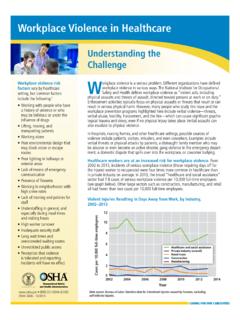
6 Verbal assaults can also escalate to physical violence . In hospitals, nursing homes, and other healthcare settings, possible sources of violence include patients, visitors, intruders, and even coworkers. Examples include verbal threats or physical attacks by patients, a distraught family member who may be abusive or even become an active shooter, gang violence in the emergency department, a domestic dispute that spills over into the workplace , or coworker bullying (Occupational Safety and Health Association (OSHA), 2015). Statistics In 2013, the broad healthcare and social assistance sector had cases of serious workplace violence per 10,000 full-time employees (see graph below).
7 Other large sectors such as construction, manufacturing, and retail all had fewer than two cases per 10,000 full-time employees. This rate of serious workplace violence in healthcare is more than four times that of other industries. Serious workplace violence those requiring days off for the injured worker to recuperate. 27 out of the 100 fatalities in healthcare and social service settings that occurred in 2013 were due to assaults and violent acts workplace violence in the medical occupations represented of all workplace violence incidents (OSHA, 2015) Did You Know?
8 In 2013, 80 percent of serious violent incidents reported in healthcare settings were caused by interactions with patients. Other incidents were caused by visitors, coworkers, or other people (Bureau of Labor Statistics (BLS), 2015). workplace violence Costs When an employee requires medical treatment or misses work because of a workplace injury, workers compensation insurance will typically have to pay the cost. For example, one hospital system had 30 nurses who required treatment for violent injuries in a year, at a total cost of $94,156; $78,924 for treatment and $15,232 for lost wages (Speroni, Litch, Dawson, Dugan, & Atherton, 2014).
9 Risk Factors The risk factors for workplace violence vary among healthcare facilities; however, there are some common themes. Patient/Setting-related Working with people who have a history of violence or who may be delirious or under the influence of drugs Transporting patients Working alone Poor environmental design that may block vision or escape routes Poor lighting in hallways or exterior areas Material Protected by Copyright Lack of means of emergency communication Presence of firearms, knives, and other weapons Working in neighborhoods with high crime rates Organizational Lack of training and policies for staff Understaffing in general.
10 And especially during meal times and visiting hours High worker turnover Inadequate security staff Long wait times and overcrowded waiting rooms Unrestricted public access Perception that violence is tolerated and reporting incidents will have no effect (OSHA, 2015b) workplace violence Reporting Incidences of violence are vastly under reported! The statistics reported by OSHA and the Bureau of Labor Statistics report only violent acts that result in time away from work; thus, the problem is considerably larger than the official statistics suggest. Traditionally, 69% of physical assaults and 71% of non-physical assaults are not reported.