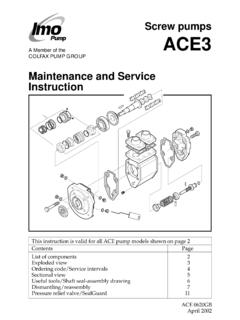
Transcription of What’s a screw pump? Understanding the unique ...
1 Colfax Fluid HandlingWhite PaperBy Rob JordanWhat s a screw pump? Understanding the unique characteristics and operating principles of 1, 2 and 3 screw pumps Colfax Fluid HandlingWhite PaperThe term screw pump is often used generically. However, this generalization can be a pitfall as it fails to recognize the different product or screw configurations, as well as the uses, advantages and design considerations for each. The design differences of each screw configuration and pump type make each suitable for different applications and handling fluids with varying characteristics. Each screw pump operates on the same basic principal of a screw turning to isolate fluid and convey it. However, the mechanical design of each is different. The primary difference in one, two, three or multiple screw pumps is the method in which the rotor/pumping element is supported within the casing.
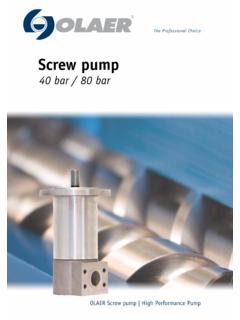
2 screw pump configurations may include single screw /eccentric screw /progressive cavity, external bearing, timed twin screw pumps , small three screw pumps on lube oil services/machinery support services, large crude oil transfer pumps or even Archimedes-style flood control screw PumpsA single screw pump -- also known as an eccentric screw , or pro-gressive cavity pump -- contains a single pumping element ( screw ) that rotates within a stationary, typically elastomeric stator. The individual turns of the screw seal, by direct contact, with the stator. The stator has a shape that corresponds to the outside surface of the screw . The interference fit between the screw or pumping element and the flexible stator/housing create a unique pump design that can handle a variety of fluid characteristics, including high levels of solids and variable viscosities.
3 However, the interference fit creates a need for lubrication and cooling of the stator material. The rotor s drive end is supported by an external bearing, and the pumping element is supported by the stator. When using a single screw pump, chemical and temperature compatibility of the stator with the application parameters must be considered. Also, the flexibility of the stator material limits how differential pressure can be handled across each turn of screw . This means that pumping rotor/stator combinations can be staged in order to make a pump capable of high pressure operation. These can be very effective in multiple stage high pressure applications. In fact, high pressure single screw pumps can be as large as 14 feet long. Provided that there is ample physical space available, single screw pumps can be an attractive pumping solution in certain situations.
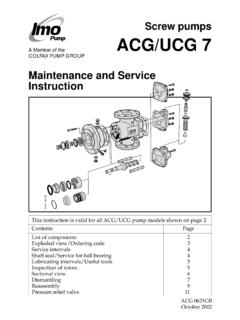
4 Traditionally, the term two screw pump has been applied to a screw pump with two shafts. However, a two screw pump can also be considered a four screw pump if it is a double suc-tion design (two opposing sets of screws pumping towards the discharge). For the purpose of this article a two screw pump is considered an external-bearing, timed pumping machine. The pumping element of a two screw pump consists of two intermesh-ing screws rotating within a stationary bore/housing that is shaped like a figure eight. The rotor and housing/body are metal and the pumping element is supported by the bearings in this design. What is a screw pump? Two screw PumpsColfax Fluid HandlingWhite PaperThree screw PumpsThe clearances between the individual areas of the pumping screws are maintained by the timing gears. When a two screw pump is properly timed and assembled there is no metal-to-metal contact within the pump screws.
5 The pumping screws and body/housing can be made from virtually any machinable alloy. This allows the pump to be applied for the most severe applications in aggressive fluid handling. Hard coatings can also be applied for wear resistance. The stages of the screw are sealed by the thin film of fluid that moves through the clearances separating them. An external bearing design has four shaft penetrations through the pump. These penetrations require sealing. Some consider the idea of four mechanical seals a nightmare -- however, this is a feature that makes a two screw pump one of the most robust pump designs, capable of handling a wide range of operating conditions and fluid characteristics. Finally, in a two screw design, the bearings are completely outside of the pumped fluid. This allows them to have a supply of clean lubricating oil and be independent of the pumped fluid characteristics.
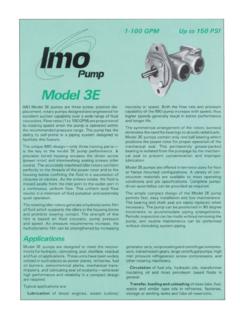
6 The external housings also allows for cooling which means the quality of the lube oil can be maintained in high temperature or horsepower applications. A three screw pump operates on the same principle of intermesh-ing screws as the two screw pump, and can be configured as a double suction pump (technically, a six screw pump). The three screw design utilizes a centrally-located primary screw , or power rotor, which intermeshes with two secondary screws, or idler ro-tors. The idler rotors are located 180 degrees from each other, are suspended within the pump and do not penetrate the hous-ing. The power rotor penetrates the housing and requires one bearing and one seal; there may be bushings/sleeve bearings that are exposed to the pumped fluid. During operation of a three screw pump, the rotor turns and allows the pumping element to create a thin film of fluid around it.
7 The force of this fluid film acting on the rotor supports the pumping element within the housing. The method of supporting the rotor limits the possible materials of construction to non-galling combinations and the fluids to typically non-aggressive fluids. Screws can be hardened, but stainless steels cannot be used due to the galling characteristics. Disrupting the fluid film around the rotor can cause the rotor to lose support and potentially contact the rotor housing or the adjacent screws. Disruption of the fluid film can result from solid particles, gas bubbles, low viscosity (slugs of water or solvents) or other variable and/or other upset conditions. If the screws come in contact with one another, they potentially lock together causing pressure to build and potentially an extreme situation if a relief valve is not in place. Three screw pumps are ideal for clean, lubricating fluids.
8 Fluid film thickness/operating clearance is typically smaller than that of a two screw design, giving higher efficiencies and higher pressure capabilities than a two screw pump providing viscosity is adequate and fluid is clean enough to avoid disruptions to the internal fluid conclusion, using the generic terminology screw pump fails to recognize the key mechanical design and performance differences that each screw pump type offers. However, once they are understand, engineers will find a proven technology suitable for a wide range of applications in multiple industries. Colfax Fluid HandlingWhite PaperColfax Fluid Handling1710 Airport RoadMonroe, NC 28110 USATel: (704) 289-6511 (877) , ALLWEILER, BARIC, COLFAX BUSINESS SYSTEM, FAIRMOUNT AUTOMATION, HOUTTUIN, IMO, LSC, ROSSCOR, TUSHACO, WARREN and ZENITH are registered trademarks of the Colfax Corporation or its subsidiaries in the and/or other countries.
9 2011 Colfax Corporation. All rights Fluid Handling, a global leader in critical fluid-handling products andtechnologies, is a brand of Colfax Corporation. Through its fluid-handlingplatform and reporting global operating subsidiaries, Colfax manufacturespositive displacement industrial pumps , valves and systems used in oil & gas, powergeneration, commercial marine, defense, industrial and lubrication markets. Colfax soperating subsidiaries supply products, services and support under the well-knownbrands Allweiler, Baric, Fairmount Automation, Houttuin, Imo, LSC, Portland Valve,Rosscor, Tushaco, Warren and Zenith. Colfax is traded on the NYSE under the tickersymbol CFX. Additional information about Colfax is available at HOUTTUIN IMO TUSHACO WARREN