Transcription of GRASIM INDUSTRIES LIMITED CHEMICAL DIVISION
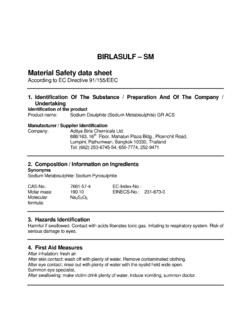
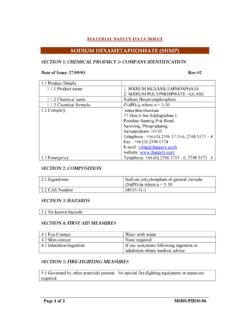
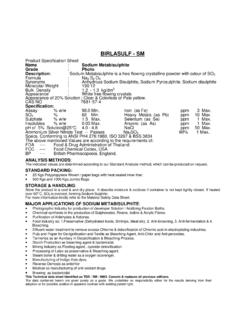
1 GRASIM INDUSTRIES LIMITED CHEMICAL DIVISION BIRLAGRAM, NAGDA ( ) MATERIAL SAFETY DATA SHEET PRODUCT NAME: CHLORINE 1. CHEMICAL Product and Company Identification GRASIM INDUSTRIES LIMITED CHEMICAL DIVISION BIRLAGRAM, NAGDA ( ) INDIA TEL. No. 07366-246760-66 FAX NO. 091-7366-246767 E-Mail: PRODUCT NAME: CHLORINE CHEMICAL NAME: Chlorine TDG (Canada) CLASSIFICATION: 2. Composition, Information on Ingredients INGREDIENT % VOLUME PEL-OSHA1 TLV-ACGIH2 LD50 or LC50 Route/Species Chlorine FORMULA: Cl2 CAS: 7782-50-5 RTECS #: FO2100000 1 ppm Ceiling ppm TWA 1 ppm STEL LC50 293 ppm/1H (rat) 1 As stated in 29 CFR 1910, Subpart Z (revised July 1, 1993) 2 As stated in the ACGIH 1994-95 Threshold Limit Values for CHEMICAL Substances and Physical Agents 3.
2 Hazards Identification ROUTE OF ENTRY: Skin Contact Skin Absorption Eye Contact Inhalation Ingestion Yes No Yes Yes No HEALTH EFFECTS: Exposure Limits Yes Irritant Yes Sensitization No Teratogen Yes Reproductive Hazard Yes Mutagen Yes Synergistic Effects Other agents that irritate the respiratory system Carcinogenicity: -- NTP: No IARC: No OSHA: No EYE EFFECTS: Corrosive and irritating to the eyes. Contact with the liquid or vapor causes painful burns and ulcerations. Burns to the eyes result in lesions and possible loss of vision. EMERGENCY OVERVIEW Corrosive and irritating to the eyes, skin and mucous membranes.
3 Inhalation may result in CHEMICAL pneumonitis and pulmonary edema. Nonflammable. Oxidizer, may explode or accelerate combustion if contacting reducing agents. SKIN EFFECTS: Corrosive and irritating to the skin and all living tissue. It hydrolyzes very rapidly yielding hydrochloric acid. Skin burns and mucosal irritation are like that from exposure to volatile inorganic acids. Chlorine burns exhibit severe pain, redness, possible swelling and early necrosis. INGESTION EFFECTS: Ingestion is unlikely. INHALATION EFFECTS: Corrosive and irritating to the upper and lower respiratory tract and all mucosal tissue.
4 Symptoms include lacrimation, cough, labored breathing, and excessive salivary and sputum formation. Excessive irritation of the lungs causes acute pneumonitis and pulmonary edema, which could be fatal. Residual pulmonary malfunction may also occur. CHEMICAL pneumonitis and pulmonary edema may result from exposure to the lower respiratory tract and deep lung. Some experimental evidence indicates chlorine causes mutagenic, teratogenic, and reproductive effects in animal studies. NFPA HAZARD CODES HMIS HAZARD CODES RATINGS SYSTEM Health: 4 Health: 4 0 = No Hazard Flammability: 0 Flammability: 0 1 = Slight Hazard Reactivity: 0 Reactivity.
5 0 2 = Moderate Hazard OXIDIZER 3 = Serious Hazard 4 = Severe Hazard 4. First Aid Measures EYES: PERSONS WITH POTENTIAL EXPOSURE SHOULD NOT WEAR CONTACT LENSES. Flush contaminated eye(s) with copious quantities of water. Part eyelids to assure complete flushing. Continue for a minimum of 15 minutes.
6 Seek immediate medical attention. SKIN: Remove contaminated clothing as rapidly as possible. Flush affected area with copious quantities of water. Seek immediate medical attention. INGESTION: None required. INHALATION: PROMPT MEDICAL ATTENTION IS MANDATORY IN ALL CASES OF OVEREXPOSURE. RESCUE PERSONNEL SHOULD BE EQUIPPED WITH SELF-CONTAINED BREATHING APPARATUS. Conscious persons should be assisted to an uncontaminated area and inhale fresh air. Unconscious persons should be moved to an uncontaminated area and given artificial resuscitation and supplemental oxygen.
7 Assure that mucus or vomited material does not obstruct the airway by use of positional drainage. Delayed pulmonary edema may occur. Keep the patient under medical observation for at least 24 hours. 5. Fire Fighting Measures Conditions of Flammability: Not flammable Flash point: None Method: Not Applicable Autoignition Temperature: None LEL(%): None UEL(%): None Hazardous combustion products: None Sensitivity to mechanical shock: None Sensitivity to static discharge: None FIRE AND EXPLOSION HAZARDS: Combustible materials burn in chlorine as they do in oxygen.
8 EXTINGUISHING MEDIA: None required. Use media suitable for surrounding materials. 6. Accidental Release Measures Evacuate all personnel from affected area. Use appropriate protective equipment. If leak is in user s equipment, be certain to purge piping with inert gas prior to attempting repairs. If leak is in container or container valve, contact the appropriate emergency telephone number listed in Section 1 or calls your closest BOC location. 7. Handling and Storage Electrical classification: Nonhazardous.
9 Most metals corrode rapidly with wet chlorine. Systems must be kept dry. Lead, gold, tantalum and Hastelloy are most resistant to wet chlorine. Use only in well-ventilated areas. Valve protection caps must remain in place unless container is secured with valve outlet piped to use point. Do not drag, slide or roll cylinders. Use a suitable hand truck for cylinder movement. Use a pressure reducing regulator when connecting cylinder to lower pressure (<250 psig) piping or systems. Do not heat cylinder by any means to increase rate of product from the cylinder.
10 Use a check valve or trap in the discharge line to prevent hazardous back flow into cylinder. Protect cylinders from physical damage. Store in cool, dry, well-ventilated areas of non-combustible construction away from heavily trafficked areas and emergency exits. Do not allow the temperature where cylinders are stored to exceed 125oF (52oC). Cylinders should be stored upright and firmly secured to prevent falling or being knocked over. Full & empty cylinders should be segregated. Use a "first in-first out" inventory system to prevent full cylinders from being stored for excessive periods of time.