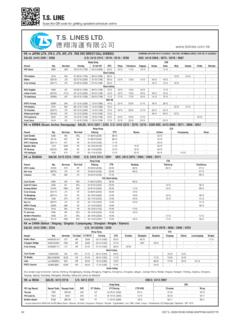
Transcription of CANDIAN SHIPS BY CALL SIGN - VE1BC - Nova Scotia
1 Canadian SHIPS by call sign for Radiotelegraph There are errors in this list simply because it is impossible to make a list like this error free. If you note an error please contact me so that I can correct the error. I have no idea why one cannot make a list like this error free. This is a list of the two, three and four letter call signs Canada assigned to SHIPS during the years radiotelegraph was in use. This is simply the list of those I have found and those I had to work with over the years. I have XJAG listed after radiotelegraph just to show that Canada is now assigning ship calls from those blocks of call signs. I have also listed the Orca, Kingston and CPF naval SHIPS simply because I have them. They were created after radiotelegraph. Some of the Canadian naval SHIPS were called Canadian but were actually commissioned as Royal Navy SHIPS . I have included SHIPS that were not registered in Canada but had Canadian crews. There are a few Canadian SHIPS that I have been unable to identify.
2 In other words this is a list of the SHIPS I have found that were assigned these call signs over the years. This list is in alphabetical order. The two and three letter call signs were the first in use from 1904 until 1923. The International Telecommunication Union had assigned sufficient blocks of these call signs to Canada over the years so that Canada could have assigned a four character call sign to every vessel of every size registered in Canada. But after World War II Canada copied the United States and issued a two or three letter prefix followed by four digits to the smaller vessels fitted with radio telephone only, although I found one vessel using a two letter four digit call sign in radio telegraph. There are an awful lot of these calls with a four digit suffix assigned today but they do not belong in this exercise. The CCGS Nanook was a World War II naval landing craft and was assigned CG2056 as her call sign and was apparently used in radiotelegraph but I do not know who the operator was that operated this on 500 kHz.
3 Her sister, another former landing craft, was CCGS Skua with call sign CGGD but not equipped for radiotelegraph. It makes no sense. Nanook was converted into a dormitory for northern stevedores and this may be the reason for radiotelegraph. Nanook was replaced with CCGS Narwhal with call sign CGBP designed as a dormitory ship for these stevedores but was never used as a northern dormitory. The government terminated the northern stevedores just before Narwhal was ready. Canada assigning a special prefix in a call sign to indicate a certain fleet made no sense. These call signs were changed when a ship transferred from one fleet to another in Canada. I am convinced this was created during the days of rum-running because various government officials were on both sides of the legal fence and this made it possible for the rum-runner to keep track of the police vessels. The police vessels were given a three letter prefix CGP indicating Canadian Government Police and this started before the creation of the Royal Canadian Mounted Police Marine Section on April 1st, 1932 and continued on after it was created.
4 It definitely made no sense for we who had to use these call signs. There are several call signs that appear to be assigned to two different SHIPS at the same time. I find it hard to believe that anyone who noticed this took the time to try and correct same. For some unknown reason I have had an interest in this subject since I joined the navy s radio branch and it has given me something to do since I retired. I managed to interview several of the first radio operators that used the three letter call signs. I m deeply indebted to a number who have helped with this project. Lieutenant Commander David J. Freeman, retired, has been a very big help and he brought back lists of the World War II call signs from England for this project. I am probably the only one in the world who has a copy of Freeman s book Canadian Warship Names nearly worn out from use. Lieutenant Commander B. H. Taylor, retired, was another big help with the air force marine craft and the list of those who helped is endless.
5 I simply started this list for something to do. I had no other reason to compose it. We communicated with several SHIPS over the years using a call sign that had been assigned to more than the one ship . I found this list rather amazing that there were so few call signs assigned to more than the one ship . Several times during World War II when a warship was lost the call sign was assigned to the next ship to commission. For example when the corvette HMCS Charlottetown was sunk her CYRF call sign was assigned to the frigate HMCS Swansea and Swansea held the call sign until scrapped in 1966. There were call signs assigned where the same call sign was assigned to both naval and air force craft at the same time during World War II. When the Canadian Patrol Frigates commissioned in the 1990 s they were assigned the call signs CHAA to CHAL inclusive. It was soon realized that these call signs were assigned to Canadian radio stations in the broadcasting service and were soon changed to their present call signs.
6 At least they changed those. Back in the 1930 s Canadian National Railway operated several broadcast radio stations for the general public and assigned a four letter call sign to each with a CN prefix from Morocco s assigned list of call signs. Then there is the Canadian Broadcast Corporation that has been assigning three and four letter call signs with a CB prefix from Chile s assigned list of call signs. It is amazing what we elect as our government officials and apparently it is common to all aspects of government. The agriculture minister that told farmers to allow their bulls with their cows during daylight only so the calves would be born during daylight is another good example. They claim it takes all kinds to make a world but one wonders at times about those in charge. It also leaves one wondering why anyone would want to be in charge. The radio telegraph operation with Canadian SHIPS was not what it could or should have been. That terminology probably applies to many trades over the years, but this was definitely a mess in Canada.
7 When I retired I had a large stack of letters that had been written to various officials pointing out the various Canadian SHIPS that had sailed in violation of international laws. The reply to some of these letters made little if any sense. Some of these Canadian SHIPS were fitted with radiotelegraph but did not use it. Many were not fitted and sailed as though they were fitted and using radiotelegraph. It was a fascinating trade for the 90 years it was in use from about 1905 to about 1995. There is no exact date that this trade terminated. Spurgeon G. Roscoe ABD DGS ABERDEEN 1912 call sign ; buoy vessel based at Saint John, New Brunswick; became DGS ABERDEEN/VDG BGGC HMCS BAYFIELD 1942 1945 Bangor Class Minesweeper; in commission as a Royal Navy Vessel BGGL HMCS CANSO 1942 1945 Bangor Class Minesweeper; in commission as a Royal Navy Vessel BGGM HMCS CARAQUET 1942 1945 Bangor Class Minesweeper; in commission as a Royal Navy Vessel BGJF HMCS GUYSBOROUGH 1942 1945 Bangor Class Minesweeper; sunk by U878; in commission as a Royal Navy Vessel BGJJ HMCS INGONISH 1942 1945 Bangor Class Minesweeper; in commission as a Royal Navy Vessel BGJQ HMCS LOCKEPORT 1942 1945 Bangor Class Minesweeper; in commission as a Royal Navy Vessel BJTB HMCS NENE 1944 1945 River Class Frigate; in commission as a Royal Navy Vessel CFC HMCS LAURENTIAN 1917 1918 Patrol Vessel; former Canada Steamship Lines LAURENTIAN/CFC CFL DGS ARLEUX 1919 1923 Fisheries Cruiser; based at Halifax, Nova Scotia .
8 Became DGS ARLEUX/CGFX CFL HMCS ARLEUX 1917 1919 Naval Patrol Trawler; became DGS ARLEUX/CFL CFM HMCS ARMENTIERES 1918 1923 Naval Patrol Trawler; became HMCS ARMENTIERES/CGAM CFN DGS GIVENCHY 1919 1923 Fisheries Patrol Vessel; became DGS GIVENCHY/CGFB CFN HMCS GIVENCHY 1918 1919 Battle Class Trawler; became DGS GIVENCHY/CFN CFO HMCS ARRAS 1918 1926 Battle Class Trawler; became DGS ARRAS/CGFD CFP HMCS THIEPVAL 1918 1930 Battle Class Trawler; this was still her call sign when wrecked in 1930 CGAA HMCS ANTICOSTI 1989 1997 Reserve Navy Minesweeper; former Panamanian Tug JEAN TIDE/HP3369 CGAA HMCS CARIBOU 2007 Orca Class Patrol Boat CGAB HMCS MORESBY 1989 1997 Reserve Navy Minesweeper; former Panamanian Tug JOYCE TIDE/HP3167 CGAB HMCS ORCA 2006 Orca Class Patrol Boat CGAB HMCS SAGUENAY 1931 1934 River Class Destroyer; became HMCS SAGUENAY/CGBD CGAC HMCS VILLE DE QUEBEC 1994 Halifax Class Patrol Frigate CGAD HMCS TORONTO 1993 Halifax Class Patrol Frigate CGAE HMCS REGINA 1994 Halifax Class Patrol Frigate CGAF HMCS CALGRY 1995 Halifax Class Patrol Frigate CGAF HMCS FESTUBERT 1926 1938 Battle Class Trawler; became HMCS FESTUBERT/CGBF; unable 3 letter call as trawler CGAG HMCS MONTREAL 1994 Halifax Class Patrol Frigate CGAH CCGS ANN HARVEY built 1987, Buoy Tender Search and Rescue Vessel; light icebreaker duties; based St.
9 John s, Newfoundland CGAI HMCS WINNIPEG 1995 Halifax Class Patrol Frigate CGAJ HMCS CHARLOTTETOWN 1995 Halifax Class Patrol Frigate CGAK HMCS CHAMPLAIN 1928 1934 S Class Destroyer; former HMS TORBAY CGAK HMCS ST. JOHN S 1996 Halifax Class Patrol Frigate CGAL HMCS OTTAWA 1996 Halifax Class Patrol Frigate CGAL HMCS SKEENA 1931 1934 River Class Destroyer; became HMCS SKEENA/CGBK CGAM HMCS ARMENTIERES 1923 1938 Training Vessel Minesweeper; became HMCS ARMENTIERES/CGBL CGAM HMCS RAVEN 2007 Orca Class Patrol Boat CGAN HMCS FREDERICTON 1994 Halifax Class Patrol Frigate CGAP HMCS HALIFAX 1992 Halifax Class Patrol Frigate CGAR HMCS VANCOUVER 1993 Halifax Class Patrol Frigate CGAS HMCS RENARD 2007 Orca Class Patrol Boat CGAU HMCS GLACE BAY 1996 Kingston Class Maritime Coastal Defence Vessel CGAV HMCS NANAIMO 1997 Kingston Class Maritime Coastal Defence Vessel CGAV HMCS VANCOUVER 1928 1934 S Class Destroyer; former HMS TOREADOR; became HMCS VANCOUVER/CGBM CGAW HMCS EDMONTON 1997 Kingston Class Maritime Coastal Defence Vessel CGAX HMCS SHAWINIGAN 1997 Kingston Class Maritime Coastal Defence Vessel CGAY HMCS YELLOWKNIFE 1998 Kingston Class Maritime Coastal Defence Vessel CGAY HMCS YPRES 1926 1938 Training Vessel; became HMCS YPRES/CGBN; unable the three letter call sign 1917 1920 CGAZ HMCS WHITEHORSE 1998 Kingston Class Maritime Coastal Defence Vessel CGBB CCGS MONTCALM built 1957, Medium Class Icebreaker CGBB HMCS BEAUHARNOIS 1944 1945 Corvette CGBC HMCS ROCKCLIFF 1944 1950 Algerine Class Minesweeper Training Vessel CGBD CGS A.
10 T. CAMERON 1958 1982 Fisheries Research; based at St. John s, Newfoundland; became ARCTIC RANGER/CGBD CGBD HMCS ANDREE DUPRE 1939 1945 Examination Vessel; former Tug ANDRE DUPRE CGBD HMCS SAGUENAY 1934 1945 River Class Destroyer; former HMCS SAGUENAY/CGAB CGBF CCGS ALEXANDER HENRY built 1959, Great Lakes Icebreaker Buoy Tender CGBF HMC GV17 1942 1945 Gate Vessel; former HMCS FESTUBER/CGBF CGBF HMCS FESTUBERT 1938 1942 Training ship ; former HMCS FESTUBERT/CGAF; became HMC GV17/CGBF CGBG CCGS MIKULA built 1959, Coast Guard College Training Vessel; former LURCHER LIGHTSHIP NO. 4/CGBG (1959 1972) CGBG HMCS BORDER CITIES 1944 1946 Algerine Class Minesweeper CGBJ CCGS GRENVILLE built 1915, Lighthouse Supply and Buoy Vessel, Great Lakes CGBJ HMCS CHAMPLAIN 1934 1936 S Class Destroyer; former HMCS CHAMPLAIN/CGAK CGBJ HMCS ST LAURENT 1937 1945 River Class Destroyer; former HMS CYGNET/GVKB CGBK CCGS JOHN A. MACDONALD built 1960, Heavy Icebreaker; based Dartmouth, Nova Scotia CGBK HMCS SKEENA 1934 1944 River Class Destroyer; former HMCS SKEENA/CGAL; wrecked Iceland CGBL HMCS ARMENTIERES 1939 1946 Examination Vessel Prince Rupert, British Columbia; former HMCS ARMENTIERES/CGAM CGBL CCGS THOMAS CARLETON 1960 1993 Icebreaking Lighthouse Supply and Buoy vessel; became CLEVELAND AMORY CGBM CCGS PORTE DAUPHINE 1955 1974 Great Lakes Research Vessel; former HMCS PORTE DAUPHINE/CGYL; became HMCS PORTE DAUPHINE/CZFL CGBM HMCS FRASER 1937 1940 River Class Destroyer; former HMS CRESCENT/GACX; sank June 25th, 1940 CGBM HMCS HAMILTON 1941 1945 Town Class Destroyer; former HMS HAMILTON CGBM HMCS VANCOUVER 1934 1936 S Class Destroyer; former HMCS VANCOUVER/CGAV CGBN CCGS LOUIS S.