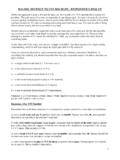
Transcription of RELEVANT PERCENTAGES FOR BRIDGE PLAYERS
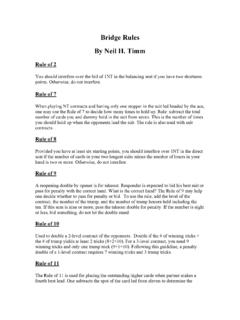
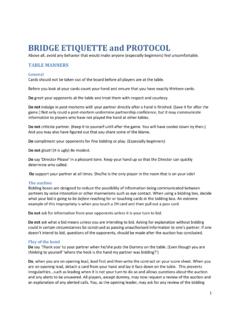
1 RELEVANT PERCENTAGES FOR BRIDGE PLAYERS 1) PERCENTAGES of Card Division between two hidden hands Cards out 2 cd 1-1 52% 2-0 48% Except for 2 cards 3 cd 2-1 78% 3-0 22% the general rule is 4 cd 2-2 41% 3-1 50% 4-0 10% Even cards probably do not split evenly 5 cd 3-2 68% 4-1 28% 5-0 4% Odd cards probably do split as evenly as possible 6 cd 3-3 35% 4-2 49% 5-1 15% 6-0 2% 7 cd 4-3 62% 5-2 30% 6-1 7% 7-0 8 cd 4-4 33% 5-3 47% 6-2 17% 7-1 3% 8-0 9 cd 5-4 59% 6-3 31% 7-2 9% 8-1 1% 9-0 The PERCENTAGES for card division presume that there is NO evidence from bidding or play to alter the probabilities. Eg a hand which has pre-empted showing a 7 card club suit has only 6 vacant spaces for other cards while if declarer and dummy together have 4 clubs the other defender has 2 clubs leaving 11 vacant spaces in that hand.
2 If there are 4 cards in another suit (hearts) in those hands the probability of them splitting 2-2 drops from over 40% to under 35% while the hand with more vacant spaces is 5 times as likely than the other to hold 3 or 4 hearts. 2) 3) Probability of opponents ruffing on - Cards out Probability of Drop of 4th rd 3rd rd 2nd rd 1st rd K Q J 10 100% 100% 100% 48% 2 cards 52% 100% 100% 100% 100% 100% 100% 22% 3 cards 26% 78% 100% 100% 100% 100% 60% 10% 4 cards 12% 52% 90% 100% 100% 100% 32% 4% 5 cards 5% 31% 73% 96% 100% 65% 17% 2% 6 cards 3% 19% 54% 87% 100% 38% 8% 1% 7 cards 1% 9% 38% 71% With 2 cards missing go for the drop of the King (52%) With 4 cards missing go for the drop of the Queen (52%), the cards may be 2-2 (41%) or she may be singleton (12%) With 6 cards missing go for the drop of the Jack (54%)
3 , the cards may be 3-3 (35%) or he may be doubleton (18%) or singleton(2%) With 3, 5 or 7 cards out do NOT expect to drop K, Q or J respectively 4) Probability of High Card Points in a hand 5) Common Hand Patterns HCP Probability(%) HCP Probability(%) Pattern (any suit order) Probability (%) 0 16 4432 1 17 4333 2 18 4441 3 19 5332 4 20 5431 5 21 5422 6 22 5521 7 23 5440 8 24 5530 9 25 6322 10 26 6421 11 27 6331 12 28 6430 13 29 6511 or 6520 14 30 Any with 7 cd 15 31-37 Any with 8+ suit Being dealt 7-12pts accounts for over half of all hands. Nearly half the hands are balanced It is unlikely any hand in a 26 board session has over 24 HCP In a 26 board session there may be 4 x 7cd suits A partner who bids 1NT (12-14) probably has 12 or a poor 13 HCP 2/3 of hands probably contain a 5 card or longer suit A partner who bids 2NT (20-22) probably has only 20 HCP 1/3 of all hands probably have a singleton or void Bear in mind that these are the mathematically determined values, and do not take into account the fact that hands which are imperfectly shuffled and dealt often are more balanced than those randomly generated on a computer.
4 6) Probabilities of a partnership having a fit (at least 8 cards in a chosen suit) The higher the probability of fit the lower the points needed to open or overcall Probability of a partnership having a good fit Number of cards between two hands 7 8 9 10 11 Percentage of deals 16% 46% 28% 9% 2% Probability of your partner having a fit with a single suit in your hand Probability of partner having a fit with one of your TWO suits Your suits 4 - 3 4 - 4 5 - 3 5 - 4 5 - 5 Probability of fit 49% 60% 66% 74% 84% 7) Miscellaneous BRIDGE Probabilities Number of different hands a player can receive = 635,013,559,600 possible deals = 53,644,737,765,488,792,839,237,440,000 possible auctions = 128,745,650,347,030,683,120,231,926,111, 609,371,363,122,697,557 Odds against a player being dealt Playing 26 boards twice a week expect 13 cards in one suit = 169,066,442 to 1 Once every 60 000 years!
5 8 cards in one suit = 213 to 1 Once a month 7 cards in one suit = 28 to 1 Once a session 6 cards in one suit = 6 to 1 Four times a night at least one singleton = 2 to 1 Once a two board round at least one void = 19 to 1 Once a session AKQJ10 in a suit = 500 to 1 Once every three months four Aces = 378 to 1 Once every two months a hand with no points = 278 to 1 Once a month a Yarborough (no10) = 1827 to 1 Twice a year Odds against a partnership being dealt 26+ HCP = 8 to 1 Three times a night 33+ HCP small slam in NT = 288 to 1 Once a month 37+ HCP grand slam in NT = 11600 to 1 Once every two years Cards in your suit Probability of at least Total number of cards held by you and your partner together 8 card fit 7 card 8 card 9 card 10 card 4 34% 32% 21% 9% 2% 5 54% 29% 31% 17% 5% 6 76% 19% 33% 28% 12% 7 93% 7% 26% 35% 22%