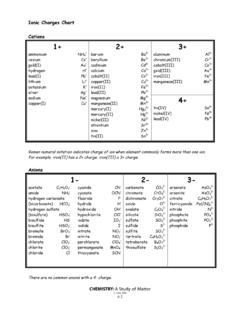
Transcription of TABLE OF COMMON MONATOMIC IONS - …
1 AIAIIBIBIIAIIIAVAIVAIIVH+H-iL+eB+2N-3O-2 F-aN+gM+2lA+3P-3S-2lC-K+aC+2nZ+2aG+3eS-2 rB-bR+rS+2gA+dC+2nI+3I-sC+aB+2 TABLE OF COMMON MONATOMIC IONS fixed-charge metals in Groups IA, IIA, and IIIA fixed-charge metals in Groups IB and IIB (transition elements) COMMON -charge non-metals from Groups IVA, VA, VIA, and VIIA semi-metal from Group IVAFor ions in group VA, VI, and VIIA, the magnitude of charge is calculated by subtract-ing the group number from 8. Non-metal elements have a COMMON or fixed charge/oxidation when compounded with metals.
2 Yet oxidation values can vary depending onwhich non-metal elements they are combined with, as in polyatomic ions and molecu-lar 2005 by Matthew Medeiros. All rights +2iT+3V+2V+3rC+2rC+3rC+6nM+2nM+3nM+7eF+2 eF+3oC+2oC+3iN+2iN+3uC+uC+2eG+2eG+4dP+2d P+3nS+2nS+4tP+2tP+3uA+uA+3gH+gH+2lT+lT+3 bP+2bP+4 TABLE OF COMMON VARIABLE-CHARGE METALS variable-charge transisiton metals variable-charge metals from groups IIIA and IVAC omment: The variable-charge nature of certain metals presents a unique outcome in compound formation.
3 Since these metals can form multiplecharges they will compound with nonmetals (or polyatomic ions) in differing ratios. Therefore, the Roman numeral designation is required inthe nomenclature to specify the correct compound. For example, there are several types of manganese oxides, each with characteristic chemicaland physical properties. Manganese (III) oxide, Mn2O3, is a black mineral insoluble in water. Whereas, manganese (VII) oxide, Mn2O7, is adark reddish mineral which is soluble in water. Manganese will also form two other oxides each with differing colors and 2005 by Matthew Medeiros.
4 All rights +ammoniumPHOSPHORUSP3-phosphidePO33-phos phiteHPO32-hydrogen phosphitePO43-phosphateHPO42-hydrogren phos-phateH2PO4-dihydrogen phos-phateSULFURS2-sulfideSO32-sulfiteHS O3-hydrogen sulfiteSO42-sulfateHSO4-hydrogen sulfateS2O32-thiosulfateS2O72-disulfateC ARBONC4-carbideCO32-carbonateHCO3-hydrog en carbonate(or bicarbonate)CN-cyanideORGANIC (CARBON CONT.)HCOO-formate (derivedfrom formic acid,also written HCO2-)H3C2O2-acetate (derivedfrom acetic acid,also commonlywritten CH3 COO-)C2O42-oxalate (derivedfrom oxalic acid)OXYGENO2-oxideO22-peroxideOH-hydrox ideCHLORINECl-chlorideClO4-perchlorateCl O3-chlorateClO2-chloriteClO-hypochlorite METALS/SEMI-METALSMnO4-permanganateCrO42 -chromateCr2O72-dichromateAsO43-arsenate SiO44-silicateOTHER COMMON ANIONSBO33-borateBrO3-bromateIO3-iodateI O4-periodateOCN-cyanateSCN-thiocyanateNO TES-ate.
5 Used to designatethe oxyanion withthe higher numberof oxygen atoms-ite ..used to designatethe oxyanion withthe lower number ofoxygen atomsthio- .. add one sulfur,remove one oxygenper- .. one additionaloxygenhypo- .. one less oxygen-ide ..although this suffixis reserved for themonatomic anion,the exceptions arecyanide, hydroxide,and peroxidedi- .. two or double ( ,as with dichromate,double the numericsubscripts on thechromate ion andreduce the oxygenby one; retaincharge)SOME COMBINED IONSHS-hydrogen sulfideNH4PO42-ammonium phos-phateHC2O4-hydrogen oxalateFe(CN)63-hexacyanoferrateLIST OF COMMON POLYATOMIC IONS( MONATOMIC ions are listed first in the family.)
6 Copyright 2005 by Matthew Medeiros. All rights reserved.