Transcription of in the twentieth century - Rivendell Village
1 By Copyright, Canada, 1972, Second edition, B. Allan Mackie & Ida Mary Mackie P. O. Box 1205 Prince George, B. C The axeman in the twentieth century displaying this determination to find peace and sanity is [oined in history to every pioneer who set himself to carving a homestead in a new world. Most Canadians think of themselves as natural born axemen. Indeed, they are entitled to this image even though they may never have seen a tree felled, for it is still possible in this country to develop with pride these skills which were practised by our surprisingly recent ancestors.]
2 This book is intended to encourage those Canadians who would leave the suburban reservations to live part of their lives at peace with nature, and those who admire solid timber construction as one of the strongest, most durable, and beautiful building forms known. There are three prime reasons for using logs in house construction. First, a log house is one of the most aesthetically satisfying in which to live. Logs bring the natural world back into our lives in a way that is becoming more necessary than ever to our survival as thoughtful human beings.
3 There is a deep sense of peace, living in a house made of natural trees. No stripped, chipped, cooked, treated, compressed, or otherwise manufac-tured product of industrial technology can give you, the builder, such an awareness of each living tree as it once stood. You will remember long after your house is built, whether its trees had few limbs or many because of where it grew. You'll know how it looked as it fell to the ground. A scar may remind you of the day the logs were skidded to the building site.
4 The length of time it took you to build will be recorded in the faint darkening of the rising logs as they became drier and less easy to peel. You will remember a log that chased you down the skids or one that humped its back before it was subdued and fitted into place. The scrubbing, oiling, and perhaps varnishing will warm the colours and highlight the textures of the new walls revealing curbes, limb lines, perhaps the lacework of bark beetles or the clawmarks of a bear all signs of nature to be saved and treasured.
5 In the end, the family that builds a log house knows their home as a work of art. They can savour it as no other. None but the log house provides its own sweet incense of sap and resin. Solid timber walls have an acoustic quality that makes music sound richer. Harsh household clatter does not strike, echo, and bounce as they do from plaster surfaces. Logs also can absorb nails, to hold up a picture or a fireplace poker, concealing the holes again if, later, the nails are removed.
6 The natural brown tones are restful to the eye. Above all, there is a quality of snug security in the fortress-thick walls. Perhaps this comes from log construction being old in Canadian history. A log building ties time honoured tradition into our sometimes uncertain todays, giving a sense of continuity and stability that is unusual in modern housing. The second advantage of log construction is durability. With a good foundation to protect the wood from the composting urge of earth, and a wide overhang to shelter against rain and snow soakings, the log building will rival concrete in its long life.
7 Very few frame structures can com-pare, and these only when the timber framing approaches the stoutness of logs. In style, the log house has an amazing durability. Pressures of fashion have never succeeded in making the log house look outdated. It is In timeless good taste even in a most simple building as well as in the dramatic designs in logwork coming into being. This harmony is due entirely to the logs themselves, the most appropriate building material in any landscape.
8 Third: log construction is the only contemporary construction method which enables an individual to exchange his own labour and ingenuity, rather than cash or a mortgage debt, for a home to be proud of. Building with logs does require hard work but it is pleasant and healthy work and, if undertaken at a pace that permits full appreciation of the undertaking as a once in a lifetime experience, it is work not at all beyond the strength of most families.
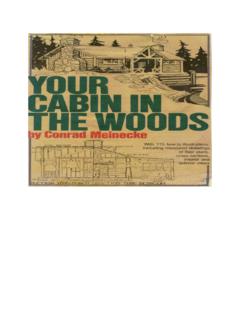
9 The house sketched on the back cover of this book was built at Southbank in 1953 for a total cash outlay of two hundred dollars. The only purchased items were glass, roofing, spar varnish, and rough lumber. The rest was accomplished with a good deal of innovating, trading, scrounging, and neighbourly cooperation all activities which are still permissible in many parts of this country. But where the use of logs requires not only the purchase and delivery of all materials but also the hiring of the builders, the log house will be as costly as frame or masonry construction.
10 This should not deter the family able to afford what pleases them most. And savings will occur both in the centuries-long durability and in the very low cost of building maintenance. Let us begin the discussion of how to build with logs, knowing it to be a discussion, for there are always different ways to do each task. Every axeman will find many new answers of his own. This is part of the craft. It Is what helps to make each house unique.