Transcription of Raman Scattering and Fluorescence - HORIBA
1 1/2 Fluorescence 01 Raman Scattering and Fluorescence Introduction Raman Scattering and Fluorescence emission are two competing phenomena, which have similar origins. Generally, a laser photon bounces off a molecule and looses a certain amount of energy that allows the molecule to vibrate (Stokes process). The scattered photon is therefore less energetic and the associated light exhibits a frequency shift. The various frequency shifts associated with different molecular vibrations give rise to a spectrum, that is characteristic of a specific compound. In contrast, Fluorescence or luminescence emission follows an absorption process. For a better understanding, one can refer to the diagram below. Figure 1 : Mechanisms of various light- Scattering processes. (a) Rayleigh, (b) non-resonance Raman , (c) pre-resonance Raman , (d) resonance Raman resonance Fluorescence and (e) relaxed Fluorescence .
2 Virtual states have to be considered to explain Raman Scattering . This is related to the fact that the interaction of the photon with the molecule and the re-emission of the scattered photon occur almost simultaneously. The existence of such virtual states also explains why the non-resonance Raman effect does not depend on the wavelength of the excitation, since no real states are involved in this interaction mechanism. In fact, the Raman spectrum generally does not depend on the laser excitation. However, when the energy of the excitation photon gets close to the transition energy between two electronic states, one then deals with resonance Raman or resonance Fluorescence ( , case (d)). The basic difference between these two processes is related to the time scales involved, as well as with the nature of the so-called intermediate states.
3 In contrast with resonant fluorescent, relaxed Fluorescence results from the emission of a photon from the lowest vibrational level of an excited electronic state, following a direct absorption of the photon and relaxation of the molecule from its vibrationally excited level of the electronic state back to the lowest vibrational level of the electronic state. A Fluorescence process typically requires more than 10-9 s. In contrary, a Raman transition is completed within a picosecond or less. It clearly appears that, depending on the laser wavelength, resonance effects ( Raman or Fluorescence ), may or may not exist. If the excitation photon does not provide sufficient energy to the molecule, the required transition to generate Fluorescence will not take place. However, if Fluorescence is generated, it is often much more intense than Raman Scattering , hiding Raman features.
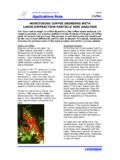
4 But because the Raman spectrum tends to be more informative than Fluorescence , the Raman spectroscopist is continually searching for methods to avoid Fluorescence . 2/2 Fluorescence 01 One method to avoid Fluorescence emission is to select the laser excitation wavelength. For most examples, the choice of a near IR (NIR) or UV laser wavelength can avoid exciting Fluorescence . In the first case, the laser photon does not have enough energy to excite molecular Fluorescence . In the second case, the Fluorescence may be excited, but the emission is widely separated in energy from the Raman signal so that the Raman spectrum can be recorded without the Fluorescence interference. A few examples demonstrating the effect of tuning the excitation wavelength on the Fluorescence emission are shown below.
5 These highlight the prime importance of a careful laser wavelength selection for each of these samples. Polluted polymer Pigment Industrial latex Sometimes, Fluorescence may come from impurities of a polluted sample or from the matrix surrounding an inclusion. In these cases, use of a Raman microprobe on solid samples, can avoid or minimize background Fluorescence by limiting the collection volume from which the Raman signal is acquired. This can be achieved using the selective capability of the true confocal configuration of the Raman microscope. By closing the confocal hole, one indeed can define a smaller collection volume. Conclusion Although intense Fluorescence emission sometimes renders the acquisition of useable Raman spectra very difficult, several ways to counteract it exist.
6 Raman instruments offering the possibility to select the laser wavelength have a great in cases where samples show Fluorescence in the visible range. 35000300002500020000150001000050000 Intensity ( )5001000150020002500 Wavenumber (cm-1)150001000050000 Intensity ( )50010001500 Wavenumber (cm-1)6000050000400003000020000100000 Intensity ( )50010001500200025003000 Wavenumber (cm-1)France : HORIBA Jobin Yvon , 231 rue de Lille, 59650 Villeneuve d Ascq. Tel : +33 (0)3 20 59 18 00, Fax : +33 (0)3 20 59 18 08. Email : USA : HORIBA Jobin Yvon Inc., 3880 Park Avenue, Edison, NJ 08820-3012. Tel : +1-732-494-8660, Fax : +1-732-549-2571. Email : Japan : HORIBA Ltd., JY Optical Sales Dept., 1-7-8 Higashi-kanda, Chiyoda-ku, Tokyo 101-0031. Tel: +81 (0)3 3861 8231, Fax: +81 (0)3 3861 8259. Email: Germany: +49 (0) 6251 84 75-0 Italy: +39 02 57603050 UK: +44 (0)20 8204 8142 China: +86 (0) 10 6849 2216 (All HORIBA Jobin Yvon companies were formerly known as Jobin Yvon)