Transcription of Conjugation of Verbs - The Latin Library
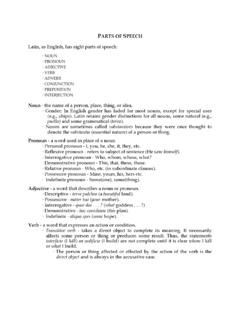
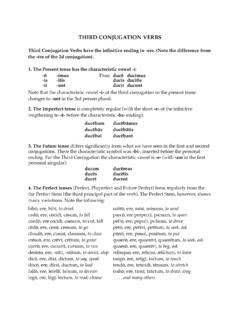
1 Conjugation of VerbsThe inflection of a verb is called a Conjugation . Most verb inflections in English havedisappeared, although we still distinguish between I go, he goes, etc. Latin , however,retains full inflections for most Verbs , the forms of which must be mastered in order todistinguish meaning. Through Conjugation a verb expresses: Person, Number, Tense, Mood and PERSON & NUMBER: A verb agrees with its subject in number and person. Thereare Three Persons and Two Numbers, arranged thus:1st person singular (I)1st person plural (we)2nd person singular (you)2nd person plural (you)3rd person singular (he, she it)3rd person plural (they)In English person and number normally cannot be determined without the aid ofpronouns (I, you, we, they, etc.)
2 Except in the 3rd pers. sing.: I go, you go, we go, they go;but he goes. Latin always distinguishes number and person: amo (I love), amas (you love) amat (heloves), etc. Because person and number are contained in the endings themselves, thepersonal pronouns (I, you, he, etc.) are used mainly for personal endings in Latin distinguish the person and number of the verb , and mustbe mastered early:1st person singular-o, -m1st person plural-mus2nd person singular-s2nd person plural (you)-tis3rd person singular-t3rd person plural (they)-nt2.
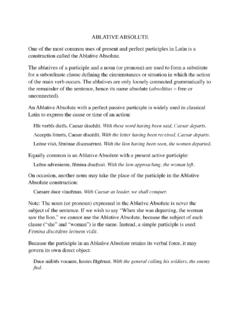
3 TENSE: Latin tenses have the same general meaning as the corresponding Englishtenses:Continued action:Present: I love, I am loving, I do :I loved, I was loving, I did :I will action:Perfect:I have loved, I had PerfectI will have that the emphatic (I do love) and the progressive (I am loving) tenses do not existas separate forms in MOOD: Latin has four Moods: Indicative, Subjunctive, Imperative, ) Indicative: The Indicative is used for statements and questions: I love that book. Areyou reading that book?b) Subjunctive: The Subjunctive has many uses, including commands, conditions,wishes, possibility, and dependent clauses.
4 It is often translated by the Englishindicative; frequently by auxiliary Verbs indicating uncertainty or wish (may,might, would, should); sometimes by the (now rare) subjunctive (I wish I were inRome); sometimes by the Infinitive; and often by the ) Imperative: The Imperative is used to express command or exhortation: Go! Heshall be set free!d) Infinitive: The Infinitive is chiefly used as an indeclinable noun (To err is human) oras a complementary infinitive to complete the meaning of another verb (I want togo).
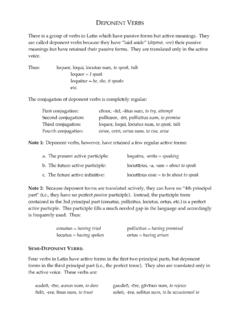
5 Note that the basic idea of a verb expressed by the Infinitive is not limited(infinitivus) by person or number (though it is limited by tense and voice).4. VOICE: Latin has two Voices (Active and Passive) with uses corresponding toEnglish: I love (Active); I am loved (Passive). a) The Active Voice expresses what the subject of the verb is or does: I am well. I ) The Passive Voice expresses what is done to the subject of the verb : I am subject "I" is no longer the actor in the sentence, but the recipient of that only transitive Verbs can have a full passive voice.
6 A little thoughtwill show that such forms as "I live" or "we persevere" can have no meaningin the passive voice. But meaning can attach to 3rd person singular forms ofsome intransitive Verbs : His life was lived well. The verb to Be: The verb "to be" is irregular in English and Latin . Learn the forms forthe Present Indicative:sumsumusesestisestsuntPrincip al Parts: The complete Conjugation of a verb can be obtained from its PrincipalParts, which must be memorized when a verb is first encountered. The Four PrincipalParts are: 1) Present Indicative, 1st pers.
7 Sing. 2) Infinitive3) Perfect Indicative, 1st pers. sing. 4) Perfect Passive Participle. Thus: amo (I love)amare (to love)amavi (I loved)amatus (loved)