Transcription of PRODUCT INFORMATION Kalma - Medicines
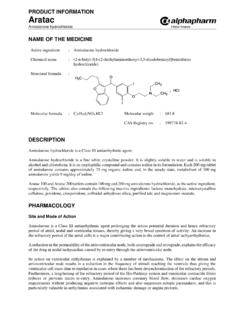
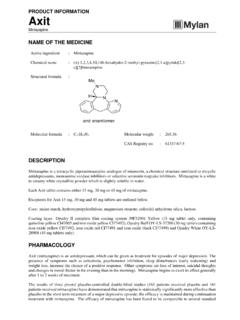
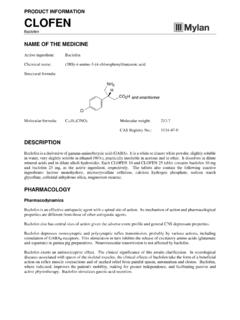
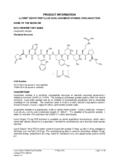
1 PRODUCT INFORMATION Kalma Alprazolam NAME OF THE medicine Active ingredient : Alprazolam Chemical name : 8-chloro-1-methyl-6-phenyl-4H-S-triazolo (4,3- )(1,4)-benzodiazepine Structural formula : Molecular formula : C17H13 ClN4 Molecular weight : CAS Registry no. : 28981-97-7 DESCRIPTION Kalma tablets contain alprazolam, an anti-anxiety, benzodiazepine derivative chemically and pharmacologically related to other drugs of this class. Alprazolam is a white crystalline powder which is soluble in methanol or ethanol but has no appreciable solubility in water.
2 Each Kalma tablet contains mg of alprazolam; each Kalma tablet contains mg of alprazolam; each Kalma 1 tablet contains 1 mg of alprazolam; each Kalma 2 tablet contains 2 mg of alprazolam. Kalma , Kalma , Kalma 1 and Kalma 2 tablets also contain lactose monohydrate, microcrystalline cellulose, maize starch, sodium benzoate, docusate sodium, povidone, colloidal anhydrous silica, sodium starch glycollate, magnesium stearate, . Kalma tablets also contain erythrosine CI 45430 ( Kalma only) and indigo carmine CI 73015 ( Kalma and Kalma 1 only).
3 PHARMACOLOGY Pharmacological properties of alprazolam in animals appear similar to those of other benzodiazepines, that is, it produces significant anxiolytic, muscle relaxant, sleep promoting and anticonvulsant effects in appropriate animal models. The exact site and mechanism of action of benzodiazepines is unknown. It is known that they act within the CNS as selective depressants. Clinical studies in healthy volunteers with doses up to 4 mg/day, and in patients with panic disorder at doses up to 10 mg/day, produce only effects which can be considered to be extensions of its pharmacological activities.
4 Kalma PRODUCT INFORMATION 2 No clinically significant effects on the cardiovascular or respiratory systems were observed. Alprazolam doses up to 10 mg/day do not clinically affect laboratory parameters or vital signs. Sleep laboratory studies in humans showed that alprazolam decreased sleep latency, increased duration of sleep and decreased the number of nocturnal awakenings. Alprazolam produced small decreases in both stages 3 to 4 and rapid eye movement (REM) sleep. Pharmacokinetics Absorption Following oral administration to fasting subjects, alprazolam is rapidly absorbed with almost complete bioavailability.
5 Alprazolam exhibits linear kinetics; after single dose administration of to 3 mg, plasma levels of 8 to 40 nanogram/mL were observed; during multiple dose administration of to 10 mg/day in divided doses, steady state plasma levels of to 100 nanogram/mL were observed. Plasma levels of drug reach steady state within 7 days after starting or altering dosage size. The steady state level is 3 to 4 times that achieved with a single dose. Peak plasma levels showed a two- to three-fold variation within individual treatment groups.
6 The plasma half-life of alprazolam after single doses in healthy subjects has ranged from 6 to 25 hours. The mean half-life of individual treatment groups ranged from 10 to 14 hours. Distribution In vitro alprazolam is bound (80%) to human serum protein. Serum albumin accounts for the majority of the binding. Metabolism Alprazolam is extensively metabolised in humans, primarily by cytochrome P450 3A4 (CYP3A4), to two major metabolites in the plasma: 4-hydroxyalprazolam and -hydroxyalprazolam.
7 A benzophenone derived from alprazolam is also found in humans. Their half-lives appear to be similar to that of alprazolam. The plasma concentrations of 4-hydroxyalprazolam and -hydroxyalprazolam relative to unchanged alprazolam concentration were always less than 4%. The reported relative potencies in benzodiazepine receptor binding experiments and in animal models of induced seizure inhibition are and , respectively, for 4-hydroxyalprazolam and -hydroxyalprazolam.
8 Such low concentrations and the lesser potencies of 4-hydroxyalprazolam and -hydroxyalprazolam suggest that they are unlikely to contribute much to the pharmacological effects of alprazolam. The benzophenone metabolite is essentially inactive. Elimination Alprazolam and its metabolites are excreted primarily in the urine. In addition to alprazolam, the major drug-related materials excreted in urine are -hydroxyalprazolam, and a benzophenone analog. About 50 percent of the dose is excreted within 24 hours, and 94 percent after 72 hours.
9 With chronic dosing, the apparent elimination half-life increases by about 50 percent, possibly because of compartmentalisation effects. Special Populations Changes in the absorption, distribution, metabolism and excretion of benzodiazepines have been reported in a variety of disease states including alcoholism, impaired hepatic function and impaired renal function. Changes have also been demonstrated in the elderly. (See Precautions.) Race - Maximal concentrations and half-life of alprazolam are approximately 15% and 25% higher in Asians compared to Caucasians.
10 Cigarette Smoking - Alprazolam concentrations may be reduced by up to 50% in smokers compared to non-smokers. Kalma PRODUCT INFORMATION 3 INDICATIONS Anxiety Short-term symptomatic treatment of anxiety including treatment of anxious patients with some symptoms of depression. Panic disorder The treatment of panic disorder with or without some phobic avoidance, and for blocking or attenuation of panic attacks and phobias in patients who have agoraphobia with panic attacks. The diagnostic criteria for panic disorder in DSM-III-R are as follows: The panic attacks (discrete periods of intense fear or discomfort), at least initially, are unexpected.