Transcription of SECTION .1800 - PRESCRIPTIONS 21 NCAC 46 .1801 …
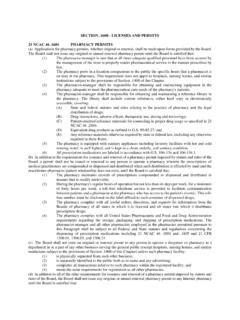
1 SECTION .1800 - PRESCRIPTIONS 21 NCAC 46 .1801 EXERCISE OF professional JUDGMENT IN filling PRESCRIPTIONS (a) A pharmacist or device and medical equipment dispenser shall have a right to refuse to fill or refill a prescription order if doing so would be contrary to his or her professional judgment. (b) A pharmacist or device and medical equipment dispenser shall not fill or refill a prescription order if, in the exercise of professional judgment, there is or reasonably may be a question regarding the order's accuracy, validity, authenticity, or safety for the patient. (c) A prescription order is valid only if it is a lawful order for a drug, device, or medical equipment issued by a health care provider for a legitimate medical purpose, in the context of a patient-prescriber relationship, and in the course of legitimate professional practice as recognized by the occupational licensing board governing the health care provider.
2 History Note: Authority ; ; Eff. April 1, 1983; Amended Eff. August 1, 2015; February 1, 2007; March 1, 2004; April 1, 2003; September 1, 1995; Pursuant to , rule is necessary without substantive public interest Eff. October 3, 2017. 21 NCAC 46 .1802 prescription REFILLS (a) Authorization for prescription refills is presumed to be within the prescribed dosage or normal therapeutic use. Refilling PRESCRIPTIONS more frequently than the prescribed dosage would require, or refilling PRESCRIPTIONS in significant excess of normal therapeutic use, may be considered as negligence under (a)(9). (b) If deemed appropriate in the pharmacist's professional judgment, a patient may receive upon request drug quantities in excess of the face amount of a prescription for a non-controlled substance, up to the total amount authorized.
3 The pharmacist shall not dispense in excess of the face amount of a prescription for a controlled substance or psychotherapeutic drug without authorization from the prescriber. History Note: Authority ; ; Eff. April 1, 1983; Amended Eff. September 1, 1993; May 1, 1989; Pursuant to , rule is necessary without substantive public interest Eff. October 3, 2017. 21 NCAC 46 .1803 prescription RECORDS All records pertaining to the filling and refilling of PRESCRIPTIONS shall be available to designated employees of the Board during normal business hours. History Note: Authority ; ; ; Eff. April 1, 1983; Pursuant to , rule is necessary without substantive public interest Eff. October 3, 2017. 21 NCAC 46 .1804 prescription : RECEIVING AND DISPENSING (a) In order to assure that the practitioner-pharmacist-patient relationship exists and to promote the safe and secure distribution of drugs and devices from a pharmacy, prescription orders may be received for filling and refilling only by a pharmacist or a bona fide employee of the pharmacy.
4 The pharmacist-manager of the pharmacy shall be ultimately responsible for the safe, lawful and secure receipt of prescription orders and delivery of prescription drugs. Notwithstanding the provisions of this Rule, prescription drugs also may be delivered by mail in accordance with the provisions of 21 NCAC 46 .1601(b). (b) In filling or refilling prescription orders, the pharmacist shall not be required to deal with parties, including managed care companies and insurance providers, outside the practitioner-pharmacist-patient relationship. (c) In order to promote the safe and secure distribution of devices and medical equipment from a facility holding a device and medical equipment permit, prescription orders for devices and medical equipment may be received for filling and refilling only by the person in charge of the facility holding the device and medical equipment permit or a bona fide employee of the facility.
5 The person in charge shall be ultimately responsible for the safe, lawful and secure receipt of prescription orders and delivery of devices and medical equipment. Unless the location also holds a pharmacy permit, a facility holding a device and medical equipment permit shall not acquire, receive, store, or deliver prescription drugs. History Note: Authority ; ; Eff. December 1, 1983; Amended Eff. April 1, 2004; August 1, 2000; September 1, 1995; May 1, 1989; August 1, 1988; Pursuant to , rule is necessary without substantive public interest Eff. October 3, 2017. 21 NCAC 46 .1805 DISPENSING DRUGS WITHOUT A prescription The dispensing of or any delivery of a prescription drug, including the surrender of control or possession in any manner which results in a delivery of a prescription drug, without a valid prescription order is unlawful.
6 Refilling a prescription for a prescription drug without authorization is unlawful. History Note: Authority (s); ; ; Eff. March 1, 1984; Amended Eff. May 1, 1989; Pursuant to , rule is necessary without substantive public interest Eff. October 3, 2017. 21 NCAC 46 .1806 TRANSFER OF prescription INFORMATION (a) The transfer of original prescription information for the purpose of refill dispensing is permissible between pharmacies subject to the following requirements: (1) the transfer is communicated directly from either a pharmacist or certified technician to either a pharmacist or certified technician and not by only one pharmacist or certified technician gaining access to an information file containing data for several locations, unless all locations accessed are under common ownership or accessed pursuant to contractual agreement of the pharmacies.
7 (2) the transferring pharmacist or certified technician invalidates the prescription and any remaining refills at the transferring pharmacy by marking the word "void" on the face of the prescription or its equivalent; (3) the transferring pharmacist or certified technician records the name and address of the pharmacy to which it was transferred and the name of the pharmacist or certified technician receiving the prescription information on the reverse of the invalidated prescription ; (4) the transferring pharmacist or certified technician records the date of the transfer and the name of the pharmacist or certified technician transferring the information. (b) The pharmacist or certified technician receiving the transferred prescription information shall reduce to writing the following: (1) The word "transfer" on the face of the transferred prescription ; (2) All information required to be on a prescription , including: (A) Date of issuance of original prescription ; (B) Number of refills authorized on original prescription ; (C) Date and time of transfer; (D) Number of valid refills remaining and date of last refill; (E) Pharmacy's name, address and original prescription number from which the prescription information was transferred; (F) Name of transferring pharmacist or certified technician; and (G) Manufacturer or brand of drug dispensed.
8 (c) The transferred prescription , as well as the original, must be maintained for a period of three years from the date of last refill. (d) Dispensing is permitted only within the original authorization for refills and no dispensing on such transfer shall occur beyond that authorized on the original prescription . Any dispensing beyond that originally authorized or one year, whichever is less, may occur only on a new prescription . (e) The requirements of Paragraphs (a) and (b) of this Rule may be facilitated by use of a computer or data system without reference to an original prescription document. The system must be able to identify transferred PRESCRIPTIONS and prevent subsequent prescription refills at that pharmacy. (f) This Rule applies to the transfer of PRESCRIPTIONS issued by prescribers in other states, provided that the pharmacist or certified technician receiving the prescription actually knows or reasonably should know that a physician-patient relationship exists and dispensing the drug is in the patient's best interests.
9 (g) All records pertinent to this Rule shall be readily retrievable. (h) A system must be in place that will allow only authorized access by a pharmacist or certified technician to all records pertinent to this Rule and will indicate on the prescription record when and by whom such access was made. (i) The transfer of original prescription information for the purpose of refill dispensing is permissible between device and medical equipment permit holders so long as the transferring permit holder provides all records and documentation necessary for dispensing and does not interfere with the service and claims processing procedures of the receiving permit holder. History Note: Authority (a); ; Eff. December 31, 1985; Amended Eff. June 1, 2004; September 1, 1995; July 1, 1992; May 1, 1989; Pursuant to , rule is necessary without substantive public interest Eff.
10 October 3, 2017. 21 NCAC 46 .1809 EMERGENCY prescription REFILLS In the event a pharmacist or device and medical equipment permit holder receives a request for a prescription refill and the pharmacist or permit holder is unable to obtain refill authorization from the prescriber, the pharmacist or permit holder may dispense a one-time emergency refill of up to a 30 day supply of the prescribed medication, provided that: (1) The prescription is not for a Schedule II controlled substance; (2) The medication is essential to the maintenance of life or to the continuation of therapy in a chronic condition; (3) In the pharmacist's or permit holder's professional judgment, the interruption of therapy might reasonably produce undesirable health consequences.