Transcription of Legal Basics- Elder Financial Exploitation - NCLER
1 Legal basics : Elder Financial ExploitationCHAPTER SUMMARY January 2018 Charles P. Sabatino, ABA Commission on Law and Aging1 American Bar Association Commission on Law and AgingThe mission of the American Bar Association Commission on Law and Aging (ABA Commission) is to serve as the collaborative, interdisciplinary leader of the Association s work to strengthen and secure the Legal rights, dignity, autonomy, quality of life, and quality of care of aging persons, particularly low-income and vulnerable elders. Since 1979, the ABA Commission has carried out this mission through research, policy development, technical assistance, advocacy, education, and training. Key Lessons1. There are many different types of Financial Exploitation . Financial Exploitation is costly, devastating, and usually unreported. 2. It is important to observe and screen for common characteristics of victims and perpetrators of Several Legal action strategies are available to attorneys to prevent, intervene, and redress Financial Take advantage of systems change opportunities.
2 No one entity is fully capable of preventing the problem or meeting the needs of victims. Each has a crucial role to play, and interaction and collaboration among resources and stakeholders is 1: Definition & Types of Financial ExploitationFinancial Exploitation is one form of Elder Federal and state laws use a myriad of definitions, and different categories within those definitions, for Elder abuse and Financial Exploitation . Financial Exploitation is defined in the Older Americans Act as: The fraudulent or otherwise illegal, unauthorized, or improper act or process of an individual, including a caregiver or fiduciary, that uses the resources of an older individual for monetary or personal benefit, profit, or gain, or that results in depriving an older individual of rightful access to, or use of, benefits, resources, belongings, or assets. 3 Similarly, the National Research Council and the Government Accountability Office4 define unjust, improper, and/or illegal use of another s resources, property, and/or assets as Financial Exploitation .
3 At the state level, legislative definitions vary. State law civil and criminal definitions of Financial abuse or Exploitation can be found through the Department of Justice Elder Rights Initiative The author thanks his colleague Lori Stiegel for the use of portions of her For more Legal basics information on Elder Abuse, see: 3 42 Bonnie, Wallace R. Elder Mistreatment: Abuse, Neglect, and Exploitation in an Aging America. National Research Council ( ). Washington: National Academies Press (2003). 5 Department of Justice, Elder Rights Initiative. See (last visited December 22, 2017).Chapter Summary 2 Research and professional anecdotes indicate that Elder abuse victims usually experience multiple types of abuse; this may be referred to as polyvictimization. 6 Types of Financial exploitationThere are differing ways of categorizing types of Financial abuse and Exploitation , and the boundaries between them can be blurry, but one simple distinction divides Financial Exploitation into two types: those by a known person and those by a stranger : Known person: Financial abuse/ Exploitation by a known person (a family member, close friend, caregiver, or person/organization in a position of trust) who breaches the trust of a vulnerable person and misuses the individual s funds to serve their own needs at the Elder s expense.
4 Remedies for these kinds of abuse are generally civil and possibly criminal. Stranger or new friend : fraud , misrepresentation, or scams by a stranger or new friend who deceives the vulnerable person via an ever-changing variety of con games, such as bogus lotteries, sweetheart swindles, grandparent scams, fake charities, home repair fraud , IRS back taxes schemes, identity theft, etc. These are generally all criminal forms of 2015 study by True Link Financial breaks out a subset of the fraud and misrepresentation category above of Exploitation that is done openly with the claimed consent of the victim and involved matters such as hidden shipping and handling or subscriptions; work-from-home schemes; and quack weight loss or dietary products or other dubious This might be thought of as snake oil salesman abuse and may or may not rise to the level of criminal abuse in long-term care settings pose uniquely different challenges and is often categorized separately.
5 Nursing home and institutional abuse is outside the focus of this Chapter extent of Financial exploitationFinancial Exploitation of older adults is a prevalent and underreported problem. The National Elder Mistreatment Study by Ron Acierno and colleagues surveyed a national sample of community-residing, cognitively intact, adults aged 60 years and older in 2008. The study found that over 11% of respondents reported experiencing some type of abuse or potential neglect in the past year, with the most frequent form of mistreatment noted being Financial Exploitation by family members ( ).8 This is likely a low estimate since those with cognitive impairments, no phone, or who are living in facilities were excluded. Other studies have shown slightly lower levels, but limited samples and methodologies have made precise data 2011 Federal Trade Commission survey of the prevalence of scams and fraud in the found that of adults 65-74 and of adults 75 and older were victims.
6 Another factor making good data hard to come by is underreporting of Elder abuse of all forms: only 1 in 5 cases9 to 1 in 23 cases is Pamela B. Teaster, A Framework for Polyvictimization in Later Life, 29(5) J. Elder Abuse & Neglect 289 (2017).7 True Link Financial , The True Link Report on Elder Financial Abuse 2015, (last visited December 22, 2017).8 Acierno R, Hernandez MA, Amstadter AB, Resnick HS, Steve K, Muzzy W, Kilpatrick DG. Prevalence and Correlates of Emotional, Physical, Sexual, and Financial Abuse and Potential Neglect In the United States: The National Elder Mistreatment Study. 100 AM J Public Health 292-7 (2010).9 National Center on Elder Abuse. The National Elder Abuse Incidence Study, Final report to the Administration on Children and Families and Administration on Aging, Department of Health and Human Services, Grant No. 90 AM 0660 (1998).10 Lifespan of Greater Rochester, Inc., Weill Cornell Medical Center of Cornell University & New York City Department for the Aging, Under the Radar: New York State Elder Abuse Prevalence Study (2011).
7 Chapter Summary 3 The cost of Elder Financial exploitationFinancial Exploitation is enormously costly to a victim s health and economic security. Studies estimate the Financial loss due to Exploitation in the billions of dollars. A 2010 MetLife study examined news and media articles about Elder Financial Exploitation and estimated annual Financial losses to seniors at approximately $ Yet, a 2014 survey of Americans aged 50 70 by True Link Financial estimated annual losses at a much higher $ For Elder abuse in general, multiple studies have shown that Elder abuse increases a victim s risk of hospitalization by three times, nursing home admission by four times, and mortality by three Advocates for older adults know that Elder abuse also may cause impoverishment and the need to rely on government benefit programs (although Financial Exploitation also may lead to Medicaid penalties),14 as well as homelessness or involuntary 2: Victim and Perpetrator Characteristics and ScreeningAttorneys working with older adult clients should become familiar with the characteristics of victims who may be at risk for Financial Exploitation .
8 Factors that have been shown to increase the risk of being a victim of abuse in general include: age, female gender, cognitive impairment, physical impairments, depression, loneliness, substance abuse, and social Perpetrators of abuse are predominantly family members or another person in a relationship of trust and more likely to be younger than the victim. Relationship of trust is a term commonly used to describe the relationship an older adult has with intimate partners, relatives, paid or unpaid caregivers, friends, neighbors, and fiduciaries such as agents under a power of attorney, trustees, guardians, or conservators. Factors that increase the likelihood of being a perpetrator include caregiver burden, depression, substance abuse, and other mental health issues, and a lack of social victim-perpetrator relationship tends to make it very difficult for victims to rectify their circumstance or seek help. Victims may not recognize the Exploitation .
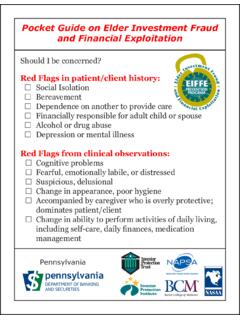
9 They may fear retaliation, disbelief by others, or the stigma of victimization. They may depend on the perpetrator for all or most of their needs. They may be reluctant to get perpetrator in trouble, or worse, fear that the result will be their own placement under guardianship or in a nursing addition to characteristics, attorneys should also be aware of different situations that may indicate the risk or occurrence of Financial Exploitation . These common indicators include: Financial changes: Banking inconsistent with Elder s ability and past history Unusual ATM use or wiring of money11 The MetLife Mature Market Institute, et al., The MetLife Study of Elder Financial Abuse: Crimes of Occasion, Desperation, and Predation Against America s Elders (June 2011). (last visited December 22, 2017).12 True Link, The True Link Report on Elder Financial Abuse 2015 1, (last visited December 22, 2017).13 Marie-Therese Connolly, et al., The Elder Justice Roadmap, A Stakeholder Initiative to Respond to an Emerging Health, Justice, Financial and Social Crisis 3 (2014), (last visited December 22, 2017).
10 14 See Elder Financial Abuse and Medicaid Denials, (2017), available at: 15 Ruijia Chen and XinQi Dong, Risk Factors of Elder Abuse, in XinQi Dong (ed.), Elder Abuse: Research, Practice and Policy (2017).16 Summary 4 Changed or missing Financial documents Failing to pay bills normally paidDocument and property changes: Forged or suspicious signature on documents Missing property Failure to remember or understand recent transactionsPersonal and relationship changes: Lack of previously enjoyed necessities or amenities Recent, new best friends or sweethearts Isolation due to actions by others Changes in Elder s appearance, mood, habits Being accompanied by a coercive other personScreening tools for abuse and neglect have a scattered and limited There is no proven standard for Elder abuse screening. Of tools that exist, a majority are designed for use by health care providers. In all cases, a positive screening for Elder abuse means that further information should be gathered.