Transcription of Issuing Date: June 1, 2016 SAFETY DATA SHEET
1 1 SAFETY data SHEET SECTION 1: IDENTIFICATION Product Name: Film insulated copper magnet wire including square, rectangular and round single strand constructions conforming to ANSI/NEMA MW1000, Microsquare magnet wire and MWS Multifilar and Twistite multi-strand magnet wire constructions Alternate Identification: AWG size and ANSI/NEMA insulation type, MWS Wire Industries part number or user part number Product Use: Winding wire Company: MWS Wire Industries, 31200 Cedar Valley Dr., Westlake Village, CA 91362 Phone: (818) 991-8553 Emergency Phone: (818) 991-8553 SECTION 2: HAZARDS IDENTIFICATION Film insulated copper magnet wire supplied by MWS Wire Industries poses no hazard as shipped and required label elements are based on this status. Hazard classification: Not classified Signal word, hazard statement, symbol & precautionary statement: None Hazards not otherwise classified: When burned, soldered or hot staked, magnet wire coatings may release hazardous decomposition products that can cause eye or respiratory irritation.
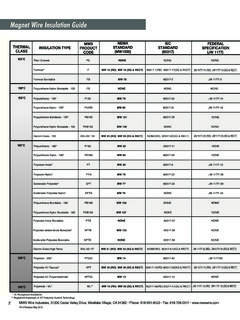
2 Decomposition products may include isocyanates such as toluene diisocyanate (TDI). Decomposition of urethanes and coatings rated at 155 C and lower will begin at 230 C. Also, excessive exposure to dust or fumes from soldering, burning or mechanically stripping insulation coatings may cause irritation to the eyes, nose, throat and respiratory system. Acute exposure to copper fumes can cause metal fume fever and irritation of the respiratory tract. If ingested, copper is moderately irritating to the stomach and intestinal lining. SECTION 3: COMPOSITION Copper [UNS alloy 11000, 10200 or 10100] CAS 7440-50-8 81-99% by weight Polymer resin film insulation 1-19% by weight Polymer Resin Film Insulation Types Insulation Type Temperature Class Insulation Resin Plain Enamel 105 C Synthetic Oleoresinous Issuing Date: June 1, 2016 2 SECTION 3.
3 COMPOSITION (continued) Insulation Type Temperature Class Insulation Resin Formvar 105 C / 120 C Polyvinyl Acetal Polyurethane 155 C / 180 C Modified Polyurethane Polyurethane Nylon 155 C/ 180 C Modified Polyurethane with Polyamide overcoat Solderable Polyesterimide 180 C Polyesterimide Polyester 200 180 C Modified Polyester Armored Polyester 200 C Modified Polyester or Polyesterimide with Amide- imide overcoat Pyre ML1 240 C Polyimide 1 IST (USA) Corp. Registered Trademark All insulations may be supplied with a bondable overcoat: Butvar Bond Polyvinyl Butyral Polyester Bond Polyester Epoxy Bond Epoxy Polyamide Bond Polyamide SECTION 4: FIRST AID MEASURES Eyes: If nuisance dust, smoke or fume is created by burning, soldering, mechanical insulation stripping or abrasion, personnel in the vicinity may experience eye irritation.
4 Rinse with water for 15 minutes and contact physician as needed. Inhalation: If dust, smoke or fume is created by burning, soldering, mechanical insulation stripping or abrasion, personnel in the vicinity may experience nose and throat irritation. Move to fresh air immediately and seek medical attention if needed. Skin Contact & Ingestion: Not expected route of exposure SECTION 5: FIRE FIGHTING MEASURES Copper magnet wire presents minimal explosion or fire hazard, however toxic fumes may be produced when subject to high heat as from a surrounding fire. Use extinguishing media suitable for the surrounding fire. Fire fighters should use self-contained breathing apparatus if necessary. SECTION 6: ACCIDENTAL RELEASE MEASURES In solid form magnet wire poses no special clean up problems. If material is in powder or dust form, clean up should be conducted to minimize airborne powder and dust and to avoid contamination of air and water.
5 Unprocessed copper magnet wire is an easily contained solid material and has reclamation value as copper scrap. 3 SECTION 7: HANDLING AND STORAGE Safe Handling and Storage: Handle spools by the flanges and use powered lift equipment when necessary to lift or move heavy reels. The optimum storage environment is low humidity and temperature controlled to avoid extremes. Prolonged exposure to sunlight or artificial lighting should be avoided to prevent degradation of the polymer insulation. Incompatible Products: Copper in contact with hydrogen peroxide or heated with magnesium may produce violent reaction. Copper in contact with acetylene can produce unstable acetylides. Also avoid contact with chlorine gas, ammonium nitrate, bromates, chlorates, hydrogen sulfide, lead azide, hydrazine mononitrate, hydroazoic acid, potassium peroxide, sodium azide and sodium peroxides.
6 SECTION 8: EXPOSURE CONTROLS AND PERSONAL PROTECTION Substance OSHA PEL1 TLV2 Copper 1 mg/M3 [Dust] 1 mg/M3 [Dust] Polymer resin insulation Not established Not established 1 Occupational SAFETY & Health Administration Permissible Exposure Limit 2 American Conference of Governmental Industrial Hygienists Threshold Limit Value Link to NIOSH Pocket Guide to Chemical Hazards: CDC - NIOSH Pocket Guide to Chemical Haz-ards - Copper (dusts and mists, as Cu) Engineering Controls: Operations that generate fume or dust created by burning, solder-ing, mechanical insulation stripping or abrasion should be conducted under a fume hood or in an area with good local ventilation as required by the circumstances of exposure. Personal Protective Equipment: Wear SAFETY glasses when the risk of eye injury is pre-sent, particularly during machining, grinding, soldering, brazing, welding, powder handling, etc.
7 Gloves and other protective equipment may be required during handling operations as appro-priate to the circumstances of exposure. SECTION 9: PHYSICAL AND CHEMICAL PROPERTIES Appearance & Odor: Solid with no odor to very mild solvent odor. Color varies with type of coating. Standard colors are red, green, brown and amber. Additional colors may be produced. Odor threshold is estimated < 1 ppm. pH: Not Applicable Melting Point: 1083 C (copper metal) Boiling Point: 2563 C (copper metal) Flash Point: Not Applicable Evaporation Rate: Not Applicable Flammability: Non-flammable solid 4 SECTION 10: STABILITY AND REACTIVITY Film insulated copper magnet wire is chemically stable. Copper wire and polymer film insulations have low chemical reactivity with air, water and common solvents. Copper in contact with hydrogen peroxide may produce violent reaction.
8 Copper in contact with acetylene can produce unstable acetylides. Also avoid contact with chlorine gas, ammonium nitrate, bromates, chlorates, hydrogen sulfide, lead azide, hydrazine mononitrate, hydroazoic acid, potassium peroxide, sodium azide and sodium peroxides. Conditions to avoid ( , static discharge, shock or vibration): None known. When burned, soldered or hot staked, magnet wire coatings may release hazardous decomposition products that can cause eye or respiratory irritation. Decomposition products may include isocyanates such as toluene diisocyanate (TDI). Decomposition of nylon and coatings rated at 155 C and lower will begin at 230 C. SECTION 11: TOXICOLOGICAL INFORMATION Exposure to high doses of copper can be harmful. Exposure to copper dust can irritate he nose, mouth, and eyes, and cause headaches, dizziness, nausea, and diarrhea.
9 Workers exposed to copper dust report a number of symptoms that are suggestive of respiratory irritation, including coughing, sneezing, thoracic pain and runny nose. data on the potential of copper to induce respiratory effects are limited to the NTP (1993) study that found no histological alterations in the lungs of rats exposed to 285 or 134 mg copper/kg/day as copper sulfate in the diet for 14 or 90 days respectively, or in mice exposed to 717 o 814 mg copper/kg/day for 14 or 90 days. Intentionally high intakes of copper can cause liver and kidney damage and even death. It is not known if copper can cause cancer in humans. EPA does not classify copper as a human carcinogen because there are no adequate human or animal cancer studies. (Source: Agency for Toxic Substances & Disease Registry, Public Health Statement for Copper) The toxicological effects of polymer resin film insulation are not known but nuisance dust created by mechanically stripping and fumes from burning, soldering or brazing are known irritants to the eyes, nose, throat and lungs.
10 Effects of chronic exposure to insulation particulate or fumes are unknown. Copper has not been listed as a carcinogen or potential carcinogen by NTP, IARC or OSHA. SECTION 9: PHYSICAL AND CHEMICAL PROPERTIES (continued) Vapor Density (Copper): 1@1628 C Relative Density: (AWG 12H-AWG 50Q) Solubility: Insoluble in H2O Partition Coefficient (n-octanol/water): No data Viscosity: Not applicable Auto-ignition temperature: No data Decomposition temperature: Begins at 230 C for low temperature film insulations 5 SECTION 12: ECOLOGICAL INFORMATION When released into the environment copper strongly attaches to organic matter and minerals. In surface water copper can travel great distances, either suspended on sludge particles or as free ions. The ecological impact of magnet wire film insulation released into the environment is not known but the material is an inert solid and not expected to be more detrimental than other plastics under the same conditions.