Transcription of SHARING STRENGTH AND GROWTH AREAS - …
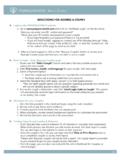
1 6 2017 6 SHARING STRENGTH AND GROWTH AREAS Your strengths develop by working through your issues. Check what AREAS you agree or disagree most with your Select three STRENGTH AREAS (most agreement and positive aspects of your relationship) 2. Select three GROWTH AREAS (most disagreement and AREAS you want to improve) STRENGTH AREASGROWTH AREAS1. COMMUNICATION We share feelings and understand each other. 2. CONFLICT RESOLUTION We are able to discuss and resolve PARTNER STYLE AND HABITS We appreciate each other s personality and FINANCIAL MANAGEMENT We agree on budget and financial LEISURE ACTIVITIES We have a good balance of activities together and SEXUALITY AND AFFECTION We are comfortable discussing sexual issues and FAMILY AND FRIENDS We feel good about our relationships with relatives and RELATIONSHIP ROLES We agree on how to share decision-making and CHILDREN AND PARENTING We agree on issues related to having and raising
2 SPIRITUAL BELIEFS We hold similar religious values and DISCUSSION Take turns SHARING what each of you perceive as your relationship strengths. Verbally share one STRENGTH at a time, until you each have shared three. Use the same procedure to share and discuss GROWTH AREAS . Discuss these three questions: - Did any of your partner s responses surprise you? - In what AREAS did you mostly agree with your partner? - In what AREAS did you mostly disagree with your partner?8 2017 8 COMMUNICATION It is a luxury to be understood.
3 Ralph Waldo EmersonCREATING A WISH LISTIn this exercise, you will each individually make a Wish List of things you would like more or less of in your relationship. Next, take turns SHARING your Wish Lists with each is the ability to express your feelings and ask for what you want in your listening is the ability to let your partner know you understand them by restating their SHARING your Wish List with your partner, you will be demonstrating your Assertiveness skills. In giving feedback to your partner about their Wish List, you will be demonstrating your Active Listening a Wish List of three things you would like more or less of in your _____2.
4 _____3. _____SHARING YOUR WISH LISTTake turns SHARING your Wish List with each other, keeping in mind the following: Speaker s Job:- Speak for yourself ( I statements I ).- Describe how you would feel if your wish came true. Listener s Job:- Repeat/summarize what you have Describe the wish AND how your partner would feel if the wish came DISCUSSIONA fter completing the Wish List Exercise, discuss the following questions: How good were each of you at being assertive? In what ways did you each effectively use active listening skills?
5 10 2017 10 PERSONAL STRESS PROFILE Grant me the serenity to accept the things I cannot change; the courage to change the things I can;and the wisdom to know the difference. Reinhold NiebuhrIDENTIFYING MOST CRITICAL ISSUESDo you control stress in your life or does stress control you? Stressors are events that cause an emotional and/or physical reaction. Stress can be positive (wedding, job promo-tion) or negative (loss of job, car accident, major illness). But what is important is to be able to manage the many stressors in your life. One way to manage stress is to prioritize the issues that are most important to you.
6 Another is to decide what issues can be changed or resolved and which ones cannot. This exercise will help you focus on the high priority issues and those that can be changed (Box 1).COUPLE EXERCISE 1. Select up to four issues that are the most stressful for each of Review each issue and put it into one of the four cells below. (Box 1 contains the Most Critical Issues. )COUPLE DISCUSSION Select one issue from Box 1 that you will work on together as a couple. Work together as a team to achieve your goals. - Communicate about the issue.
7 - Use good conflict resolution skills. - Be flexible with one another. Able to ChangeLow PriorityBox 1 Box 3 Are you spending too much time on low priority issues?What changes can you each make?Box 2 Box 4 Can you accept or forget about these issues?How do you plan to cope?Difficult to ChangeHigh PriorityLEAST CRITICAL ISSUESMOST CRITICAL ISSUES13 2017 13 CONFLICT RESOLUTION Anyone can become angry. That is easy. But to be angry with the right person, to the right degree, at the right time, for the right purpose and in the right way that is not easy.
8 AristotleTEN STEPS FOR RESOLVING CONFLICTAll couples have differences and disagreements. Studies show the amount of disagreements are not related to marital happiness as much as how they are handled. Happy couples do not avoid disagreements; they resolve them while remaining respectful of each other, thereby strengthening their relationship. This Ten Step Model is a simple, but ef-fective way to resolve conflict while avoiding the common and destructive patterns. Use this model with an ongoing issue in your relationship, as well as future issues.
9 1. Set a time and place for Define the problem. Be specific. _____3. List the ways you each contribute to the problem. Partner 1: _____ Partner 2: _____4. List past attempts to resolve the issue that were not successful. 1) _____ 3) _____ 2) _____ 4) _____5. Brainstorm 10 possible solutions to the problem. Do not judge or criticize any of the suggestions at this point. 1) _____ 6) _____ 2) _____ 7) _____ 3) _____ 8) _____ 4) _____ 9) _____ 5) _____ 10) _____6.
10 Discuss and evaluate each of these possible solutions. Be as objective as possible. Talk about how useful and appropriate each suggestion feels for resolving your Agree on one solution to try: _____8. Agree how you will each work toward this solution. Be as specific as possible. Partner 1: _____ Partner 2: _____9. Set up another meeting to discuss your progress. Place: _____ Date: _____ Time: _____10. Reward each other for progress. If you notice your partner making a positive contribution toward the solution, praise his/her 2017 29 In marrying another person, you are also marrying their family.