Transcription of THE SUPREME COURT OF APPEAL OF SOUTH …
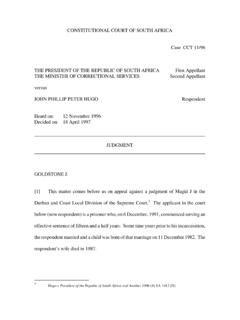
1 THE SUPREME COURT OF APPEAL OF SOUTH AFRICA JUDGMENT Reportable Case No: 599/2015 In the matter between: ESKOM HOLDINGS LIMITED APPELLANT and DEREK ANTHONY HALSTEAD-CLEAK RESPONDENT Neutral citation: Eskom Holdings Limited v Halstead-Cleak ZASCA 150 (30 September 2016) Coram: Lewis and Willis JJA and Schoeman, Fourie and Makgoka AJJA Heard: 13 September 2016 Delivered: 30 September 2016 Summary: Section 61 of the Consumer Protection Act 68 of 2008 does not create strict liability on the part of a supplier of electricity if the plaintiff is not a consumer vis- -vis it .2 ORDER On APPEAL from: Gauteng Division of the High COURT of SOUTH Africa (Pretoria) (Baqwa J sitting as COURT of first instance): judgment reported sub nom Halstead-Cleak v Eskom Holdings Ltd 2016 (2) SA 141 (GP) 1 The APPEAL is upheld with costs.
2 2 The order of the COURT below is replaced with the following: 1 (a) The defendant is not liable to the plaintiff in terms of the provisions of s 61 of the Consumer Protection Act 68 of 2008. (b) The plaintiff s claim, based on those provisions, is dismissed, with costs, those costs to include the costs of the pre-trial conference of 19 February 2015 and the costs of the trial that commenced on 23 February 2015. (c) The plaintiff s action is remitted to the trial COURT for the determination of the remaining issues in the action. JUDGMENT Schoeman AJA (Lewis and Willis JJA and Fourie and Makgoka AJJA concurring) [1 ] The central question in this APPEAL is whether the appellant, Eskom Holdings Ltd (Eskom), can be held strictly liable in terms of s 61 of the Consumer Protection Act 68 of 2008 (the Act) for harm caused to the respondent, Mr Derek Anthony Halstead-Cleak, by a low hanging power line which was not supplying or required to supply electricity to anyone.
3 3 The background [2 ] On 11 August 2013 the respondent, one of a group of four cyclists, came into contact with a low hanging live power line spanning a footpath they were cycling on. He sustained severe electrical burns and issued a summons against Eskom for the damages he had suffered. [3 ] The respondent s claim is based on (a) Eskom s role as the sole supplier or producer of electricity on the national grid and its control of all power lines not falling under the control of any local authority or municipality; (b) the strict liability of Eskom as the producer or supplier of electricity provided for in terms of s 61 of the Act; and in the alternative (c) delict, in that Eskom negligently and wrongfully caused the respondent s damages.
4 [4 ] The parties agreed that the limited issue pertaining to whether Eskom was liable in terms of s 61 of the Act would be separately adjudicated with the remaining issues to stand over for later determination, if necessary. It was so ordered in terms of Uniform rule 33(4). [5 ] The Gauteng Division of the High COURT of SOUTH Africa (Pretoria) (to which I shall refer for the sake of convenience as the high COURT ) found that Eskom was 100 per cent liable for the respondent s injuries in terms of the provisions of s 61 of the Act. The APPEAL is with the leave of the high COURT . The pleadings [6 ] The claim, based on s 61 of the Act, avers that Eskom was a producer or supplier of electricity or a service in terms of the Act while 4 the production or generation of electricity constituted supply and market as defined in the Act.
5 The respondent was a person mentioned in s 61(5) of the Act, that is a natural person who had been injured, or a consumer , and had suffered injuries which constituted harm as envisaged in ss 61(1) and 61(5) of the Act due to the alleged supply of unsafe goods and/or defective goods, or a hazard in the goods resulting in the injuries sustained. The goods were the electricity generated, supplied and permitted to be present in the lines spanning the footpath. [7 ] Eskom s plea was broadly that it was a licensee in terms of the provisions of the Electricity Regulation Act 4 of 2006 and responsible for the relevant power line through which it conducted electricity.
6 Eskom was made aware that the respondent had come into contact with the power line on 11 August 2013 whilst riding a bicycle. Subsequently the employees of Eskom inspected the power lines and discovered that all three conductors of the power line had been vandalised by the theft of stay rods, which resulted in the power lines hanging in a low position. Eskom denied that, in the context of this particular accident, it was a producer or supplier as defined in the Act or that the respondent was a consumer as defined. Eskom denied that the incident arose as a result of the supply of unsafe goods or a product failure, defect or hazard in any goods or inadequate instruction or warnings.
7 Furthermore, Eskom could not have been expected to discover the state of the power line. [8] In terms of the common law a manufacturer could not be held strictly liable in delict for any harm caused. In Wagener v Pharmacare Ltd; Cuttings v Pharmacare Ltd1 it was found that if the common law is 1 Wagener v Pharmacare Ltd; Cuttings v Pharmacare Ltd 2003 (4) SA 285 (SCA) para 38. 5 to be extended to make provision for strict liability, it is the Legislature s duty to do so. That came to fruition with the promulgation of the Act. The interpretation of the Act and s 61 in particular The applicable definitions and tools of interpretation [9] In interpreting the Act it is instructive to refer to the principles enunciated in Natal Joint Municipal Pension Fund v Endumeni Municipality2 and Novartis SA (Pty) Ltd v Maphil Trading (Pty) Ltd3 that the interpetative process involves ascertaing the intention of the legislature but considers the words used in the light of all relevant and admissible context, including the circumstances in which the legislation came into being.
8 Furthemore, as was said in Endumeni .. a sensible meaning is to be preferred to one that leads to insensible or unbusinesslike results.. [10] The long title of the Act provides that it is to promote a .. fair, accessible and sustainable marketplace for consumer products and services and for that purpose to establish national norms and standards relating to consumer protection, to provide for improved standards of consumer information, to prohibit certain unfair marketing and business practices, to promote responsible consumer behaviour, to promote a consistent legislative and enforcement framework relating to consumer transactions and agreements.
9 [11] The Green Paper discussion of the Act makes it clear that a broad spectrum of consumers needed protection: Perhaps one of the greatest pitfalls in most consumer protection laws in SOUTH Africa, is the absence of a uniform definition of "a consumer". This has 2 Natal Joint Municipal Pension Fund v Endumeni Municipality [2012] ZASCA 13; 2012 (4) SA 593 (SCA) para 18. 3 Novartis SA (Pty) Ltd v Maphil Trading (Pty) Ltd [2015] ZASCA 111; 2016 (1) 518 para 27. 6 resulted in a difficulty for enforcers to accurately identify individuals that the State seeks to protect. Consumers must be defined broadly as individuals who purchase goods and services, and must include third parties who act on behalf of the consumer.
10 4 [12] In terms of the provisions of s 2(1), the Act must be interpreted in a manner that gives effect to the purpose of the Act as set out in s 3. That purpose is to promote and advance the social and economic welfare of consumers, in particular vulnerable consumers, in SOUTH If there is an inconsistency between the Act and any other legislation both Acts apply concurrently, to the extent that it is possible. If it is not possible, the provisions that extend the greater protection to a consumer prevail over the alternative provision. [13] Section 5 concerns the application of the Act. The relevant provisions apply to every transaction occurring within SOUTH Africa for the supply of goods or services or the promotion of goods or services.