Transcription of Brainstem Calmer Activities - beaconhouse.org.uk
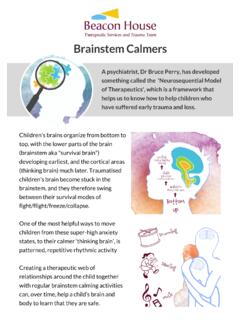
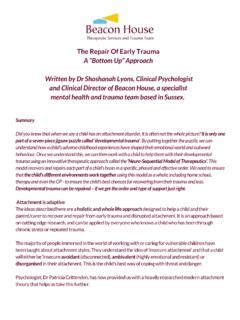
1 Brainstem CalmersA psychiatrist, Dr Bruce Perry, has developedsomething called the 'Neurosequential Modelof Therapeutics', which is a framework thathelps us to know how to help children whohave suffered early trauma and loss. Children's brains organize from bottom totop, with the lower parts of the brain( Brainstem aka "survival brain")developing earliest, and the cortical areas(thinking brain) much later. Traumatisedchildren's brain become stuck in thebrainstem, and they therefore swingbetween their survival modes offight/flight/freeze/collapse. One of the most helpful ways to movechildren from these super-high anxietystates, to their Calmer thinking brain , ispatterned, repetitive rhythmic activity Creating a therapeutic web ofrelationships around the child togetherwith regular Brainstem calming activitiescan, over time, help a child s brain andbody to learn that they are safe.
2 Brainstem CalmersBrainstem calming Activities need to be: Relational (offered by a safe adult) Relevant (developmentally-matched to the child rather than matched to theiractual age) Repetitive (patterned) Rewarding (pleasurable) Rhythmic (resonant with neural patterns) Respectful (of the child and family) Below is a list of Brainstem calming Activities which could be offered acrosshome and school, with the above "R" principles in mind. Examples of how youcan translate this into practice are offered. The best way to use these Activities is to weave them into the child's dailyroutine so that they have them little and often, every day. Many of them canbe offered as part of a whole-class activity. Brainstem Calmer ActivitiesIndividual - Being asked to do regular jobs so that there are walking breaks in between tasks - Being ask to show visitors where things are in the school Whole Class - Being given information whilst walking - A walking mindfulness exerciseWALKINGW hole Class - During - A morning tutor group energy boosting movement minute - A whole class song with actions in between tasks - As part of a clubDANCINGW hole Class - During - A morning tutor group energy boosting movement minute - Periodic movement breaks during a lesson such as running round a hall - As part of a clubRUNNINGT rampoline and skipping are also helpful repetitive movementsBrainstem Calmer
3 ActivitiesIndividual - Formal or informal lessons - Formal or informal therapy Whole Class - As a playful activity in between tasks DRUMMINGI ndividual and/or Whole Class - Self tapping on knees (left/right) to think of good or positive things - Self tapping whilst breathing - Self tapping whilst engaged in something fun TAPPINGI ndividual - A safe adult singing during 1:1 time Whole Class - Having a CD in the background of smooth, 'motherese' tones SINGINGB rainstem Calmer ActivitiesIndividual - Trusted adult partnership breathing (child matches adults breathing using an agreed non verbal cue) Whole Class - Blowing things as a focussed activity (with the primary aim to do deep breathing) - Post lunch body scan meditation - Make it a classroom tradition to take 3 deep breathes, held for 3 seconds, before starting a new piece of - Reading on a rocking chair Whole Class - Singing to songs with movement - Simple pre-lunch yoga sequence - Tension stretch at the end of the school day - Chair AerobicsMOVEMENTI ndividual - Using headphones to listen to the music privately Whole Class - Having a CD in the background with rhythmic beats (short bursts throughout the day) - Writing, singing and creating music for rap songsMUSIC