Transcription of MEE 6501, Advanced Air Quality Control - Login
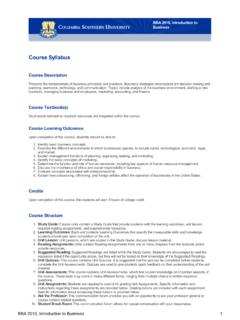
1 MEE 6501, Advanced Air Quality Control Course Syllabus Course Description Explores an in-depth study of Advanced air Quality Control science and management practices. Addresses health effects, environmental impacts, monitoring, modeling, and treatment. Course Textbook Godish, T., Davis, W. T., & Fu, J. S. (2015). Air Quality (5th ed.). Boca Raton, FL: CRC Press. Course Learning Outcomes Upon completion of this course, students should be able to: 1. Describe methods for monitoring air pollution. 2. Critique air pollutant modeling equations and/or software. 3. Assess health effects of air pollution. 4. Examine causes of indoor and outdoor air pollution. 5. Evaluate health risks of air pollution exposure. 6. Estimate the impact of air pollution on the environment.
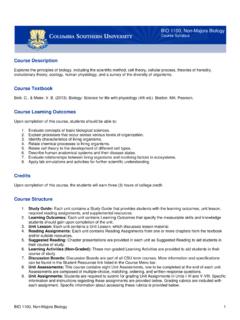
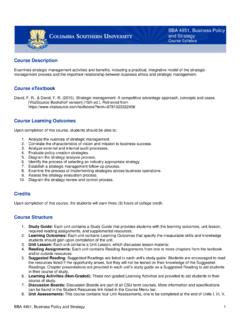
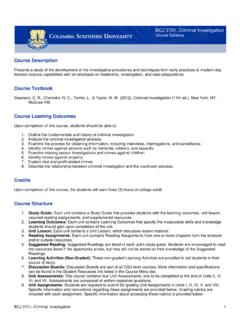
2 7. Evaluate air pollution Control technologies. Credits Upon completion of this course, the students will earn three (3) hours of college credit. Course Structure 1. Study Guide: Each unit contains a Study Guide that provides students with the learning outcomes, unit lesson, required reading assignments, and supplemental resources. 2. Learning Outcomes: Each unit contains Learning Outcomes that specify the measurable skills and knowledge students should gain upon completion of the unit. 3. Unit Lesson: Each unit contains a Unit Lesson, which discusses lesson material. 4. Reading Assignments: Each unit contains Reading Assignments from one or more chapters from the textbook and/or outside resources. 5. Suggested Reading: A Suggested Reading is listed in Unit II.
3 Students are encouraged to read the resource listed if the opportunity arises, but they will not be tested on their knowledge of the Suggested Reading. 6. Unit Assessments: This course contains four Unit Assessments, one to be completed at the end of Units I, III, V, and VII. Assessments are composed of written-response questions. 7. Unit Assignments: Students are required to submit for grading Unit Assignments in Units II-VIII. Specific information and instructions regarding these assignments are provided below. Grading rubrics are included with each assignment. Specific information about accessing these rubrics is provided below. 8. Ask the Professor: This communication forum provides you with an opportunity to ask your professor general or course content related questions.
4 9. Student Break Room: This communication forum allows for casual conversation with your classmates. MEE 6501, Advanced Air Quality Control 1. CSU Online Library The CSU Online Library is available to support your courses and programs. The online library includes databases, journals, e-books, and research guides. These resources are always accessible and can be reached through the library webpage. To access the library, log into the myCSU Student Portal, and click on CSU Online Library. You can also access the CSU Online Library from the My Library button on the course menu for each course in Blackboard. The CSU Online Library offers several reference services. E-mail and telephone ( ) assistance is available Monday Thursday from 8 am to 5 pm and Friday from 8 am to 3 pm.
5 The library's chat reference service, Ask a Librarian, is available 24/7; look for the chat box on the online library page. Librarians can help you develop your research plan or assist you in finding relevant, appropriate, and timely information. Reference requests can include customized keyword search strategies, links to articles, database help, and other services. Unit Assignments Unit II Mini Project Over the course of these remaining seven units, we will be developing a course project. We will do a single section of the course project in every unit, completing one section of the course project in each unit, and then adding the subsequent work in the following unit. This unit work will be in the form of mini projects, and in Unit VIII, you will submit the entire project.
6 Throughout the course, your instructor will provide you with feedback on every unit you submit; therefore, it is important to implement the feedback you receive in the upcoming unit(s). You will be required to integrate an online resource in your final submission. The Business Continuity & Disaster Recovery Reference Center is a good online database for this course project. Our course project will be to develop a document titled A Permit By Rule (PBR) Application for an Interior Surface Coating Facility that will serve as a simulation of our work as a contract environmental engineer to a small vehicle body shop located in the state of Texas. The Scenario: You have been contracted with a vehicle body repair shop named Texas Car Body Repairs, USA to engineer and write a state (Texas) air permit application for a carefully designed interior lining (painting) facility.
7 According to Texas state laws and EPA laws, the facility must have an air permit before construction begins. Once the facility is completed, the construction air permit will then become the operational air permit for the facility. As a result, your client wants the air permit application to automatically align the interior surface coating facility into operational compliance with state and federal air Quality laws. Consequently, it is extremely important for you to write the air permit application to meet the air permit criteria using the state guidance document and considering the equipment and chemicals already planned for the facility operations. Your client has presented you with the following specifications regarding the facility operations plan: Interior Liner 10 gallons 2 gallons of Coating coating/vehicle solvent/vehicle Material Vehicle Lining Apply interior Work five (5).
8 Application liners to two hours/day and (2) four (4). vehicles/day days/week Vehicle Lining Cure interior Work five (5). Curing liners of two hours/day and (2) four (4). vehicles/day days/week MEE 6501, Advanced Air Quality Control 2. Interior Liner Heater fuel Heater Cure source is generates natural gas- million (MM). fired drying Btu/hr at oven maximum 2,500 hrs/year Vehicle Lining Cross-draft air Vehicle interior Design plenum is the spray area Exhaust Fan 10,000 ft3/min 1 exhaust fan (CFM). Air Makeup 5760 ft3/min 1 air makeup Unit (CFM) unit Filter ft2 each Two (2) filter Openings openings Coating W V VOC content lb/gal coating Coating VM Coating gal volume Water Content Per gal/coating lb/gal Water Density Per gal/water lb/gal Coating VW Water volume Calculation Exempt- Per gal/coating lb/gal solvent Content Exempt- Per gal/exempt lb/gal solvent solvent Density Coating Ves Exempt Calculation solvent volume The client has designed an interior coating spray painting system that allows the interior of a vehicle to be coated (such as for new vehicles, or vehicles being restored after fire damage or other catastrophic interior damage).
9 The operations will involve a stripped-down vehicle body being brought into the facility's shop. The shop is a steel building with a finished concrete floor and a paint booth for each vehicle. The vehicle will be placed in the spray booth. The booth will be opened at one end of the booth for makeup air. The exhaust air will flow through an exhaust chamber at the other end of the vehicle (see Cross-Draft Automotive Spray Booth in Appendix F of the TCEQ Regulatory Guidance Document). For each vehicle, once the liner application operations are completed the forced curing (drying) operations will immediately commence. Instructions 1. Closely read the Required Reading assignment from your textbook, Appendix B and Appendix K of the Texas Commission on Environmental Quality (TCEQ) Regulatory Guidance document (Click here to access the document), and the Unit Lesson within the Study Guide.
10 Consider reading the Suggested Reading. 2. Using APA style (title page, abstract page, body with level 1 headings, and a reference page) for a research paper, begin drafting a proposal document. You will add to this document in every unit with another level 1. heading. 3. Make your Unit II work your first level 1 heading titled General Considerations for Operation, and describe the scenario that is presented above. You may find it convenient to present the tabulated information in your General Considerations section of the permit for future reference throughout the rest of the course. This submission (and every submission through Unit VII) needs to be a minimum of at least a one page in length, double-spaced. NOTE: In the following units (Units III through VIII), the unit lessons will contain information related to the interior surface coating operation by means of practical examples.