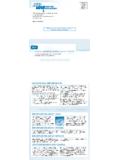
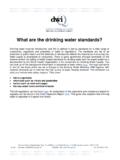
Transcription of Drinking Water Standards poster - SaskH 2 O
1 Chemical-Health Category Chemical Pesticides (commonly used in Saskatchewan) Radiological8 Parameter MAC IMAC (mg/L) (mg/L) Parameter MAC IMAC (mg/L) (mg/L) Screening Concentration Becquerels Parameter Per litre (Bq/L) Arsenic* Barium 1 Benzene Benzo(a)pyrene Boron Bromate* Cadmium Carbon tetrachloride Chlorate* Chlorite* Chromium Cyanide Dichlorobenzene, 1,2 Dichlorobenzene, 1,4 Dichloroethane, 1,2 Dichloroethylene, 1,1 Dichloromethane Dichlorophenol, 2.
2 4 Fluoride1 Haloacetic Acids*6 Lead2 Mercury Microcystin-LR* Monochlorobenzene Nitrate3 as NO3 45 Selenium Tetrachlorophenol, 2,3,4,6 Trichloroethylene Trichlorophenol, 2,4,6 Trihalomethanes* (THM)4 Uranium Vinyl Chloride Atrazine Bromoxynil Carbofuran Chlorpyrifos Dicamba 2,4-D5 Diclofop-methyl Dimethoate Malathion MCPA*7 Pentachlorophenol Picloram Trifluralin 1 Maximum allowable concentration of naturally occurring fluoride in a treated Drinking Water intended or used for human consumptive use.
3 2 Faucets should be thoroughly flushed before sample is collected. 3 Nitrate levels in excess of 45 mg/L (10 mg/L as nitrate-nitrogen) may cause adverse health effects in infants less than six months old. Where nitrate and nitrite are determined separately, levels of nitrite should not exceed mg/L. 4 Based on an annual average of 4 seasonal samples. 5 2,4 Dichorophenoxyacetic Acid 6 Total of monochloroacetic acid, dichloroacetic acid, trichlororacetic acid, monobromoacetic acid and dibromoacetic acid and is based on a locational running average of quarterly samples taken from Water mains within the distribution system.
4 7 2-Methyl-4-Chlorophenoxyacetic Acid Gross alpha* Gross beta* Lead-210* Radium-226* Tritium* 7000 Strontium-90* 5 Iodine-131* 6 Cesium-137* 10 8 Water samples may be initially screened for radioactivity using gross alpha and gross beta activity determinations. Compliance with the Standards may be inferred if the measurements for gross alpha and gross beta activity are less than Bq/L and Bq/L, respectively, as these are lower than the strictest MACs.
5 If these values are exceeded then then Table 3 of the Guidelines for Canadian Drinking Water Quality - Summary Table, Health Canada (August 2012), as amended from time to time, applies. inyl Chloride 5 2,4 Dichlorophenoxyacetic acid from time to time, applies. Physical Chemical Parameter AO Parameter AO (mg/L) Color 15 ACU Alkalinity (as CaCO3) 500 Odor Inoffensive Chloride PH to Copper Taste Inoffensive Ethylbenzene Temperature <15 C Hardness (as CaCO3) Iron Total Dissolved Solids (TDS): For the purposes of Saskatchewan Magnesium Environment's Drinking Water quality objectives, TDS are based on Manganese 1 summation of ions.
6 Sodium Sulphate2 Summation of Ions: Cl + SO4+ Ca + Mg + K + Na + NO3 + CO3 + Sulphite (as H S) HCO3 = TDS calculation Total Dissolved Solids Toluene Xylenes Zinc 250 1 800 200 300 500 1500 5 1 Sodium: It is recommended sodium be included in routine monitoring programmes. Sodium levels may be of interest to authorities who wish to prescribe sodium-restricted diets to their patients. 2 Sulphate: There may be a laxative effect in some individuals when sulphate levels exceed 500 mg/L.
7 Saskatchewan s Drinking Water Quality Standards and Objectives (Summarized) Standards Standards and objectives Standards are legally enforceable requirements for Drinking Water quality and are set out in The Waterworks and Sewage Works Regulations. Parameters marked with an * have been added or changed in comparison with The Water Regulations, 2002. Bacteriological Standards : Effective immediately, Standards include: total coliform levels of zero organisms detectable per 100 millilitre (mL); E.
8 Coli* levels of zero organisms detectable per 100 mL; and background bacteria levels on a total coliform filtration plate of less than 200 colonies per 100 mL or no overgrowth. Turbidity Standards : Turbidity is an important indicator of Water treatment process efficiency from both health and aesthetic perspectives. Compliance with turbidity Standards is immediate for newly constructed and existing waterworks. can be applied to Water for both hygienic use and human consumption. In general, Standards are mandatory for systems that supply Water for human consumptive use.
9 For systems that supply Water for hygienic use, only bacteriological Standards apply. Both systems should also strive to achieve the Water Surface water1,2: Chemically Assisted Filtration - When monthly source Water average is NTU or more Surface water1,2: Chemically Assisted Filtration - When monthly source Water average is less than NTU Surface water1,2: Membrane Filtration Surface water1,2: Slow Sand or Diatomaceous Earth Filtration Groundwater3 Less than NTU, 95% of discrete measurements or 95%4 of the time if continuous monitoring employed Less than NTU, 95% of discrete measurements or 95%4 of the time if continuous monitoring employed Less than NTU, 99%* of discrete measurements or 99*4 of the time if continuous monitoring employed Less than NTU, 95% of discrete measurements or 95%4 of the time if continuous monitoring employed Less than NTU.
10 95% of discrete measurements or 95%4 of the time if continuous monitoring employed Not to exceed NTU for more than 12 consecutive hours if continuous monitoring employed Not to exceed NTU for more than 12 consecutive hours if continuous monitoring employed No stated standard Not to exceed NTU for more than 12 consecutive hours if continuous monitoring employed No stated standard Never to exceed NTU Never to exceed NTU Never to exceed NTU for greater than 15 minutes Never to exceed NTU No stated standard - see permit quality objectives.