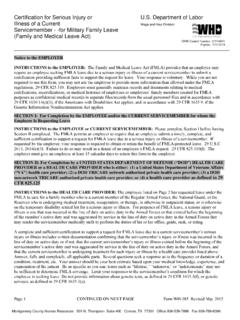
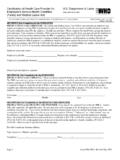
Transcription of CERTIFICATION OF FAMILY MEMBER’S SERIOUS …
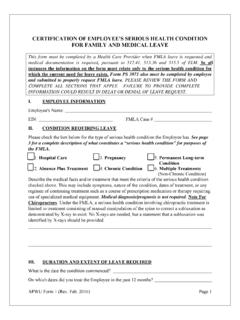
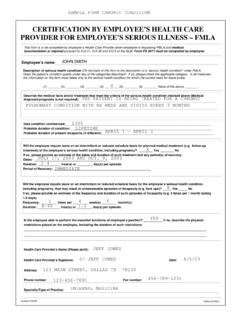
1 CERTIFICATION OF FAMILY MEMBER'S. SERIOUS HEALTH CONDITION. FOR FAMILY AND MEDICAL LEAVE. This form must be completed by a health care provider when FMLA leave is requested and medical documentation is required pursuant to , and of ELM. In all instances the information on the form must relate only to the SERIOUS health condition for which the current need for leave exists. Form PS 3971 also must be completed by employee and submitted to properly request FMLA leave. PLEASE REVIEW THE FORM AND. COMPLETE ALL SECTIONS THAT APPLY. FAILURE TO PROVIDE COMPLETE.
2 INFORMATION COULD RESULT IN DELAY OR DENIAL OF LEAVE REQUEST. I. EMPLOYEE INFORMATION. Employee's Name: EIN: FMLA Case #. Relationship of Employee to patient for whom leave is requested: (Spouse, Parent, Child; child over 18 must be incapable of self-care because of disability). II. CONDITION REQUIRING LEAVE. Please check the box below for the type of SERIOUS health condition the patient has. See page 3. for a complete description of what constitutes a SERIOUS health condition for purposes of the FMLA. __ 1. Hospital Care __ 3. Pregnancy __ 5.
3 Permanent Long-term Condition __ 2. Absence Plus Treatment __ 4. Chronic Condition __ 6. Multiple Treatments (Non-Chronic Condition). Describe the medical facts and/or treatment that meet the criteria of the SERIOUS health condition checked above. This may include symptoms nature of the condition dates of treatment or any regimen of continuing treatment such as a course of prescription medication or therapy requiring use of specialized medical equipment. Medical diagnosis/prognosis is not required. Note For Chiropractors: Under the FMLA, a SERIOUS health condition involving chiropractic treatment is limited to treatment consisting of manual manipulation of the spine to correct a subluxation as demonstrated by X-ray to exist.
4 No X-rays are needed, but a statement that a subluxation was identified by X-rays should be provided. _____. _____. _____. _____. APWU Form 2 (Rev. Feb. 2016) Page 1. III. DURATION AND EXTENT OF LEAVE REQUIRED. What is the date the condition commenced? On which dates did you treat the patient in the past 12 months? How long do you project the condition to continue? How long will the patient be incapacitated (if different)? Does the patient require assistance to meet basic medical, hygiene, nutritional, safety or transportation needs because of the condition or during periods of incapacity?
5 ___Yes ___ No If not, would the Hmployee's presence provide psychological comfort beneficial . to the patient's recovery? ___Yes ___ No How long will the Hmployee need to be on leave to care for the patient? Will the patient need treatment at least twice per year for the condition? ___ Yes ___ No Will the Hmployee require intermittent leave or a reduced work schedule due either to planned medical treatment of the patient (for example, follow-up visits or physical therapy), or because of unforeseeable episodes of the patient's incapacity (for example, flare ups)?
6 ___Yes ___ No If yes, please provide the following additional information: Estimated dates of scheduled treatment: _____. Frequency of treatment/episodes of incapacity: ___ times per ___week ___ month Duration of treatment/episode of incapacity: ____hour(s) or ____ day(s). (for example, 3 times per 1 month lasting 1-2 days per episode). Period of Recovery: _____. IV. HEALTH CARE PROVIDER SIGNATURE. Dated: _____ By: Health Care Provider's Name (Please print): _____. Address: _____. Telephone Number: Fax Number: _____. Specialty/Type of Practice: _____.
7 APWU Form 2 (Rev. Feb. 2016) Page 2. FMLA DESCRIPTION OF SERIOUS HEALTH CONDITION. A " SERIOUS Health Condition" means an illness, injury, impairment, or physical or mental condition that involves one of the following: 1. Hospital Care Inpatient care ( an overnight stay) in a hospital, hospice, or residential medical care facility, including any period of incapacity or subsequent treatment in connection with or consequent to such inpatient care. 2. Absence plus Treatment A period of incapacity of more than three full consecutive days (including any subsequent treatment or period of incapacity relating to the same condition), that also involves.
8 A) Treatment two or more times (within 30 days of the first day of incapacity, unless extenuating circumstances exist) by a health care provider, by a nurse or physician's assistant under direct supervision of a health care provider, or by a provider of health care services ( physical therapist) under orders of, or on referral by, a health care provider, (b) Treatment by a health care provider on at least one occasion which results in a regimen of continuing treatment under the supervision of a health care provider. The requirements for treatment by a health care provider means an in-person visit to a healthcare provider.
9 The first (or only) in-person treatment visit must take place within seven days of the first day of incapacity. 3. Pregnancy Any period of incapacity due to pregnancy, or for prenatal care. 4. Chronic Conditions Requiring Treatments A chronic condition which;. (a) Requires periodic visits (at least twice a year) for treatment by a health care provider, or by a nurse or physician's assistant under direct supervision of a health care provider;. (b) Continues over an extended period of time (including recurring episodes of a single underlying condition); and (c) May cause episodic rather than a continuing period of incapacity ( , asthma, diabetes, epilepsy).
10 5. Permanent/Long-term Conditions Requiring Supervision A period of incapacity which is permanent or long term due to a condition for which treatment may not be effective. The employee or FAMILY member must be under the continuing supervision of, but need not be receiving active treatment by, a health care provider. Examples include Alzheimer's, a severe stroke, or the terminal stages of a disease. 6. Multiple Treatments (Non-Chronic Conditions). Any period of absence to receive multiple treatments (including any period of recovery therefrom) by a health care provider or by a provider of health care services under orders of, or on referral by, a health care provider, either for restorative surgery after an accident or other injury, or for a condition that would likely result in a period of incapacity4 of more than three full consecutive calendar days in the absence of medical intervention or treatment, such as cancer (chemotherapy, radiation, etc.)