Transcription of SW-846 Method 3051A: Microwave Assisted Acid …
1 3051A - 1 Revision 1 February 2007 Method 3051 AMICROWAVE Assisted acid digestion OF SEDIMENTS, SLUDGES, SOILS, AND OILSSW-846 is not intended to be an analytical training manual. Therefore, methodprocedures are written based on the assumption that they will be performed by analysts who areformally trained in at least the basic principles of chemical analysis and in the use of the addition, SW-846 methods , with the exception of required Method use for the analysisof Method -defined parameters, are intended to be guidance methods which contain generalinformation on how to perform an analytical procedure or technique which a laboratory can useas a basic starting point for generating its own detailed Standard Operating Procedure (SOP),either for its own general use or for a specific project application. The performance dataincluded in this Method are for guidance purposes only, and are not intended to be and mustnot be used as absolute QC acceptance criteria for purposes of laboratory SCOPE AND Microwave extraction Method is designed to mimic extraction usingconventional heating with nitric acid (HNO3), or alternatively, nitric acid and hydrochloric acid (HCl), according to EPA Method and Method 3050.
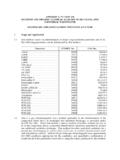
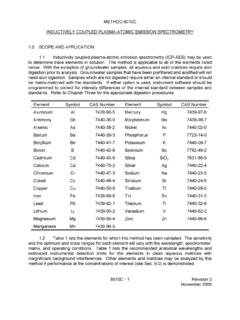
2 Since this Method is not intended toaccomplish total decomposition of the sample, the extracted analyte concentrations may notreflect the total content in the sample. This Method is applicable to the Microwave - Assisted acidextraction/dissolution of sediments, sludges, soils, and oils for the following elements:ElementCAS Registry No. a*Aluminum(Al)7429-90-5*Antimony(Sb)7440 -36-0 Arsenic(As)7440-38-2*Barium(Ba)7440-39-3 *Beryllium(Be)7440-41-7 Boron(B)7440-42-8 Cadmium(Cd)7440-43-9 Calcium(Ca)7440-70-2*Chromium(Cr)7440-47 -3 Cobalt(Co)7440-48-4 Copper(Cu)7440-50-8*Iron(Fe)7439-89-6 ElementCAS Registry No. a3051A - 2 Revision 1 February 2007 Lead(Pb)7439-92-1*Magnesium(Mg)7439-95-4 Manganese(Mn)7439-96-5 Mercury(Hg)7439-97-6 Molybdenum(Mo)7439-98-7 Nickel(Ni)7440-02-0 Potassium(K)7440-09-7 Selenium(Se)7782-49-2*Silver(Ag)7440-22- 4 Sodium(Na)7440-23-5 Strontium(Sr)7440-24-6 Thallium(Tl)7440-28-0*Vanadium(V)7440-62 -2 Zinc(Zn)7440-66-6a Chemical Abstract Service Registry Number *Indicates elements which typically require the addition of HCl to achieveequivalent results with Method 3050, as noted in Ref.
3 3. Note: For matrices such as certain types of oils, this Method may or may notprovide total sample dissolution. For other matrices, such as soils and sediments,it should be considered an extraction Method . Other elements and matrices maybe analyzed by this Method if performance is demonstrated for the analyte ofinterest, in the matrices of interest, at the concentration levels of interest (seeSec. ). Method is provided as an alternative to EPA Method and Method 3050. This Method provides options for improving the performance for certain analytes, such asantimony, iron, aluminum, and silver by the addition of hydrochloric acid , when necessary. It isintended to provide a rapid multi-element acid extraction or dissolution prior to analysis so thatdecisions can be made about materials and site cleanup levels, the need for TCLP testing of awaste (see Method 1311), and whether a BDAT process is providing acceptable performance.
4 Digests produced by the Method are suitable for analysis by flame atomic absorptionspectrophotometry (FLAA), graphite furnace atomic absorption spectrophotometry (GFAA),inductively coupled plasma atomic emission spectrometry (ICP-AES) and inductively coupledplasma mass spectrometry (ICP-MS). However, the addition of HCl may limit the quantitationmethods, or increase the difficulties of quantitation with some to the rapid advances in Microwave technology, consult your manufacturer'srecommended instructions for guidance on their Microwave digestion - 3 Revision 1 February Prior to employing this Method , analysts are advised to consult the determinativemethod that may be employed in the overall analysis for additional information on quality controlprocedures, development of QC acceptance criteria, calculations, and general guidance. Analysts also should consult the disclaimer statement at the front of the manual and theinformation in Chapter Two for guidance on the intended flexibility in the choice of methods ,apparatus, materials, reagents, and supplies, and on the responsibilities of the analyst fordemonstrating that the techniques employed are appropriate for the analytes of interest, in thematrix of interest, and at the levels of concern.
5 In addition, analysts and data users are advised that, except where explicitly specified in aregulation, the use of SW-846 methods is not mandatory in response to Federal testingrequirements. The information contained in this Method is provided by EPA as guidance to beused by the analyst and the regulated community in making judgments necessary to generateresults that meet the data quality objectives for the intended of this Method is restricted to use by, or under supervision of, properlypersonnel experienced and trained in the use of Microwave digestion systems. Each analystmust demonstrate the ability to generate acceptable results with this Method . SUMMARY OF METHODA representative sample is extracted and/or dissolved in concentrated nitric acid , oralternatively, concentrated nitric acid and concentrated hydrochloric acid using microwaveheating with a suitable laboratory Microwave unit.
6 The sample and acid (s) are placed in afluorocarbon polymer (PFA or TFM) or quartz Microwave vessel or vessel liner. The vessel issealed and heated in the Microwave unit for a specified period of time. After cooling, the vesselcontents are filtered, centrifuged, or allowed to settle and then diluted to volume and analyzedby the appropriate determinative DEFINITIONSR efer to Chapter One, Chapter Three and the manufacturer's instructions for definitionsthat may be relevant to this , reagents, glassware, and other sample processing hardware may yieldartifacts and/or interferences to sample analysis. All of these materials must be demonstratedto be free from interferences under the conditions of the analysis by analyzing Method blanks. Specific selection of reagents and purification of solvents by distillation in all-glass systems maybe necessary.
7 Refer to each Method to be used for specific guidance on quality controlprocedures and to Chapter Three for general guidance on the cleaning of glassware. Also referto the determinative methods to be used for a discussion of reactive samples or volatile materials may create high pressures due to theevolution of gaseous digestion products. This may cause venting of the vessels with potentialloss of sample and/or analytes. The complete decomposition of either carbonates, or carbonbased samples, may produce enough pressure to vent the vessel if the sample size is greaterthan g (depending on the pressure capability of the vessel). Variations of the Method toaccommodate very reactive materials are specifically addressed in Sec. - 4 Revision 1 February types of samples will be dissolved by this Method . A few refractory samplematrix compounds, such as quartz, silicates, titanium dioxide, alumina, and other oxides maynot be dissolved and in some cases may sequester target analyte elements.
8 These boundelements are considered non-mobile in the environment and are excluded from most aqueoustransport mechanisms of that are highly reactive or contaminated may require dilution beforeanalysis. If samples are diluted, then any dilutions must be accounted for in all subsequent calculations. Highly reactive samples may also require pre- digestion in a hood to minimize thedanger of thermal runaway and excessively vigorous reactions. Method does not address all safety issues associated with its use. Thelaboratory is responsible for maintaining a safe work environment and a current awareness fileof OSHA regulations regarding the safe handling of the chemicals listed in this Method . Areference file of material safety data sheets (MSDSs) should be available to all personnelinvolved in these Microwave unit cavity must be corrosion resistant and well ventilated.
9 Allelectronics must be protected against corrosion for safe : There are many safety and operational recommendations specific to the model andmanufacturer of the Microwave equipment used in individual laboratories. A listingof these specific suggestions is beyond the scope of this Method . The analyst isadvised to consult the equipment manual, the equipment manufacturer, and otherappropriate literature for proper and safe operation of the Microwave equipmentand vessels. For further details and a review of safety methods during microwavesample preparation, see Ref. 3 and the document of Sec. Method requires Microwave transparent and reagent resistant materials suchas fluorocarbon polymers (examples are PFA or TFM) or quartz to contain acids and samples. For higher pressure capabilities the vessel may be contained within layers of differentmicrowave transparent materials for strength, durability, and safety.
10 The internal volume of thevessel should be at least 45 mL, and the vessel must be capable of withstanding pressures of atleast 30 atm (435 psi), and capable of controlled pressure relief. These specifications are toprovide an appropriate, safe, and durable reaction vessel of which there are many adequatedesigns by many : The reagent combination (9 mL nitric acid to 3 mL hydrochloric acid ) results ingreater pressures than those resulting from the use of only nitric acid . Asdemonstrated in Figures 1 and 2, pressures of approximately 12 atm have beenreached during the heating of the acid mixture alone (no sample in the vessel). Pressures reached during the actual decomposition of a sediment sample (SRM2704, a matrix with low organic content) have more than doubled when using the 9mL nitric and 3 mL hydrochloric acid mixture. These higher pressures necessitatethe use of vessels having higher pressure capabilities (30 atm or 435 psi).