Transcription of FREQUENTLY ASKED QUESTIONS ABOUT ON-THE …
1 FREQUENTLY ASKED QUESTIONS ABOUT ON-THE -SPOT QUEEN REARING Q: What is ON-THE -spot queen rearing? A: ON-THE -spot queen rearing is an approach to rearing your own, quality queens free without grafting, while working in your apiary. I discovered and started using this approach for rearing queens in my own apiary back in 1988 and then published it in a booklet entitled System of Queen Rearing which I have now made available free on this website Q: Why is it advantageous to direct colonies to rear queens for you? A: Aside from being economically advantageous (free queens), ON-THE -spot queen rearing enables the beekeeper to rear queens from select stock that has successfully overwintered in a desired location.
2 Also, ON-THE -spot queen rearing naturally increases genetic diversity Q: Does ON-THE -spot queen rearing require any special tools or skills? A: ON-THE -spot queen rearing DOES NOT require special skills or tools except the ability to identify 36-hour-or-younger larvae. Any novice, amateur, or professional beekeeper can rear their own queens this way Q: How does ON-THE -spot queen rearing work? A: ON-THE -spot queen rearing utilizes simple techniques as explained in my booklet System of Queen Rearing to direct colonies to rear queen cells anywhere on any frame where there is a 36-hour-or-younger larva.
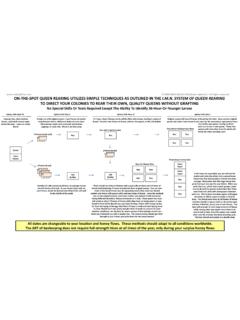
3 Once these queen cells are built and sealed within a Cell Builder, they can be placed in nucs (see chart titled: ON-THE -Spot Queen Rearing Utilizes Simple Techniques To Direct Your Colonies To Rear Their Own, Quality Queens Without Grafting) Q: How is a beekeeper to know that a larva s age is 36-hours-or-younger? A: A worker larva is mass fed with royal jelly until it is 36-hours old. The bees are able to develop this worker larva into either a queen or a worker. For a more in-depth analysis, see page 22 of Contemporary Queen Rearing written by Harry H.
4 Laidlaw, Jr. (Dadant and Sons: 1979), which exhibits 20-hour-old larvae on royal jelly. Larvae 36-hours-old would be half again as large and would be running out of mass-fed royal jelly. I would recommend this book to every beekeeper, especially the section entitled, In Retrospect , near the end of the book Q: How is it possible for a beekeeper to direct a colony to rear its own queen cells? A: A beekeeper can direct any colony to rear its own queen cells by removing the queen and then locating 4 or 5 cells with 36-hour-or-younger larvae on any frame where the beekeeper wishes to have a queen cell to use for future nucs.
5 Upon locating each 36-hour-or-younger larva, the beekeeper breaks the bottom 1/3 of the cell wall beneath the larva to the midrib of the comb and then places that frame back into the queen-less hive Q: What if the bees choose larvae too old to make quality queens? A: Healthy, chemical-free bees will always choose the best larvae for the best queens. The bees will NOT choose larvae too old to make quality queens. Dr. Miller, the world s authority in this matter, states in his book, Fifty Years Among The Bees, I have never known the bees to start a cell after the larvae were too old.
6 Give them larvae of all ages from which to select, they always choose that which is two-days old or younger. (pages 237-238) Q: Why does breaking the cell wall to the midrib beneath the 36-hour-or-younger larva direct a colony to rear a queen cell in that spot? A: For some reason, breaking the cell wall to the midrib beneath a 36-hour-or-younger larva causes the bees to treat that larva as a queen. Dr. Miller observed this biological response when he found that bees would produce queen cells along the bottom edge of a trimmed comb, where it is common for the bottom of the cell wall to be missing Q: When is the ideal time to direct a colony to rear a queen ON-THE -spot?
7 A: The ideal time to direct a colony to rear a queen ON-THE -spot is when you are in the apiary and need a queen cell for making 2-brood-frame nucs or splits (see chart titled: ON-THE -Spot Queen Rearing Utilizes Simple Techniques To Direct Your Colonies To Rear Their Own, Quality Queens Without Grafting) Q: What should a beekeeper use to break the cell wall beneath the 36-hour-or-younger larva? A: The beekeeper can use any kind of tool as long as the bottom third of the cell wall beneath that larva is broken to the midrib (base of the foundation) of the comb Q: Exactly how does the beekeeper break a cell wall appropriately and without damaging the larva?
8 A: The beekeeper can use the pointed-edge of a clean hive tool to carefully cut the bottom third of the chosen cell to the midrib and then press and fold the bottom third downward without ever touching the larva. In other words, you are removing the floor beneath the larva Q: How many frames do you treat this way in the Cell Builder? A: All of them. The goal is to have at least 4 frames of brood with cells on them Q: What do you do if you have cells on only one or two frames of brood instead of the 4 frames I need? A: This does not happen very often but when it does I carefully cut the extra cells off the comb and place on other brood frames to make 4 frames with cells on them.
9 This exposes the royal jelly at the top of the cell and must be protected or the bees will destroy the cell. I then place the cell in a 9/16" diameter x 1 1/2" long plastic tubing and place a cap on the top. This protects the exposed royal jelly, it protects the side of the cell, and it has an open bottom so that the virgin can walk out. It is a very effective cell protector Q: When a frame has many queen cells on it, what happens to the other queen cells on the frame? A: The first virgin that emerges eliminates any other cells Q: Why use the ON-THE -spot method when I can just let my splits raise their own queens?
10 A: The basic law in the art of beekeeping is that big, strong hives perform better than little, weak hives. Making splits and letting them rear their own queens can be successful if you are splitting large hives in half so that each half contains 4-5 frames of brood along with the appropriate amount of nurse bees, etc. But these splits will only raise one or two queen cells which leaves you unable to queen any additional nucs. The ON-THE -spot method is designed to efficiently rear very high-quality queen cells on every frame in a Cell Builder so that those frames can be used for nucs.