Transcription of THE APOSTLES’ CREED - SermonAudio
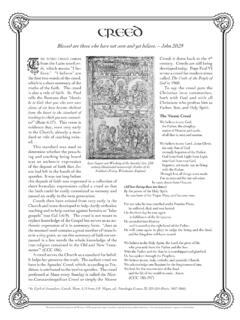
1 THE APOSTLES CREED I. I believe in God, the Father Almighty, Maker of heaven and earth; II. And in Jesus Christ, His only begotten Son, our Lord; III. Who was conceived by the Holy Ghost, born of the virgin Mary; IV. Suffered under Pontius Pilate; was crucified, dead, and buried: He descended into hell; V. The third day He arose again from the dead; VI. He ascended into heaven, and sitteth at the right hand of God the Father Almighty; VII. From thence he shall come to judge the quick and the dead. VIII. I believe in the Holy Ghost; IX. I believe an holy catholic church: the communion of saints; X.
2 The forgiveness of sins; XI. The resurrection of the body; XII. And the life everlasting. AMEN. Comments This is the most ancient ecumenical CREED of the New Testament Church. It is called the Apostles CREED not because it was written by the apostles. Rather, it is so-called because of its antiquity and its reflection of the main points which the apostles would have emphasised judging from the Gospel accounts. Indeed, it is very possible that some of the statements in its earliest form could have been enumerated by the apostles and their successors as they catechised new converts and covenant children.
3 There is evidence that the most basic form of this CREED was already in use in about AD 200 though there was never any official endorsement by any of the ecumenical councils. The present form, which is commonly recited in traditional and Continental Reformed Churches, however, dates to the middle of the 7th Century. In particular, the phrase He descended into hell in the 4th article was not found in any version prior to 650, though a version in 390 refers to Christ descending into hades or the place of the dead. In any case, certain sectors of Christianity have insisted on the basis of this phrase that Christ actually descended to hell or to what is called the Limbus Patrium to preach to the unconverted who died earlier.
4 The Protestant and Reformed Church have generally interpreted the phrase differently. John Calvin, who argues that the phrase must be retained even though it was a late insertion, suggests that by it the church confesses that Christ did not only suffer bodily, but spiritually in that he suffered the pains of hell on behalf of the Church while on the Cross. (cf. ICR ). This is taken up in the Heidelberg Catechism, Q. 44: Why is it added: He descended into Hell? That in my greatest temptations I may be assured that Christ, my Lord, by His inexpressible anguish, pains and terrors, which He suffered in His soul on the cross and before, has redeemed me from the anguish and torment of hell.
5 The Westminster Larger Catechism, on the other hand, while not denying that Christ suffered the pains of hell for us, observes that the event mentioned in the CREED occurred after the Lord s burial, and therefore, it is a reference to Christ being under the power of death till the third day (WLC 50). All other statements in the CREED are straightforward and non-controversial. Nevertheless, it will be useful for us to look at them briefly, one article at a time. Article I I believe in God, the Father Almighty, Maker of heaven and earth; Comments The Apostles CREED is seldom used by itself as a unifying confession in today s church because over the centuries many varieties of Christian churches which can claim subscription to it have arisen.
6 We think of Roman Catholics, Eastern Orthodox, Lutherans, Anglicans, Methodist and Presbyterians amongst others. All these churches can claim subscription to it. But Can two walk together, except they be agreed? (Amos 3:3). Unity based on the Apostles CREED today is no real unity. Nevertheless, the CREED contains the basic propositions that every true believe must believe and confess with proper understanding. Faith is a gift of God, but true faith is not empty. True faith is faith in Christ, but Christ does not stand apart from the context of His existence in the Godhead or of the Church and of the blessings He has procured for her.
7 This CREED covers these things with very broad strokes in twelve articles. In the first article, we are given to confess that we, individually, believe in God, the Father Almighty, Maker of heaven and earth. What do we mean by that? At first sight, this seems rather straightforward, but things get a little complicated when we realise that this is the first CREED in which the doctrine of the Trinity is asserted, and it is asserted without the clarity of, say, the Athanasian CREED of the 4th century. Nevertheless, as it stands it reflects something of the difficulties that theologians have when they try to reduce the theology of the Scriptures into a few propositions.
8 With the more developed understanding that we have today, we generally express first our belief that there is only one living and true God and then affirm that there are three persons in the Godhead, the Father, Son and Holy Ghost who are same in substance, equal in power and glory. But we should note that in the Scriptures, the nomenclature Father does not only refer to the first person of the Trinity, but also to the one living and true Triune God. In fact, it is often hard to decide with certainty whether an occurrence of the word actually refers to one or the other.
9 Indeed, perhaps except for instances where it is very clear, such as Matthew 28:19, a good way of looking at it is that it refers to both. And it is no contradiction to do so for the Father is God, and God is Triune. Thus, for example, when the Lord Jesus teaches us to pray to the Father in the Lord s Prayer, he is actually teaching us to pray to God Triune, but at the same time, we should direct our prayer to the first person of the Godhead. So when we think of the first person of the Godhead, we must never conceive of Him as having a separate existence from the second and third persons of the Godhead.
10 This is how we must understand the first article of the Apostles CREED . We believe that there is only one God, the Father Almighty, Creator of the heaven and earth. It is remarkable that no verse in the Scriptures directly attributes Creation to the First Person of the Trinity. We can find verses attributing Creation to the Son ( Heb 2:1, 3; Eph 3:9; Col 1:16) and to the Spirit ( Gen 1:2; Ps 104:30). But all other references to Creation attribute it to God Triune or to all persons of the Trinity without directly referring to the Father.