Transcription of A family study of the Apostles’ Creed - Intoxicated On Life
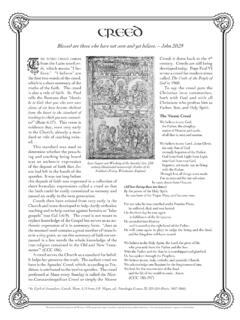
1 A family study of the Apostles CreedBy Luke GilkersonLaying theFoundationUse alone or as acompanion to our Write Through the Biblecurriculum!All contents copyright 2014 by Luke Gilkerson. All rights reserved. No part of this document may be reproduced or transmitted in any form, by any means (electronic, photocopying, recording, or otherwise) without the prior written permission of the you have this file and have not paid for it, please be sure to visit to pay for your own copy. The author of this book put many hours into working on this Bible publication is protected under the US Copyright Act of 1976 and all other applicable international, federal, state, and local laws, and all rights are APOSTLES CREEDI believe in God, the Father Almighty, the Maker of heaven and Earth, and in Jesus Christ, His only Son, our Lord: Who was conceived by the Holy Ghost, born of the virgin Mary, suffered under Pontius Pilate, was crucified, dead, and buried; He descended into hell.
2 The third day He arose again from the dead; He ascended into heaven, and sitteth on the right hand of God the Father Almighty; from thence he shall come to judge the quick and the dead. I believe in the Holy Ghost; the holy catholic church; the communion of saints; the forgiveness of sins; the resurrection of the body; and the life everlasting. OF CONTENTSI ntroduction for ParentsHow to Use This Study1. The Creed2. I Believe3. I Believe in God4. Father, Son, & Spirit5. Maker6. God Almighty7. God the Father8. Jesus9. Christ10. Our Lord11. His Only Son12. Conceived and Born13. Suffered14. Under Pontius Pilate15. Crucified (Part 1)16. Crucified (Part 2)17. Dead & Buried18. Descendit Ad Inferna19. He Arose (Part 1)20. He Arose (Part 2)21. He Ascended 22. God s Right Hand23. Coming to Judge24. Holy Ghost25. Holy Catholic Church26. Communion of Saints27. Forgiveness of Sins28. Resurrection of the Body29. Life Everlasting30. AmenAppendix: He Descended into Hell Comments on a Difficult Phrase INTRODUCTION FOR PARENTSThe Apostles Creed is one of the oldest Christian creeds, confessed by believers for more than 1,600 years and older versions date back to some of the earliest days of the is common today, especially among Evangelicals, to fear formal creeds as somehow replacing the Bible, but this was not a fear shared by the original Reformers.
3 The Creed assumes the authority of the Bible by borrowing the very language of Scripture for its of the Apostles Creed in the Roman Catholic Church is still common today, but it is also common in many Protestant churches. When Reformer Martin Luther was compiling his Small Catechism for Christian families, he included what he considered three essentials: the Ten Commandments, the Lord s Prayer, and the Apostles Creed . The Anglican Book of Common Prayer and the Heidelberg Catechism contain the same three essentials. Both Calvin and Zwingli included it among their doctrinal norms. It is also cited in full at the end of the oldest editions of the 1647 Westminster Shorter said of the Apostles Creed , Christian truth could not possibly be put into a shorter and clearer statement. John Calvin set the Creed to music so it could be used for public worship. John Wesley called the Apostles Creed a beautiful summary of the essential truths of our faith, and when writing the evening prayer service for Methodists, he included the recitation of the Apostles Creed has an honored place in many Christian traditions, but what value does it have for Christian families today?
4 1. The Creed gives our children essentials of the remind us that there are some beliefs worth fighting for. We should strive to rightly interpret and believe all God has revealed, but creeds help us to remember there are some matters of first importance (1 Corinthians 15:3).Most creeds are formed in times of heresy. As heretical sects arose in the church, the church fathers would point to the traditions passed down to them by the Apostles and of course the writings of the Apostles to crush heresies that were threatening the creeds like the Apostles Creed give our children accurate summaries of the essentials. And as heresies arise today, our children will be more equipped to say, This is not what I was taught. This is not the faith handed down to us from Christ. This is why we should teach kids the Apostles Creed : it states in simple, Scriptural language the essential facts of our faith as God has revealed them, from the creation of the world to Christ s redeeming work to eternal life in the world to The Creed teaches our kids that Christianity is confessional.
5 For the last couple hundred years, Western Christianity, by and large, has moved away from the importance of creeds. In the interest of unity, some in the Church want to be minimalists when it comes to doctrine. No Creed but Christ, no book but the Bible, they say. As well intentioned as this is, it overlooks two facts: (1) no Creed but Christ is functionally a type of Creed anyway, and (2) the apostles themselves stressed the importance of Apostles did not just write sacred Scripture; they also summarized essentials of the gospel in creedal statements. The first Creed of the New Testament is Jesus is Lord (Romans 10:9; cf. 1 Corinthians 12:3; 2 Corinthians 4:5; Philippians 2:11). The Christian was one who received Christ Jesus the Lord (Colossians 2:6), confessing that Jesus is God s Son, come in the flesh (1 John 2:23; 4:2-3; 4:15; 2 John 7). These short statements summarize the believer s loyalty and commitment to Jesus Christ, and they state truths about Jesus in his relation to examples of apostolic creeds include 1 Corinthians 15:3-8, Ephesians 4:4-6, 1 Timothy 3:16, and Philippians 2:6-11.
6 The Apostles taught the church to be confessional: to provide believers with formal, verbal summaries of the faith. 3. The Creed teaches our children to value in today s culture devalue the past. But as Christians, we should celebrate is important not to confuse tradition with traditionalism. Jaroslav Pelikan wisely stated, Tradition is the living faith of the dead; traditionalism is the dead faith of the living. As Christians we should take joy in the living faith of those who came before us, those whose lives were radically changed by the gospel, who fought to pass the gospel on to the next from being a cold, lifeless, abstract text, church historian Philip Schaff says the Apostles Creed is a profession of living facts and saving truths. It is a liturgical poem and an act of worship. 4. The Creed teaches our children that Christianity is personal but not families and churches recite the Apostles Creed , they are reciting something deeply personal, starting with the phrase I believe.
7 The Creed was written as a personal statement of faith, and this is something all parents should stress to their kids. Merely reciting the words isn t nearly as important as really believing in our increasingly relativistic age, we fight a culture that believes that personal faith is meant to be kept private. It s fine if you have your personal beliefs, as long as you don t try to pass them on to others. But creeds are written not merely as personal statements, but as public declarations said by whole communities. The very reason why creeds are formulated is to pass the essentials of the faith on to future The Creed connects our children to their Christian church fathers, following in the footsteps of the Apostles, formulated what they called the Rule of Faith (Regula Fidei), meaning a measure or ruler or orthodoxy. In the second and third centuries, this Rule of Faith was also called the tradition, the preaching, and the Rule of Truth.
8 Church father Origen described it as the teaching of the church preserved unaltered and handed down in unbroken succession from the apostles. This Rule was passed on via oral tradition, and while it varied in form and content, its core was similar from church to church. In the late second century, Irenaeus was the first to record a version of the Rule of Faith in written form: ..this faith: in one God, the Father Almighty, who made the heaven and the earth and the seas and all that are in them; and in one Christ Jesus, the Son of God, who was made flesh for our salvation; and in the Holy Spirit, who made known through the prophets the plan of salvation, and the coming, and the birth from a virgin, and the passion, and the resurrection from the dead, and the bodily ascension into heaven of the beloved Christ Jesus , our Lord, and his future appearing from heaven in the glory of the Father to sum up all things and to raise up anew all flesh of the whole human Similar creedal statements are found in various forms and are discussed in the writings of others like Justin Martyr, Tertullian, and disciple of Irenaeus, Hippolytus, recorded what would become known as the Old Roman Creed in AD 215, which was used for baptism candidates in the church at Rome.
9 Notice how similar it is to the present day Apostles Creed :I believe in God the Father almightyand in Christ Jesus His only Son, our LordWho was born from the Holy Spirit and the Virgin MaryWho was under Pontius Pilate, was crucified and buried,on the third day rose again from the dead,ascended into heaven,sits at the right hand of the Father,whence He will come to judge the living and the dead;and in the Holy Spirit,the holy Churchthe remission of sins,the resurrection of the practice to recite the Old Roman Creed before baptism spread to other churches and became a widespread Creed was first called the Apostles Creed (Symbolum Apostolorum) in AD 390 in a letter addressed to Pope Siricius by the Council of Milan. Variations in this Creed were worked out by the seventh we teach our children the Apostles Creed , we should help them to appreciate that they are reciting a confession of faith that has been uttered by countless millions of Christians throughout the Note About the Origin of the Apostles CreedDoes the Rule of Faith go back to the Apostles themselves?
10 We don t know. But the oral tradition that contained these core truths is possibly as old AD 100. The Rule of Faith was a measure for the proper reading of the was believed throughout the Middle Ages that, on the day of Pentecost, the twelve Apostles were inspired by the Holy Spirit to pen the Apostles Creed each apostle contributing one of twelve articles. This belief is foreshadowed in a sermon by Ambrose, the Bishop of Milan, in the late fourth century, who wrote that the Creed was pieced together by twelve workmen. Soon after, Rufinus of Aquileia wrote something similar, stating the Creed was the joint work of all the Apostles on the day of Pentecost. By the sixth century, the complete legend had story, as far as church historians can tell, is unhistorical. It is a legend that gave credence to the use of the Creed in the Note About He Descended into Hell See the appendix for a more detailed description of this phrase. This phrase is one of the more controversial phrases in the whole Creed .