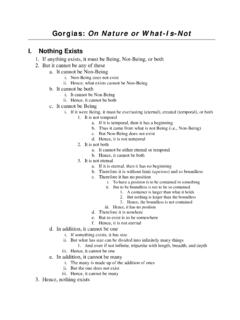
Transcription of Plato's Gorgias as a Premodern Attack on Modernity
1 Plato's Gorgias as a Premodern Attack on ModernityMatthew Raphael JohnsonJohnstown, PAI was reading an excellent work on revolutionary syndicalism. I read all manner of slogans about societies of free men and self-governing guilds. While I've always been sympathetic to syndicalism, it occurred to me: what evidence is there that all people are capable of freedom? Freedom requires the profound use of reason independently of self-interest and other internal drives. Worse, do workers want freedom? Freedom means that all your actions are your fault, regardless of the distinction between intent and consequence.
2 Few see freedom that way. Tito's experiment in Yugoslavia was an excellent one. Proving that the USSR was not in least concerned with labor, self-management brought down the fire of Hell itself upon Belgrade. War was threatened. When Marx threw out the Proudhonists for asking why there were no actual workers at the First International, he was so enraged that people were concerned for his health. Such rage speaks to a deeper 's experiment was a failure. Few workers could be bothered with the details of administration.
3 It entailed hours after work dealing with all manner of boring administrative minutia. Obviously, a class of professional politicians emerged that took over the process. Tito then introduced a rotational law to fight this. Yet, passing a law has no relation to the cause of theissue in the first place. Freedom is of immense difficulty and only few actually have or want it. Freedom is constant labor, thought and battle. It's a struggle for autonomy, not to become a plaything of the cannot be the mere surrender to passions.
4 This is the opposite of freedom since these drives are immediate, instinctual instincts over which the person has no control. Freedom must be rational and totally autonomous. How many are capable of that? Most see freedom as an intolerable burden. Few workers want to rule themselves. They want to put in their eight and go home or to a bar. They don't want to go over details of production targets with suppliers for three hours after work. This might be a strange beginning for a paper like this. So few philosophers are actually capable of critical thought in the universities.
5 A question like that floors them. The individual is assumed to be the basic unit of society and that all human beings desire freedom. Philosophers use undergraduate papers for research and just rearrange professionally-sanctioned slogans in an in-group environment so closed off that it mine as well be, to an outsider, a Bulgarian choral group. They're useless and wildly overpaid human the pretensions of the professional academics or some other institutionalized power was Plato's whole purpose. This is why academics, institutionalized, self-seeking, intellectually inbred and ludicrously conformist, have no tools available to deal with Plato.
6 They, by the very structure of their life, cannot understand him. If they did, they'd realize he's talking about Gorgias is one of the most profound Platonic dialogue. It is a perfect introduction to Platonic thought in general and is highly underrated in this respect. It is probably the most important dialogue when dealing with modern civic debate and the lowering of civic understanding in the western world. People want freedom in the same sense that they want honesty. Only a handful really mean it and even fewer are capable of living it consistently.
7 Everyone must admit that and no one's innocent that humanity cares only about having their lifestyle validated. They want to hear what they want to hear. The question is not about public Like everything in American life, the terms are so debased that they have no meaning. The Gorgias is not about the political speech of citizens in a democracy. That does not even come up. The very fact that it does over and over again in the literature proves how useless academics have become. Persuasion is not a value-neutral term.
8 It's about the powerful manipulating the herd fortheir own interests. Few people would desire a situation where the best paid lawyer would win the day in court. Truth and truth alone matters. That is what the issue is here. This is why the professionals in the university will not and can not deal with Plato, especially in this dialogue. Oratory requires a world in which no truths are accepted or understood other than power. This is Socrates' whole argument. In a world where truth mattered, oratory, as such, would have no place.
9 It is a sign of social decay. It is a sign that society has deviated so far from the divine that those most pleasing to the ear are as good as diligent researchers. There is no clear distinction between them. The truth is that persuasion is an evil unless it is founded on the true and the good. The only alternative is self-interest. Unfortunately, the adversarial system of justiceenshrines it. Self-interest, defined broadly, only accidentally arrives at the question is not merely that of producing conviction and inculcating belief.
10 Its producing conviction among the powerful, with no foundation for any truth claims. It's the Will to Power. This is not a free will. Power is not free by definition. From 449a onward, Socrates demolishes Gorgias ' pomposity by easily connecting knowledge to oratory. There is no specific craft of speaking well (that is, of manipulating others),only expertise within a real craft can do that. There, it is knowledge, not manipulation. If one is ignorant, than faking it would be a necessity (452a). It's modern politics.