Transcription of Application of the Chinese version of the International ...
1 458 Hong Kong Med J Vol 14 No 6 # December 2008 # term lower urinary tract symptoms (LUTS) was first introduced in 1994 by Paul Abrams1 to describe conditions with chronic urinary symptoms including frequency, urgency, hesitance, intermittence, decrease in urinary stream, difficulty in emptying, and nocturia. lower urinary tract symptoms in adult male patients are a common clinical problem in primary and secondary health The underlying cause varies from minimal functional disorder7,8 to organic bladder outflow obstruction. Patients with LUTS are usually referred to specialty clinics for assessment and provision of treatment.
2 For those without organic pathology however, it is preferable that they are managed by their family physicians, who provide a familiar environment and continuity of care. Uroflowmetry study objectively measures urine outflow. A peak flow rate of less than 10 mL per second with a void volume of 200 mL or more is generally accepted as remarkable impairment of urine outflow and predicts satisfactory surgical Urethrocystoscopy is the confirmatory test for organic pathology, which entails Objectives To determine whether the Chinese version of the International prostate symptom score can differentiate surgically treatable conditions from functional disorders among patients with lower urinary tract symptoms.
3 Design Retrospective cross-sectional study. Setting Community hospital, Hong Kong. Patients A cohort of 121 adult males with lower urinary tract symptoms referred to a specialty clinic from July 2006 to February 2007. Main outcome measures Scores were obtained following self-administration of the Chinese version of the International prostate symptom questionnaire. A combination of uroflowmetry and urethrocystoscopy were applied as the gold-standard diagnostic tests for surgically treatable conditions. The effectiveness of the instrument was explored in terms of sensitivity, specificity, and positive and negative predictive values.
4 Results A total of 121 records were reviewed, among which 58 patients with lower urinary tract symptoms had completed both the questionnaire and gone through the relevant diagnostic tests. The receiver operating characteristics curve was constructed; the area under curve was Using the receiver operating characteristics analysis, the optimal cut-off value for the Chinese version of the International prostate symptom score was 24. The respective sensitivity and specificity values were 62% and 84%. The positive predictive value was 68% and negative predictive value was 79%. Conclusion The Chinese version of International prostate symptom score is not a sensitive instrument for diagnosing surgically treatable conditions and it is not a suitable medical test to exclude patients from referrals to secondary health care services.
5 An acceptable specificity with a score of 24 was advantageous for triaging patients to receive early specialist of the Chinese version of the International prostate symptom score for the management of lower urinary tract symptoms in a primary health care settingO R I G I N A LARTICLEKey wordsPredictive value of tests; Prostatic hyperplasia; Questionnaire; Sensitivity and specificity; urinary bladder neck obstructionHong Kong Med J 2008;14:458-64 Department of Surgery, Tseung Kwan O Hospital, Tseung Kwan O, Hong KongPS Szeto, FRCS (Urology) (Edin), FHKAM (Surgery)Correspondence to: Dr PS SzetoE-mail: S Szeto # International prostate symptom score ( Chinese )
6 # Hong Kong Med J Vol 14 No 6 # December 2008 # 459 2006 7 2007 2 121 121 58 ROC ROC 24 62% 84% 68% 79% 24 detailed inspection of the lower urinary tract . Surgically treatable pathology including benign prostatic hyperplasia (BPH), urethral stricture, lower urinary tract tumour and calculi can be confirmed under direct vision.
7 Nevertheless, both uroflowmetry study and urethrocystoscopy are not available in primary health care. Because of the unavailability of diagnostic tools, LUTS patients are referred to specialists for assessment and this creates a burden on the secondary health care service asked to manage patients with mild functional disorder. The International prostate symptom score (IPSS) developed by the American Urological Association13 was adopted in different communities to assess severity of urinary ,15 It was validated16-19 and translated into different The results generated both by self-administration and with assistance by health care workers are consistent with each other (not significantly different).
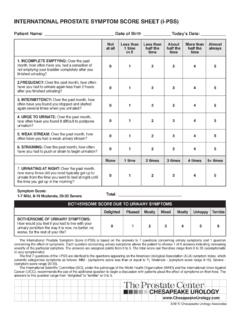
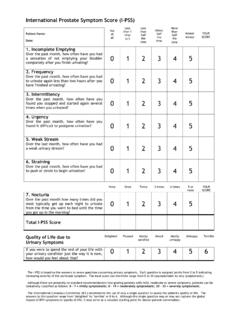
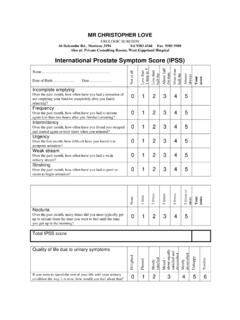
8 21,22 The IPSS is a common tool for pre-consultation assessment and follow-up after therapy. There are seven questions on seven urinary symptoms. According to their frequency, the patient needs to rate the frequency of each symptom from 0 to 5, making up a total possible score ranging from 0 to 35. The Chinese version translated by Hong Kong Urological Association has been applied since 1995. The IPSS is not used as a diagnostic tool for any specific disease because different pathologies of the lower urinary tract present with similar urinary symptoms. Since surgically treatable conditions produce more severe symptoms, it is possible that the IPSS can differentiate such conditions from functional disorders.
9 The Chinese version of IPSS (C-IPSS) is commonly used in Hong Kong, but data on its effectiveness as a medical test are limited. The primary objective of this study was to explore whether the self-administered C-IPSS is able to differentiate surgically treatable conditions from functional disorders among Chinese patients with LUTS. The secondary objective was to estimate the prevalence of surgically treatable disorder among LUTS referrals and explore the possibility of using C-IPSS assessments to empower primary health care professionals in the management of LUTS and thus reduce referrals to secondary health care designThis was a retrospective cross-sectional study, involving review of available clinical data on adult male LUTS patients referred to a secondary health care service.
10 Self-administered C-IPSS was applied as a medical test. Uroflowmetry and urethrocystoscopy were arranged as gold-standard diagnostic tests for deciding on conditions warranting surgery. The target population consisted of Chinese adult males who were 40 years or older and attending a secondary health care service for management of LUTS, after assessment by primary health care physicians. Exclusion criteria were: pre-diagnosed disease of the lower urinary tract and a history of lower urinary tract surgery. Patients referred for management of haematuria, elevated prostate -specific antigen (PSA) level, and finding of a prostate nodule were excluded, as were those referred because of a high C-IPSS score .