Transcription of Correlation between prostate volume and Lower Urinary ...
1 international Journal of Scientific and Research Publications, volume 6, Issue 4, April 2016 45 ISSN 2250-3153 Correlation between prostate volume and Lower Urinary Tract Symptoms (LUTS) as measured by international prostate symptom score (IPSS) AUB Pethiyagoda*, K Pethiyagoda** *Department of Surgery, Faculty of Medicine, University of Peradeniya, Sri Lanka **Department of Community Medicine, Faculty of Medicine, University of Peradeniya, Sri Lanka Abstract- Lower Urinary tract symptom (LUTS) is a common presentation among elderly patients particularly in men in urology clinical practice. Evaluation and treatment of LUTS is a major consideration and IPSS score and ultrasound KUBP are routine investigations for assessment of such patients. There is a controversy on relationship between IPSS score and the prostate volume in the literature. The objective is to evaluate the relationship between IPSS and prostate volume in patients with LUTS.
2 There is a significant relationship between IPSS and prostate volume measured through abdominal ultrasound. The Total IPSS increases with the prostate volume (r= , p< ). But there was no statistically significant difference between mild, moderate and severe IPSS in relation to prostate volume . Index Terms- Lower Urinary tract symptom (LUTS), international Prostrate symptom score (IPSS), ultrasound KUBP, prostate volume I. INTRODUCTION ower Urinary tract symptom (LUTS) is a common presentation among elderly patients especially encountered in men in urology practice. Numerous population based studies have demonstrated that bothersome LUTS affect 18 26% of men aged 40 79 years.(1) LUTS has many possible causes including supravesical causes such as spinal cord diseases and other neurological dysfunctions.
3 Vesical and intravesical causes such as smooth muscle dysfunction of the bladder and tumors and infravesical causes like urethral strictures. Although BPH is one common cause of these symptoms, some men with LUTS have no prostate enlargement. (2) Clinical diagnosis of benign prostatic hyperplasia is made by the assessment of Urinary symptoms, prostate size or prostate volume and Urinary flow rate evaluation. Treatments of LUTS aim to relieve bothersome symptoms, reduce complications and to increase the quality of life. Therefore the relief of symptoms and improvement in quality of life are the most frequent indications for intervention. (3) LUTS is clinically assessed by international prostate symptom score (IPSS). The ultrasound KUB is a routine investigation for assessment of patients with LUTS.
4 Ultrasound KUB refers to a diagnostic medical imaging technique of the abdomen and stands for kidneys, ureters and bladder. Although in fact the ureters will be visible only if they are abnormally distended. Although the commonest cause for LUTS among men is benign prostatic enlargement. Several studies have shown that not all the male LUTS are associated with prostate pathology as the bladder also plays a part in the development of LUTS. (4) Prostatic enlargement and bladder outlet obstruction are involved in altering the histological process. (5) The mechanisms linking to these histological processes of development of BPH in the prostate and Lower Urinary tract symptoms remain uncertain. Therefore the treatment is based on the presumed etiology of the symptoms (due to Lower Urinary tract obstruction, overactive bladder or a combination of both).
5 Ultrasound of the prostate is the investigation that enables us to visualize the prostate gland directly and is one of the commonest diagnostic modalities performed in patients presenting with LUTS. It can be done using the trans-abdominal approach as well as trans rectal approach. If the measurements of prostate volume correlate poorly with the severity of Lower Urinary tract symptoms, one should assess the severity of symptoms rather than the increase in prostate volume during the management. IPSS is an interview based (or self administered) clinical parameter.(6) prostate volume is measured using ultrasound KUB which is easy, safe, noninvasive, cost-effective, repeatable, less time-consuming and demands little co-operation from the patient. There is a controversy on the relationship between IPSS score and the prostate volume in the literature.
6 The objective of the study was to evaluate the relationship between IPSS and prostate volume in the patients with LUTS. II. MATERIALS AND METHODS The study was conducted as a descriptive cross sectional study by the Department of Surgery, Faculty of Medicine, University of Peradeniya from June 2014 to May 2015. The study population consisted of patients who were referred to the urology clinic of the teaching h hospital Peradeniya. A total of 185 patients were included in this analysis and all the patients were well informed about the study. Informed written consent was taken from patients who were willing to participate in this study. While these patients were clinically evaluated, the standardized questionnaires for IPSS (7) of the patient were also obtained by trained doctors. The prostate volume of each patient was then estimated by ultrasound KUB.
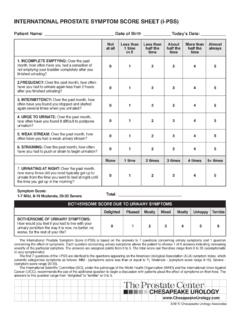
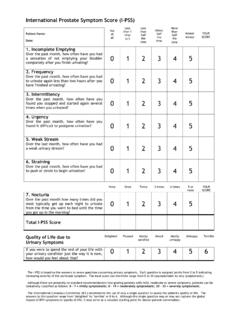
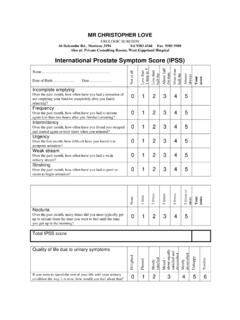
7 L international Journal of Scientific and Research Publications, volume 6, Issue 4, April 2016 46 ISSN 2250-3153 The IPSS is a numerical symptom scoring system that grades the severity of seven symptoms based on how frequently each symptom afflicts the sufferer. The scale for each symptom ranges from zero ( symptom never present) to five ( symptom always present). The seven symptoms are incomplete emptying, frequency, intermittency, urgency, weak stream, hesitancy and nocturia. Patient s demographic details, IPSS and prostate volume data were entered and evaluated using the statistical package for social sciences (SPSS) with one way ANOVAs and Spearman s rank Correlation tests. One way ANOVA test was used to detect any statistically significant difference between the IPSS severity groups and Spearman s rank Correlation coefficient was used to detect any Correlation between prostate volume and Total IPSS score .
8 III. RESULTS There were 185 patients in the study population with a mean age of (SD= ) years. The mean total IPSS was (SD= ) and the mean prostate volume was (SD= ) out of them had mild, had moderate and had severe LUTS according to IPSS total score respectively. (Figure 1) We found that the mean prostate volume measured by this method was which was comparable to other study done by Vesely et al( 8) ( cm3) and Dicuio et al (9) (41 cm3). The mean prostate volumes were cm3 in mild cm3 in moderate, and cm3 in severe. (Graph 1). There was an increment in mean prostrate sizes with the severity of the IPSS (Table 01), however there was no statistically significant difference among the mean prostate volumes in each IPSS severity groups as determined by one-way ANOVA (P =.)
9 071). A Spearman's rank-order Correlation was applied to determine the relationship between prostate volume and total IPSS score . There was a strong positive Correlation between two parameters, which was statistically significant.( Correlation Coefficient= , < ) Table (01) - Variables and values of each IPSS severity groups Graph (01) - Mean prostrate volumes in each IPSS severity groups. IV. DISCUSSION BPH is a common histological condition among older men, which is intimately related to aging. Several different instruments have been developed to quantitate the severity of BPH symptoms in which IPSS is the one that is widely used.(10) In this study 185 men with LUTS were assessed and among them the vast majority of LUTS patients were elderly males and most of them presented with moderate to severe LUTS.
10 (According to IPSS, score <7 include into mild LUTS, score of 7-20 into moderate and >20 score include into severe LUTS). This study had shown that there is a significant relationship between international prostate symptom score and prostate volume measured through trans-abdominal ultrasound KUBP. This result was similar to the study conducted in Japan T. Tsukamoto et al. (11) However there is a controversy on the relationship between the ultrasonic prostate volume and IPSS. One study has shown that there is no significant relationship between international IPSS Severity Variable Value Mild Mean cm3 Minimum 10 cm3 Maximum 55 cm3 Moderate Mean cm3 Minimum 10 cm3 Maximum 116 cm3 Severe Mean cm3 Minimum 10 cm3 Maximum 140 cm3 international Journal of Scientific and Research Publications, volume 6, Issue 4, April 2016 47 ISSN 2250-3153 prostate symptom score and prostate volume in Africans.