Transcription of The Origins of the 3 Drama Triangle Roles of Victim ...
1 1 2015 David Emerald and Donna Zajonc The Power of TED* - All rights reserved The Origins of the 3 Drama Triangle Roles of Victim , Persecutor and Rescuer Let s start at the beginning and ask: How does our Drama begin in the first place? The simple, yet complex, explanation is that all of us as human beings learn and develop strategies to get what we want as children. As infants and toddlers we are little beings looking up at giant and powerful adults. We all used our innate survival instincts to secure food, sleep, warmth, love and safety to the best of our ability. No one can escape the small-child experience of figuring out how to survive and deal with what the child sees as scary experiences. The creative genius of the young, developing mind adapts in amazing ways. Psychologist Karen Horney, (Our Inner Conflicts; Norton and Company; 1992) studied human nature and identified 3 different strategies that children can access to respond to fears and to seek a sense of safety and security.
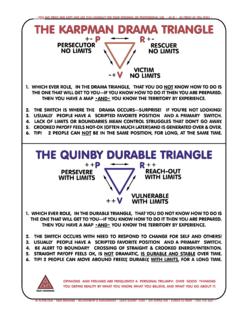
2 They are: (1) Moving toward people to please, accommodate and be helpful. From a child s perspective, if I please others, they will love and care for me. (2) Moving away from others to avoid, withdraw, observe and wait. This is based upon the child s belief that if they isolate and stay above the fray they will be safe. (3) Moving against others by being aggressive. Here the child develops the idea that, if they use control and domination, they will manage their environment to get what they want. In the late 1960 s, Dr. Stephen karpman developed the karpman Drama Triangle , with its three Roles of Victim , Rescuer, and Persecutor. In the TED* work, we call these three Roles the Dreaded Drama Triangle (DDT) because these Roles can become very toxic, like a poison. Our observation is that all three of Horney s strategies eventually lead to Victim thinking that says life happens to me and I must react to life s challenges in order to gain safety and security (and success).
3 As we grow older, our go to strategy can become a more exaggerated way of relating to our self and others. We then go on autopilot, bouncing between all three Roles but relying primarily on our go too or default role. This is how the Drama begins! 2 2015 David Emerald and Donna Zajonc The Power of TED* - All rights reserved These Drama Roles are made-up strategies that the ego-consciousness creates to manage its anxiety about what it doesn t like or want. Many aspects of the Roles are useful and help human beings cope and survive. If these Drama Roles are the only strategy to get through life, however, the Roles become outdated and limiting over time. They are not necessarily bad --- they simply limit our effectiveness and interrupt more creative ways to work with life s challenges. By recognizing these patterns when they arise, we can observe them in action and choose a more empowering way to think, relate and take action.
4 The discovery of recurring DDT Roles has meaning only if there is a possibility of liberating ourselves from the repeating Drama . We can do this more easily if we recognize the patterns of thinking, feeling and our resulting behavior. Let s look at the three strategies that Horney identified and how they manifest into the DDT Roles . The Victim Role: Description and Qualities: The Victim role is at the heart of the DDT. Victims feel powerless and at the mercy of life s events and may avoid taking responsibility for their actions, finding it easier to blame others or their circumstance. The desire to be happy and live a fulfilled life is central to human nature. When challenges arise, the ego wants to minimize or manage the pain caused by not having life go as it wishes. For the person with a Victim mentality wanting their situation to be different than it is causes perpetual suffering.
5 This suffering is the heart of the Victim mentality and belief that they will never have what they want. Consequently Victims have difficulty answering What do I want? and would rather sit on the sideline of life, criticizing and complaining. Focus and Thoughts: The Victim mentality may manifest itself in a range of different ways of thinking and talking. Internal talk may sound like: Why me? Life is against me or I am not lucky like other people or It s not my fault. I didn t do it. It is common to hear a Victim gossip or be suspicious of others. They focus on what isn t working and anticipate even expect things to go wrong. In general they use avoidance and not taking responsibility for their choices as a way to manage their fear and anxiety in life. Victims represent the flight in the flight-fight or please mechanism.
6 Inner State and Feelings: It is common to feel anger and resistance from Victims. They are unhappy with life s circumstances and, because they feel powerless, they can be full of self-pity and develop a poor me attitude. These feelings can create a strange sense of entitlement to what they don t have. They can seek sympathy by telling exaggerated stories about their pain of bad deeds they committed toward others. Their criticism of others can turn inward and they victimize themselves by becoming their own Persecutor. 3 2015 David Emerald and Donna Zajonc The Power of TED* - All rights reserved Behavior and Actions: People with a Victim mentality may develop convincing and sophisticated arguments in support of their ideas that they use to convince themselves and others of their Victim status.
7 The Victim can create a passive or aloof and defensive energy. They may make various excuses for their passivity, such as their financial situation, weight or education. They are susceptible to numbing their feelings and therefore may look for short term pleasures that could lead to addictions. The Victim mentality is not about learning or growing which makes working with change or new situation very difficult. Key Challenge (Unmet Need) for Victims: Victims must learn to take full responsibility for their response to life s events. If they do not know their values, or what they care about or really want, they are at risk of slipping back into blame or feelings of powerlessness. Learning to go deeper and discover what is driving their wants and desires is essential to remain strong and true to their values and dreams and avoid slipping into victimhood.
8 Emotional healing of trauma or other psychological wounds may be essential if the Victim mentality over-shadows the other areas of goodness in their life. The Victim s unmet need is to be loved, seen and heard for who they are. Above all, they must learn to love themselves as whole, complete, deserving and divine human beings. Recommendations: A Victim wants to feel that they matter, thus acknowledging them without reinforcing their victimhood is important. They want to be seen, heard and loved. Taking the time for reflection, values clarification and what they really love will cultivate the Victim s ability to simplify their desires and feel safe enough to choose what they want. Learn to ask: And what if it were possible? Support them in confronting their whatever mentality and learning to trust they will find their own answers if they persist.
9 Since life constantly changes, help them to ask: What do I want in this stage of my life? or How do I feel safe while exploring my dreams? or Where must I take responsibility in order to create my dreams? What is mine and only mine to do? It may be useful, at times, to mirror back to them when they complain and see the situation as negative. It is also good to remind them of their progress because they tend to only see what s wrong. Useful Aspects: A person with a Victim mentality is naturally skeptical and risk adverse. This trait may serve them and co-workers well because they are slow to change, look for what could go wrong and not jump at the first suggestion. This slow-to-change approach and looking for what could go wrong can balance others who are overly optimistic and do not see the dangers that may lie ahead.
10 4 2015 David Emerald and Donna Zajonc The Power of TED* - All rights reserved The Persecutor Role: Description and Qualities: The Persecutor is the problem to the Victim and someone (or something) to be dealt with by the Rescuer. Persecutors fear their own victimization and have, therefore, adopted various methods to control, protect and defend themselves in order to avoid feeling powerless. They must win and convince others that they are right. They have little compassion for another perspective or way of doing things. Often, their universe has been a chaotic or insecure place at some time in their early life, so they developed controlling life strategies to survive. Their unmet need is to feel secure and in control. Focus and Thoughts: A Persecutor s identify and sense of self is on the line and they are compelled to fight for it.