Transcription of IN THE COURT OF COMMON PLEAS OF PHILADELPHIA …
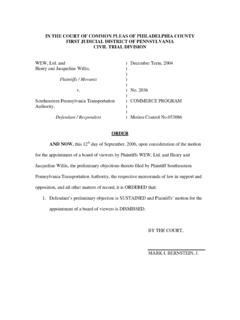
1 IN THE COURT OF COMMON PLEAS OF PHILADELPHIA COUNTYFIRST JUDICIAL DISTRICT OF PENNSYLVANIACIVIL TRIAL DIVISIONJHE, INCORPORATED,: NOVEMBER TERM, 2001 Plaintiff: No. 1790v.:Commerce ProgramSOUTHEASTERN pennsylvania transportation authority , :Defendant: Control Nos. 010312 and 020586O R D E RAND NOW, this 17th day of May 2002, upon consideration of the Preliminary Objections ofdefendant, southeastern pennsylvania transportation authority ( SEPTA ), to the Complaint of plaintiff,JHE, Incorporated, the plaintiff s response in opposition, and the plaintiff s Preliminary Objections to thedefendant s Preliminary Objections and the defendant s response in opposition, the respective memoranda,all matters of record and in accord with the Opinion being filed contemporaneously with this Order, it ishereby ORDERED and DECREED as s Preliminary Objections to Preliminary Objections are s Preliminary Objections to Count II - pennsylvania Public Works BondPayment Act, Count V - Breach of Implied Duty of Good Faith and Fair Dealing, CountVI - Negligent Misrepresentation and Count VII - Fraudulent Misrepresentation areSustained, and Counts II, V, VI and VII are s Preliminary Objections to the plaintiff s demand for punitive damages isSustained.
2 And the demands for punitive damages are s Preliminary Objections asserting insufficient specificity are Sustained, in part,and Paragraphs 17, 43, 45, 46 and 47 of the Complaint are s Preliminary Objections asserting the inclusion of scandalous and impertinentmaterial are Sustained, and Paragraphs 28, 34 and 52 of the Complaint are remaining Preliminary Objections are shall file an answer to the Complaint within twenty-two (22) days of the dateof this THE COURT , ALBERT W. SHEPPARD, JR., J. IN THE COURT OF COMMON PLEAS OF PHILADELPHIA COUNTYFIRST JUDICIAL DISTRICT OF PENNSYLVANIACIVIL TRIAL DIVISIONJHE, INCORPORATED,: NOVEMBER TERM, 2001 Plaintiff: No. 1790v.:Commerce ProgramSOUTHEASTERN pennsylvania transportation authority , :Defendant: Control Nos. 010312 and P I N I O NAlbert W. Sheppard, Jr.
3 , J.. May 17, 2002 Defendant, southeastern pennsylvania transportation authority ( SEPTA ), has filed PreliminaryObjections to the Complaint ( Complaint ) of plaintiff, JHE, Incorporated ( JHE ). In response JHE hasfiled Preliminary Objections to the Preliminary Objections. For the reasons set forth, JHE s Preliminary Objections are overruled, and SEPTA s PreliminaryObjections are sustained, in part, and overruled, in part. 62 Pa. September 1997, SEPTA awarded a general construction contract for renovations to itsOverbrook Station ( Project ) to Craft Century Construction, Inc. ( CCC ). SEPTA terminated itscontract with CCC in April 1998 after design, production and management difficulties arose. Three monthslater, CCC s bonding company requested quotations to complete the Project, and JHE was awarded theProject contract in December the four parallel tracks that traverse SEPTA s Overbrook Station ( Station ), the outer two areowned by SEPTA, and the inner two are owned by that National Railroad Passenger Corp.
4 ( Amtrak ).As part of the construction contract between JHE and SEPTA ( Contract ), JHE agreed that any workto be performed within 15 feet of the Amtrak-owned tracks ( Amtrak Tracks ) required the presence ofan Amtrak safety flagperson. However, the Complaint alleges that SEPTA later unilaterally expanded thisexclusion zone from 15 feet to 25 feet. This expansion, along with SEPTA-mandated complete trackoutages in lieu of flagperson protection, allegedly caused JHE to incur significant cost increases and resultedin numerous time delays. Allegedly, SEPTA also pushed for early opening of a pedestrian tunnel requiringextra work outside the scope of the contract, and failed to provide proper plans and specifications. Finally,after SEPTA s demands allegedly made work on the Project impracticable, SEPTA terminated theContract on October 5, this context, JHE brought suit for breach of contract, violations of the pennsylvania PublicWorks Bond Payment Act ( PWBPA ), breach of contract/cardinal change, estoppel, breach of implied13duty of good faith and fair dealing, negligent misrepresentation and fraudulent misrepresentation.
5 SEPTA filed comprehensive Preliminary Objections ( SEPTA s Objections ), which include a novel questionregarding the implied covenant of good faith and fair dealing and the defense of sovereign immunity. JHE countered with its own set of Preliminary Objections ( JHE s Objections ) asserting that theaffirmative defense of sovereign immunity may not be raised by way of preliminary COURT holds that JHE may not raise an alleged breach of an implied covenant of good faith andfair dealing as a separate count and that this claim (Count V) must be dismissed. Further, three additionalcounts - - Count II ( pennsylvania Public Works Bond Payment Act); Count VI (NegligentMisrepresentation), Count VII (Fraudulent Misrepresentation) -- are dismissed. Also, certain portions ofthe Complaint are either insufficiently specific or scandalous and impertinent and are COURT May Consider SEPTA s Objections Asserting Sovereign ImmunityPennsylvania Rule of Civil Procedure 1030(a) generally requires that affirmative defenses, includingthe affirmative defense of sovereign immunity, be pled as a new matter and not raised in preliminaryobjections.
6 Heifetz v. PHILADELPHIA State Hosp., 482 Pa. 386, 390 , 393 1160, 1162 (1978);CSX Transp., Inc. v. Franty Constr., 157 Pa. Commw. 620, 623 , 630 932, 934 (1993).This supports JHE s assertion that SEPTA s attempt to raise sovereign immunity in its Objections counters that in Caplen v. Burcik, No. 3144, 2000 WL 33711068 (Pa. Com. Pl. , 2000), this COURT recognized that sovereign immunity may be raised by preliminary objection where itis apparent on the face of the pleadings or where the plaintiff has not objected to this procedure, despite4that immunity is an affirmative defense which normally should be pleaded as new matter in accordance 1030. 2000 WL 33711068, at *9. See also E-Z Parks, Inc. v. Larson, 91 Pa. Commw. 600,608, 498 1364, 1369 (1985), aff d, 509 Pa. 496, 503 931 (1986) (noting that a COURT may address an immunity issue on preliminary objections where the immunity is apparent on the face of thepleadings, or where the plaintiff has not objected to the use of preliminary objections in its answer or anyother pleading ); Potts v.
7 Davis, 149 Pa. Commw. 8, 11, 610 74, 75 (1990) ( [P]reliminaryobjections are a proper vehicle for raising the defense of sovereign immunity where, as here, the defenseis apparent on the face of the pleading under attack ); Poliskiewicz v. East Stroudsburg Univ., 113 13, 15 , 536 472, 473 (1988) ( Preliminary objections are a proper vehicle forraising the defense of sovereign immunity where, as here, the defense is apparent on the face of the pleadingunder attack. ). Cf. Malia v. Monchak, 116 Pa. Commw. 484, 489, 543 184, 187 (1988) ( [I]fthe defense of immunity is apparent on the face of the challenged pleading, the defense of immunity will beconsidered on preliminary objection unless the opposing party challenges this procedure by filingpreliminary objections to the preliminary objections. ). This COURT finds SEPTA s argument persuasive. Thus, the COURT may address and sustain SEPTA sObjections asserting sovereign immunity if this defect is apparent from the face of the Complaint.
8 JHE sObjections are, therefore s Objections Asserting Legal Insufficiency Are Sustained in Part and Overruledin PartA review of the Complaint reveals that Count II - - pennsylvania Public Works Bond Payment Act,Count V - - Breach of Implied Duty of Good Faith and Fair Dealing, Count VI - - Negligent5 Misrepresentation and Count VII - - Fraudulent Misrepresentation are legally insufficient and must bedismissed. Additionally, JHE is not entitled to an award of punitive damages, although it may proceed onits remaining contract-related s Claim for Violations of the PWBPA Is Legally InsufficientUnder 62 Pa. 3932, a government agency shall pay the contractor or design professionalstrictly in accordance with the contract. However, this provision does not apply to [a] transportationauthority organized or operating under 74 Ch. 17 (relating to metropolitan transportationauthorities).
9 62 Pa. 3938(b)(5). Our Commonwealth COURT has held that SEPTA meets thedefinition of an entity operating under this chapter. Warrick v. Pro Cor Ambulance, Inc., 709 422,425 (Pa. Commw. Ct. 1997), aff d, 559 Pa. 44, 739 127 (1999). Accordingly, the PWBPA doesnot apply to SEPTA, and Count II, which asserts violations of the PWBPA, must be Objections to Count III Are OverruledThe doctrine of cardinal change has been applied in a construction contract context and articulatedas follows:It is well-settled that a cardinal change occurs when the government effects an alterationin the work so drastic that it effectively requires the contractor to perform duties materiallydifferent from those originally bargained for. Consequently, a plaintiff has no right tocomplain if the project it ultimately constructed was essentially the same as the one itcontracted to construct. This doctrine is created to provide a breach remedy forcontractors who are directed by the government to perform work which is not within thegeneral scope of the contract and exceeds the scope of the contract s changes clause.
10 Amodification generally falls within the scope of the original procurement if potential bidderswould have expected it to fall within the contract s changes clause. The governmentcannot impose obligations on a contractor which far exceed those contemplated in theircontract. The elements of a claim for unjust enrichment are benefits conferred on defendant by plaintiff,2appreciation of such benefits by defendant, and acceptance and retention of such benefits under suchcircumstances that it would be inequitable for defendant to retain the benefit without payment of value. Wiernik v. PHH Mortgage Corp., 736 616, 622 (Pa. Super. Ct. 1999), app. denied, 5616 Cases that have found cardinal changes have involved changes that altered the nature ofthe thing constructed. Each case must be analyzed on its own facts and in light of its owncircumstances, giving just consideration to the magnitude and quality of the changesordered and their cumulative effect upon the project as a whole.