Transcription of SUMMARY OF SAFETY AND EFFECTIVENESS DATA GENERAL ...
1 I SUMMARY OF SAFETY AND EFFECTIVENESS DATA I. GENERAL INFORMATION DEVICE GENERIC NAME: Orthopedic extracorporeal shock wave therapy Device DEVICE TRADE NAME: Orthospec Orthopedic ESWT APPLICANT'S NAME AND ADDRESS: Medispec Ltd. 12850 Middlebrook Road, Suite I Germantown, MD 20874 Phone: 301-944-1575 Fax: 301-972-6098 PREMARKET APPROVAL APPLICATION (PMA) NUMBER: P040026 DATE OF PANEL RECOMMENDATION: None DATE OF NOTICE OF APPROVAL TO THE APPLICANT: Apri I I, 2005 II. INDICATIONS FOR USE Orthospec extracorporeal shock wave therapy (ESWT) is indicated for the treatment of Proximal Plantar Fasciitis with or without heel spur in patients 18 years of age or older. Orthospec ESWT is a non-invasive alternative method for patients with symptoms of Proximal Plantar Fasciitis for 6 months or more and a history of unsuccessful conservative therapies to relieve heel pain.
2 Proximal Plantar Fasciitis is defined as heel pain in the area of the insertion of the plantar fascia on the plantar calcaneal tuberosity. III. CONTRAINDICATIONS Use of the Orthospec is contraindicated in the following situations: 1. Over or near bone growth centers until bone growth is complete. 2. When a malignancy is known to be present in or near the treatment area. 3. Over ischemic tissues in individuals with vascular disease where the blood supply would be unable to follow the increase in metabolic demand and tissue necrosis may result. 4. Patient has coagulation disorder or is taking anticoagulant medications, either for acute or chronic anticoagulant therapy . 5. Patient has infection at the area to be treated with Orthospec . This is due to the risk of spreading infection. 6. This product contains natural rubber latex which may cause allergic reactions.
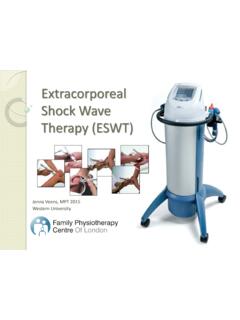
3 1 IV. WARNINGS AND PRECAUTIONS The warnings and precautions can be found in the physicians labeling. V. DEVICE DESCRIPTION The Orthospec extracorporeal shock wave therapy device provides a non-invasive method of therapy for the treatment of Proximal Plantar Fasciitis with or without heel spur. The Orthospec employs an electro-hydraulic, or "spark gap" method of creating the shock wave . With this technique, an electrode (spark plug) ignites an electrical charge within a water containing stainless steel semi-ellipsoid chamber and contact membrane, evaporating a small portion of the water and creating a shock wave reflecting outward off the ellipsoid. The shock wave is generated within the reflector chamber and transmitted through the skin surface of the patient to the treatment site. The reflector chamber is an apparatus used to apply the shock wave to the treatment zone.
4 Water enters the chamber through an intake valve that is controlled from the control panel. The water cushion can be inflated or deflated from the control panel to assure contact with the skin. This chamber must remain tilled during the treatment procedure. The energy of the shock wave can be adjusted between levels I and 7. The frequencies of shock waves are 96, 120 and 160 shocks per minute. Coupling solution is used on both the contact membrane and the patient's skin to enhance conductivity. The device has a linear motor for height adjustment and casters for lateral positioning of the reflector towards the treatment area. Imaging or sedation is not required with use of the Orthospec . The Orthospec is a portable, self-contained unit and does not require special installation. The operational platform consists of a cast iron base with a high voltage generator, contained in a locked cabinet, operating from a standard l l 5 or 230 voltage electrical wall socket.
5 The major components consist ofthe Main Frame, shock wave Head and Control Panel. Main Frame The main frame is a single, mobile unit that cases the high voltage generator. It includes the shock wave unit and control panel. shock wave Head The shock wave Head is integrated within the main frame. lt consists of a stainless steel semi ellipsoid reflector, a dry natural rubber membrane filled with water, an underwater electrode, and a high voltage power supply. These components together form a water chamber in which the shock wave is generated. The shock wave is generated from the electrode by an electric spark and transmitted to the treatment site via the contact membrane. Control Panel The control panel allows for the operation of the device. It is a touch panel built with an array of switches with transparent regions through which the system indication lights and displays can be seen.
6 The main power key switch, energy and frequency levels, water inflate and deflate operation, height control and shock wave counter are all functions of the control panel. 2 VI. ALTERNATIVE PRACTICES AND PROCEDURES Conservative therapies to treat Plantar Fasciitis consist of physical therapy , anti-inflammatory pharmaceuticals, steroid injections, deep heat treatments, and orthotics. Surgical options include endoscopic plantar fasciotomy or open plantar fascia release. VII. MARKETING HISTORY The Orthospec device has been commercially marketed and sold in over 25 countries outside the United States since 1998. Currently there are 65 devices placed in 25 countries around the world including, Europe, Asia, and South America. The Orthospec system been recalled for SAFETY and/or EFFECTIVENESS reasons. VIII. ADVERSE EVENTS OF THE DEVICE ON HEALTH ADVERSE EVENTS During the Orthospec clinical study, there were 3 reported cases of adverse events out of 172 treated patients.
7 They included two cases of bruising and one case of mild local swelling observed by the patient but not by the physician. None ofthe adverse events was severe, and none required medical intervention or subsequent medical care. SUMMARY of All Adverse Events Orthospec (N= 115) n (%) Placebo (N =57) n (%) P-Value Any Adverse Event 3 ( ) 0 (0%) Bruising 2 ( ) 0 (0%) Mild local swelling I ( ) 0 (0%) POTENTIAL ADVERSE EVENTS Potential adverse events when using the Orthospec device include: Pain during ESW treatment Petechia Superficial hematoma Neurosensory conditions (Hypesthesia or Paresthesia) Rare allergic or sensitivity reaction to the Latex membrane or to the coupling solution applied to the skin during treatment Tendon rupture IX. SUMMARY OF PRECLINICAL STUDIES shock wave Characterization (Pressure Measurements) shock wave Characterization Produced by the Orthospec shock wave pressure measurements were performed in accordance with IEC 61846, "Ultrasonics - Pressure pulse lithotripters Characteristics of fields" (1998).
8 The Orthospec was typically configured with a fluid-filled membrane and a 25 urn spot-poled membrane-type Polyvinylidene Difluoride PVDF hydrophone with a mm geometrical diameter. 3 q Measurements of the shock wave field were based on an average of over thirty measurements at the focal location. The mean peak positive pressure and mean peak negative pressure were 340 127 bar and 49 15 bar, respectively, at 24kY. From the integration ofthe pressure-time waveform, and the scans through the focal region, the integrated energy per pulse was J at 24kV. Calculations of the focal energy per pulse were based upon equation 3 in Clause oflEC 61846. The measurement was conducted by integrating over the focal plane in an approach similar to that used to measure diagnostic ultrasound equipment. The measured pressure-time waveforms were squared to get pressure-squared vs.
9 Time, and then integrated. In order to measure the rise time and pulse duration of the shock waveform, the measurement was repeated with the oscilloscope sampling rate increased to 100 Msmp/s. From a series of measurements, the average rise time was 400 100 ns; the average pulse width was 1200 45 ns. These results indicate that the device was designed to produce output characteristics that fall within the range of those used in extracorporeal shock wave lithotripsy. Preclinical data was extracted from the animal study using the Medispec Econolith TM Shockwave Lithotripsy System (P950043). The intended use for the Econolith Shockwave Lithotripsy System is for internal tissues, to fragment upper urinary tract calculi, which provides much more energy and pressure than the Orthospec , intended for orthopedic applications.
10 The Orthospec ESWT device is a low energy shock wave modification of the Econolith Shockwave Lithotripsy System by Medispec, Ltd. Medispec, Ltd. includes this study as part ofthe Orthospec PMA based on its FDA approval as a validated demonstration of SAFETY and EFFECTIVENESS . The animal study was conducted under more severe energy and intensity parameters than the Orthospec . Both devices work on the same range of voltage, however for orthopedic applications, the shock wave pressure is greatly reduced from that utilized in kidney stone treatments (ESWL). Soft tissue effects ofthe lower energy shockwaves were quantified in animal studies. Based on these soft tissue animal study results, Medispec, Ltd. developed their performance parameters for the OrthospecTM device. Standards Testing Testing was conducted on the OrthospecTM ESWT to demonstrate compliance with IEC 60601-1 1, IEC 60601-2-362, IEC 60601-1-23, ISO 14971 4 and IEC 6!