Transcription of Acidified Foods: Definitions and Regulations
1 2012 Virginia Polytechnic Institute and State University FST-61NP Virginia Cooperative Extension programs and employment are open to all, regardless of race, color, national origin, sex, religion, age, disability, political beliefs, sexual orientation, or marital or family status. An equal opportunity/affirmative action employer. Issued in furtherance of Cooperative Extension work, Virginia Polytechnic Institute and State University, Virginia State University, and the Department of Agriculture cooperating. Edwin J. Jones, Director, Virginia Cooperative Extension, Virginia Tech, Blacksburg; Jewel E. Hairston, Administrator, 1890 Extension Program, Virginia State, Petersburg. Acidified Foods: Definitions and Regulations Acidified foods are considered risky, because a product that is not produced correctly may cause serious illness to those who consume it. For this reason, Acidified foods have their own specific Regulations as outlined by the Code of Federal Regulations (21 CFR 114 and 21 CFR for FDA regulated products).
2 In Virginia, producers of Acidified foods are required to follow the regulation 21 CFR 114 Acidified Foods regardless of whether or not the products enter into interstate commerce. What is an Acidified food ? Acidified foods are low- acid foods to which acids or acid foods have been added to reduce the pH to or less, and which have a water activity of greater than In Acidified foods, the addition of low- acid ingredients significantly alters the pH of the acid food ingredients in the product. The Acidified food Regulations apply to shelf-stable foods that are sold without refrigeration in sealed containers. These shelf stable products require a heat-treatment and proper acidification to be safe for consumption. Many Acidified foods are referred to as pickled . These are low acid foods that have been canned with an acid (like vinegar or lemon juice) to reduce the pH to or lower. Examples include pickled eggs, meats, and vegetables.
3 Other Acidified foods might include black bean and corn salsa or some sauces. If a food product contains only naturally acidic foods, it will not be considered an Acidified food . However, if a food product contains both low acid food ingredients and acid food ingredients, the food will need to be tested to determine if it is classified as an Acidified food . Any food that contains an Acidified food as an ingredient is classified as an Acidified food . If your product is classified as an Acidified food , you will need to be aware of a number of requirements before you can legally sell your product: You must be certified or supervised by someone who is certified in processing of Acidified foods. You may become certified by taking the Better Process Control School. You must adhere to current Good Manufacturing Practices as outlined in 21 CFR 110. The equilibrium pH of your food is required to be or lower.
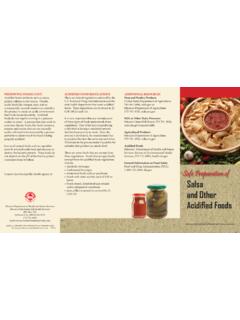
4 food Entrepreneurs Series: Rules and Regulations Photo Source: National Center for Home food Preservation 2 Your food product will require a heat treatment during processing sufficient to destroy any microorganisms of public health concern, and to destroy those microorganisms that are not of public health concern but are capable of reproducing in food . You must contact an Acidified foods processing authority to develop a scheduled process for your specific product. You will be required to adhere to your scheduled process, confirmed by documentation. You will need to measure and record the pH of the finished product for each batch of product you make. Depending on the expected final pH of your product, you will have to measure pH using a pH meter (rather than pH test strips). You will be required to test and record the integrity of the final container in which your product is packaged to ensure that the container suitably protects the food from leakage or contamination.
5 All primary product containers must be labeled with a unique identifying code visible to the naked eye. You must keep records. These include records of examination of raw materials, packaging materials, and finished product; records verifying that you have met all critical control points outlined in your scheduled process; and records identifying initial distribution of the product. These records must be kept for three years. If you deviate from your scheduled process, you must keep records addressing the deviation and how it was rectified. These records must be kept in separate files from your other processing records, and must be kept for three years. You must have an established recall plan. You must contact your state inspector to inspect your kitchen and process. You may not sell your product until you have approval from your state inspector. Note: This document should be regarded strictly as a supplement to the Acidified Foods Regulations , and should never be regarded as a substitute to reading and understanding the Regulations .
6 For a complete list of requirements, please consult 21 CFR Part 114 and 21 CFR Part