Transcription of Drops on a Coin - dhouts.com
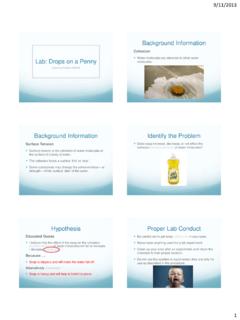
1 Drops on a Coin Background: Scientists daily apply scientific method in their activities. This activity introduces students to the inquiry of the scientific process. Purpose or Problem Statement: Which side (head or tail) of the penny will hold more water? Safety: The only safety concern is the water: Wash your hands before and after the experiment. Do not let student play with the water. Clean up spills immediately. Clean up the lab materials after the experiment and place them back into their proper location. Vocabulary: Prediction, Independent or Manipulated Variable, Dependent or Responded Variable, Controlled Variable or Constant, Hypothesis, Data analysis, Conclusions, Theory, Law, Surface Tension, Cohesion.
2 Materials (individual or per group): 1 penny or coin 1 dropper or glass dropper Plenty of Paper Towels. One 50-ml Beaker Clear water Gloves Safety goggles Lab Notebook Procedures: 1- Use a flat surface to put the coin. Use the coin as is. 2- Pour about 20 ml of tap water in the beaker. 3- Prepare the lab data table like the one below in your lab notebook. 4- Use the dropper to get water from the beaker. 5- Place Drops of water one at a time on one side of the penny until water runs over the edge of the coin. 6- Record your observation and the number of Drops during this trial.
3 7- Dry the coin side completely and repeat steps 4 to 6 for trial 2 and 3. Observations/Data: Coin side Trial 1 Trial 2 Trial 3 Average Observations Head Tail Observation/Data Analysis: Analyze your data through the data table, Determine the best format for the data and present visual summaries such as the utilization of graphs (line, bar, ) to interpret the data. Explain the data outcome. How can you describe the difference in the number of Drops for each trial on the same side? Results: Analyze not only your individual or group data but also the class data and engage classroom discussion with teacher oriented questions with higher ordered thinking to explore concept understanding and application.
4 A. In the class data, compare your results (individual trial and average) with the other groups. Why are there any discrepancies? b. Provide at least 2 possible reasons for the similarities or differences. c. Why did we have a difference on the number of Drops after each trial? d. What effect on the results, if any, if we use soap water vs simple water? Old vs new coins ? Explain. e. What could have been done for every group to have the same results? Conclusion: Write a Lab Report