Transcription of The Madman and the Masters: Nietzsche
1 1)The Madman and the Masters: Nietzsche1. ORIENTATIONAs a way of orienting ourselves within this chapter s concernwith Nietzsche but also within the broader concerns of thebook as a whole, I would like to cite two closely linked passagesfrom two rather different sources in the writing of StanleyCavell. The first is taken from an early essay on one of Kierke-gaard s less well-known works,On Authority and Revelation(per-haps better known by its subtitle,The Book on Adler); the secondcomes from the fourth part of Cavell s magnum opus, entitledThe Claim of Reason, from a point at which his concern withquestions of privacy, self-expression, and self-knowledge allowhim to return to Kierkegaard and to link that return with areturn to Nietzsche , who is a much-underestimated presencein this concluding portion of the an outsider can say about religion has the rootedviolence of things the religious have themselves had it atheart to say: no brilliant attack by an outsider against (say)obscurantism will seem to go far enough to a brilliant in-sider faced with the real obscurity of God.
2 And attacksagainst religious institutions in the name of reason willNIETZSCHE17not go far enough in a man who is attacking them in thename of may battle against the Christian s self-understandingfrom within Christianity, as Kierkegaard declares, or frombeyond Christianity, as Nietzsche declares. In both cases,you are embattled because you find thewordsof the Chris-tian to be the right words. It is the way he means themthat is empty or enfeebling. Christianity appears inNietzsche not so much as the reverse of the truth but asthe truth in foul disguise. In particular, the problem seemsto be that human action is everywhere disguised as humansuffering: this is what acceptance of the Will to Power isto find that these quotations suggest two interlinked ques-tions, one for Nietzsche and one for the Christian, from whichI propose to begin this inquiry.
3 The question for Nietzscheis this: When we read his many-faceted critiques of Judaeo-Christian morality and culture, should we think of him asspeaking from within or from without Christianity? For if, asCavell suggests, the Christian s words are, from Nietzsche spoint of view, the right words if the critical task he sets himselfis not to eliminate the Christian vocabulary but rather to re-cover it for a more human, a less life-denying, use then hecannot simply abandon them. But how can he retain them andstill succeed in speaking from beyond Christianity from a per-spective that can genuinely claim to have overcome the Chris-tian inheritance?1 Stanley Cavell, Kierkegaard sOn Authority and Revelation, inMust WeMean What We Say?(Cambridge University Press: Cambridge, 1969), Cavell,The Claim of Reason(Oxford University Press: Oxford,1979), 118 The question for the Christian is this: Is there a perspectiveavailable to the defender of Christianity from whichNietzsche s words of criticism, however radical and devastatingin intent, can in fact be seen as the truth in foul disguise?
4 Afterall, if Cavell is right in suggesting that Nietzsche can onlyachieve his purposes by retaining the Christian vocabulary, thenwhat he has it in mind to say with those words his attemptsto mean them otherwise than the Christian might well appearto the Christian as an enfeebling use of the right words, as goingless far than one can go within Christianity. In other words, isthere a way of understanding Christianity that would allow theChristian to think of Nietzsche s critique as insufficiently radi-cal and insufficiently violent as failing to see the truly radicalviolence that the Christian s words are capable of doing to thepurportedly Christian culture and institutions (what Kierke-gaard calls the domain of Christendom) in which they are un-easily domesticated?
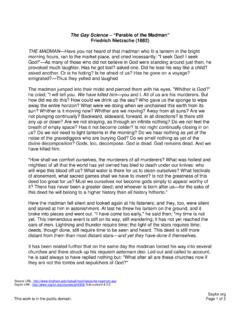
5 2. PRONOUNCING THEDEATH OFGODIn order to begin collecting the material for an answer to thesequestions, I want to examine in some detail one of the mostwell-known (perhaps, by now, rather too well-known) facets ofNietzsche s critique of Christianity his claim that God is deadand, in particular, the way in which that claim is articulated inhis parable of the Madman , as recounted inThe Gay Science:The Madman . Haven t you heard of that Madman who inthe bright morning lit a lantern and ran around the mar-ketplace crying incessantly I m looking for God! I mlooking for God! Since many of those who did not believein God were standing around together just then, he causedgreat laughter. Has he been lost, then? asked one. Did helose his way like a child? asked another.
6 Or is he hiding?NIETZSCHE19Is he afraid of us? Has he gone to sea? Emigrated? Thusthey shouted and laughed, one interrupting the other. Themadman jumped into their midst and pierced them withhis eyes. Where is God? he cried; I ll tell you!We havekilled him you and I! We are all his murderers. But howdid we do this? How were we able to drink up the sea?Who gave us the sponge to wipe away the entire horizon?What were we doing when we unchained this earth fromits sun? Where is it moving to now? Where are we movingto? Away from all suns? Are we not continually falling?And backwards, sideways, forwards, in all directions? Isthere still an up and a down? Aren t we straying as thoughthrough an infinite nothing? Isn t empty space breathingat us? Hasn t it got colder?
7 Isn t night and more nightcoming again and again? Don t lanterns have to be lit inthe morning? Do we still hear nothing of the noise of thegrave-diggers who are burying God? Do we still smellnothing of the divine decomposition? Gods, too, decom-pose! God is dead! God remains dead! And we have killedhim! How can we console ourselves, the murderers of allmurderers! The holiest and the mightiest thing the worldhas ever possessed has bled to death under our knives: whowill wipe this blood from us? With what water could weclean ourselves? What festivals of atonement, what holygames will we have to invent for ourselves? Is the magni-tude of this deed not too great for us? Do we not ourselveshave to become gods merely to appear worthy of it? Therewas never a greater deed and whoever is born after uswill on account of this deed belong to a higher history thanall history up to now!
8 Here the Madman fell silent andlooked again at his listeners; they too were silent andlooked at him disconcertedly. Finally he threw his lanternon the ground and it broke into pieces and went out. Icome too early, he then said; my time is not yet. Thistremendous event is still on its way, wandering; it has notCHAPTER 120yet reached the ears of men. Lightning and thunder needtime; the light of the stars needs time; deeds need time,even after they are done, in order to be seen and deed is still more remote to them than the remoteststars and yet they have done it themselves! It is still re-counted how on the same day the Madman forced his wayinto several churches and there started singing hisrequiemaeternam deo. Led out and called to account, he is said al-ways to have replied nothing but, What then are thesechurches now if not the tombs and sepulchres of God?
9 3 The first thing to note about this passage is that the claim thatGod is dead is not made by Nietzsche in propria persona, butis, rather, put into the mouth of a Madman ; the ironic possibili-ties here are obvious and multiple, but they suffice at the veryleast to raise the question of how far Nietzsche himself thinksthat one might succeed in meaning what the claim appears tosay and still remain recognizable as a potential interlocutor (as,say, a writer for whom the acquisition of a readership remainssomething for which he can coherently hope). The secondthing worth noting is that Nietzsche s Madman addresses hisclaim to two audiences: to the atheists in the marketplace, andto the theists who call him to account from within the churcheshe visits. It seems fair to say that critical commentary has tendedto concentrate on the first audience rather than the this is because most such commentators would regardthemselves as members of that first audience, and hence as mostdirectly addressed in that stretch of the text; perhaps it is be-cause of the undeniably striking fact that Nietzsche s madmanappears to think that it is the atheists rather than the theistswho stand most (or, at least, first) in need of the news that Godis dead, when one might rather think that making such a claim3 Friedrich Nietzsche ,The Gay Science, ed.
10 B. Williams, trans. J. Nauckhoff(Cambridge University Press: Cambridge, 2002), section an atheist could not, logically speaking, be meant to conveya piece of information (if anyone knows this, surely the atheistdoes). But this preponderance of attention directed at the in-habitants of the marketplace has by now, in my experience,reached the point at which it can become hard to remain opento the presence in this parable of the inhabitants of thechurches hard to hold onto the knowledge that its final twosentences actually exist. My reading of the parable is an attemptto work out the consequences of assuming that Nietzsche isequally concerned with both audiences, and that his aim is toreinterpret the self-understanding of both of The Atheists: Blood, Light, FallingTo think of God as dead is not to think of him as simply non-existent; if God is now dead, then, to be sure, he no longerexists, but he was previously alive hence, his corpse may stillexist and be the subject of a search.