Transcription of Food Allergy FAct Sheet - Mississippi
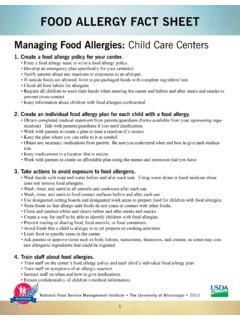
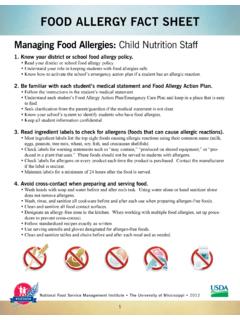
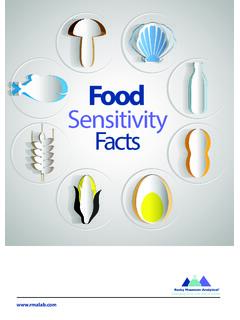
1 food Allergy fact SheetNational food Service Management Institute The University of Mississippi 20121 What resources can I use to educate child care staff about food allergies?In addition to this series of fact sheets, there are a variety of resources you can use. The National food Service Management Institute has several resources on food allergies ( ). Or-ganizations, such as the food Allergy & Anaphylaxis Network ( ), also have educa-tional resources on their Web sites. Local medical professionals may be willing to offer assistance. What are the most common foods that cause allergies?The following eight foods are responsible for 90% of food allergies: milk eggs peanuts tree nuts (for example walnuts, almonds, cashews, pistachios, and pecans) wheat soy fish crustacean shellfish (for example shrimp, lobster, and crab) What are the common symptoms of a food Allergy ? Allergy symptoms could include any of the following: itching in the mouth and throat skin rashes cramps, nausea, diarrhea, and/or vomiting swelling of the tongue or throat breathing difficulties drop in blood pressure loss of consciousness anaphylaxisWill all children display the same symptoms during an allergic reaction?
2 No. Children can display different symptoms, even if they have the same Allergy . Each time a child has a reaction, the symptoms may be different. What should I do if a child consumes a food to which he or she is allergic?Follow the child s individual food Allergy plan. If the Allergy has the potential to cause a severe reaction, call emergency medical services immediately. Con-tact the child s parent/guardian as soon as should I do if a child with a food Allergy complains of symptoms but looks fine?Take all complaints from a child with food allergies seriously. Follow the Allergy plan for that child and notify a parent/guardian. What if meals are served family style?Hands should be washed before and after each meal. Take extra precautions with serving utensils and serv-ing containers to prevent cross-contact. It may be helpful for the child with food allergies to be served first. Children should not be allowed to share food or eating there ways other than meals or snacks that a child could be exposed to an allergen?
3 Yes. Foods containing allergens are sometimes used in art projects or crafts. Foods for parties or rewards could also contain an allergen. Anyone entering the day care, including children, parents, and staff, could bring food that contains the allergen or have the al-lergen on their hands. Determine what policies are needed to help avoid exposure to food Questions: Child Care CentersFood Allergy fact SheetNational food Service Management Institute The University of Mississippi 20122 Are pot holders and oven mitts sources of cross-contact?Yes. Use only dedicated pot holders and oven mitts when making allergen-free food items. Wash hands after using pot holders and oven certain foods not be allowed in the child care center?If a child could have a severe allergic reaction to a particular food , consider having a food free policy limiting that particular food . Even with a policy in place, all ingredient labels should be checked.
4 Home-made items and items without food labels should be discouraged as it is difficult to know if the ingredients are safe. Is additional funding available to cover the cost of special food that may be requested to accommodate a child with food allergies?No, but extra expenses for Allergy -safe meals can be minimal by choosing an Allergy -safe menu from the items already being offered. how do I provide the correct food for a child with multiple food allergies?Discuss with the child s parent the accommodations you can reasonably make. In some cases, the parent may choose to provide the child s food . For the meal to be reimbursable by USDA regulations, you must provide at least one component of the meal. can I use a website to check food labels for allergens? Although websites can be helpful, they may not be up to date. To make sure a product is safe, read the ingredient label each time you purchase it and call the manufacturer if you have questions.
5 This project has been funded at least in part with Federal funds from the Department of Agriculture, food and Nutrition Service through an agreement with the National food Service Management Institute at The University of Mississippi . The contents of this publication do not necessarily reflect the views or policies of the Department of Agriculture, nor does mention of trade names, commercial products, or organizations imply endorsement by the University of Mississippi is an EEO/AA/TitleVI/Title IX/Section 504/ADA/ADEA accordance with Federal law and Department of Agriculture policy, this institution is prohibited from discriminating on the basis of race, color, national origin, sex, age, or disability. To file a complaint of discrimination, write USDA, Director, Office of Civil Rights; Room, 326-W, Whitten Building, 1400 Independence Avenue, SW, Washington, DC 20250-9410 or call (202) 720-5964 (voice and TDD).
6 USDA is an equal opportunity provider and employer. 2012, National food Service Management Institute, The University of MississippiExcept as provided below, you may freely use the text and information contained in this document for non-profit or educational use with no cost to the participant for the training providing the following credit is included. These materials may not be incorporated into other websites or textbooks and may not be photographs and images in this document may be owned by third parties and used by The University of Mississippi under a licensing agreement. The University cannot, therefore, grant permission to use these images.