Transcription of AB436 Labor Compliance Program FAQs - ucop.edu
1 AB436 Labor Compliance Program FAQs 2012 (revised 1/17/12) 1 | P a g e This document provides clarifications with respect to new Labor Compliance Program (LCP) requirements and procedures mandated by Assembly Bill 436 (effective January 1, 2012). 1. How did UC administer LCPs prior to January 1, 2012? By statute, UC was required to have an LCP in effect for all projects funded by 2002 and 2004 GO Bonds (this could have been one systemwide LCP, or each campus could have adopted its own LCP). To comply with the statutory requirement, UC elected to utilize one LCP for the entire system. Five campuses (San Diego, San Francisco, Santa Barbara, Santa Cruz, and Irvine) used employees to administer the University s systemwide LCP at their campuses.
2 The five remaining campuses (Berkeley, Davis, Los Angeles, Merced, and Riverside) used Contractor Compliance and Monitoring Inc. (CCMI) to administer the University s systemwide LCP at their campuses. CCMI also prepared an Annual Report covering all ten campuses that is submitted to the State. 2. What are the key changes mandated by AB 436, effective January 1, 2012? a. For all construction projects funded in whole or in part by bonds issued by the State of California, the University must either utilize an LCP or pay the Department of Industrial Relations (DIR) a fee of .25 of 1% of the bond funded portion of the project cost, in which case the DIR s Compliance Monitoring Unit (CMU) will enforce the prevailing wage laws on bond funded projects.
3 B. The University had the option of continuing its systemwide LCP. Upon adoption of a systemwide LCP, no campus could avoid the LCP requirement for any of its bond funded projects by paying the .25 of 1% fee to the DIR. c. Alternatively, the University had the option of abolishing its systemwide LCP, in which case each campus could elect to either establish its own LCP, or pay the .25 of 1% fee to the DIR. All projects at a campus would either be subject to the campus LCP or the fee requirement (meaning that a campus could not pay the fee on some projects and use its campus LCP on other projects). d. UC cannot use an outside consultant like CCMI to run an LCP. CCMI can provide training and assistance with tasks to supplement the work of staff in charge of and responsible for an LCP.
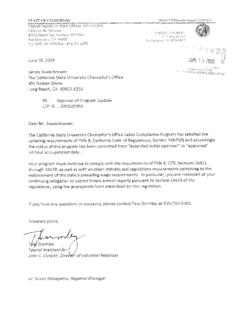
4 (See #12.) 3. How did UC elect to comply with AB 436? UC elected to continue its system wide LCP, to be administered locally by each campus. Local options were not chosen because of perceived difficulty securing approval by the DIR, which could have forced all campuses to pay the fee to the DIR, notwithstanding the desire of most to continue with the LCP. UC s application to continue use of is systemwide LCP is current pending with the DIR (pending action on the application, UC intends to continue to utilize the existing LCP unless or until UC is directed not to by the DIR). Campuses can assist each other in performing Compliance . AB436 Labor Compliance Program FAQs 2012 (revised 1/17/12) 2 | P a g e 4.
5 What is entailed when a campus administers the systemwide LCP locally? a. Campus to add applicable language to Supplementary Conditions prior to bidding. b. Campus to submit a DIR-PWC 100 form to DIR prior to Notice to Proceed. (This informs DIR that the construction phase of a project is commencing.) c. Campus to use LCPtracker or comparable software. Use attached spreadsheet to calculate LCPtracker cost. (For further assistance, call Chris Hornbeck at 510-987-0312). d. Campus to conduct the preconstruction conference and cover LCP requirements with GC and first tier subs. e. Campus to display the State LCP poster at each work site. f. Campus to conduct on-site verification of required postings weekly.
6 G. Campus to conduct on-site job interviews at least monthly. h. Campus to review monthly payroll and report violations. i. Campus to be responsible for informing the GC of wage violations, setting up of meetings with contractor, preparing documentation of violations. Campus to withhold payments to GC if necessary. j. Campus/OGC to report violation to the CMU. k. Campus to prepare an annual report. 5. Does AB 436 apply to projects funded by bonds issued by the Federal government, local public entities (counties) or UC? AB 436 does not apply to projects funded by bonds issued by the Federal government or by local public entities (counties). UC takes the position that AB 436 does not apply to projects funded with bonds issued by UC.
7 DIR has not taken a position on whether AB 436 applies to projects funded with bonds (UC would probably litigate the issue if the DIR tried to apply AB 436 to projects funded by UC bonds). 6. Does AB 436 apply to state bond funded contracts awarded on or after January 1, 2012, if the contract was advertised and bids were received prior to January 1? Yes. AB 436 is a condition of funding any contract awarded on or after January 1, and therefore applies to all such contracts, without exception. 7. Will AB 436 apply to all state bond funded projects over $1,000 funded by state bonds? Yes. $1,000 is the applicable threshold. 8. Will AB 436 apply to state bond funded maintenance and repair projects?
8 Yes. AB 436 applies to all state bond funded construction, alteration, demolition, installation ( , equipment installation, carpet installation), repair, or maintenance work done under construction or purchase contract costing more than $1,000. It includes work performed during design/preconstruction ( , inspection and land surveying) where AB436 Labor Compliance Program FAQs 2012 (revised 1/17/12) 3 | P a g e prevailing wages are required by statute. 9. Will AB 436 apply to energy projects funded by State Energy Partnership funds? No. Any bond financing for energy projects is from bonds issued by UC (see #5 regarding UC bond-financed projects). 10. Will AB 436 apply to the installation of equipment funded by state bonds?
9 Yes, if the installation is subject to the prevailing wage laws (generally meaning that the equipment is in some fashion attached to a UC building or other structure, but legal advice should be sought on this issue). (See answer to #9, above.) 11. Where should the cost to implement the LCP Program appear in the Project Budget? Sub 8. 12. A campus locally administering the systemwide LCP is allowed to hire a consultant to perform the following functions: a. For legal representation or other licensed professional services that are directly related to the operation of the Labor Compliance Program and that require special expertise that is not available among the campus own employed staff; b.
10 To augment employed staff in the performance of tasks required under Title 8, section 16432 (copy attached), provided that the consultants exercise no discretionary authority on behalf of the campus and are under the direct day-to-day control and supervision of campus employees who are principally and primarily engaged in performing duties on behalf of the Labor Compliance Program ; or c. for the purpose of reviewing Program operations or providing other assistance on a purely advisory basis in which the consultant has no authority to act or withhold action on behalf of the campus nor the authority to compel, withhold, or delay any action by the campus. 13. AB 436 applies to any public works project awarded on or after January 1, 2012 that is funded in whole or in part from any bond issued by the state to fund public works projects.