Transcription of Science Vocabulary: Word Map - Reading Rockets
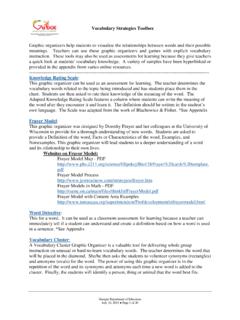
1 18 Engage the Brain: Graphic Organizers and Other visual Strategies Science , Grades 6 8978-1-4129-5232-3 Science vocabulary : Word MapSkills ObjectivesUse prior knowledge to fi nd word dictionary word association to enhance Science , students must be able to communicate ideas. An expansive vocabulary is critical to communicating those ideas effectively. A Word Map is a graphic organizer that helps students build their vocabulary . Rather than just memorize words and terms, students can use the map to help them retain learning, use vocabulary in context, and develop a framework on which to build new knowledge. A word map also works well as a prereading or postreading activity. 1. vocabulary words are often remembered because of meaningful associations rather than repetition.
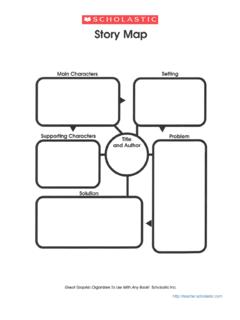
2 To demonstrate how a word clue or association can be used, tell students that the prefi x tele- means at a distance and is used to describe instruments that operate over distance. Prompt students to list words that begin with the prefi x tele-, such as telephone, television, telegraph, and telephoto. Write the words on the board. Discuss how knowing the meaning of the prefi x tele- offers a clue about the meaning of the Draw a simple word map on the board, and give students a copy of the vocabulary Word Map reproducible (page 20). Distribute dictionaries, and write the following vocabulary list on the board (or use your own list): combustibility, malleability, conductivity, insulator, mixture, solution, Demonstrate how to fi ll in the vocabulary Word Map.
3 Write combustibility in the center circle. Ask a volunteer to use prior knowledge to guess the word s meaning. Write the answer in the box labeled My Defi Then have students look up the defi nition of combustibility in a dictionary. Have them tell you what to write in the box labeled Dictionary Defi Word Map 188/29/2007 1:31:08 PM978-1-4129-5232-3 Physical Science 1 5. Point out that a dictionary often includes the origin of the word or root word. Knowing the origin of a word can help students remember the definition. For combustibility, the origin of its root word combust means burned up. Write the word origin or other clues in the box labeled Word Have students suggest a picture that shows the meaning of the word.
4 Draw one of their suggestions, such as a match or campfire, in the box labeled Picture. 7. The last box labeled Association is for any clue that will help a student remember the definition of the word. For example: The b in combustibility stands for burn. Have students brainstorm several possible associations, and write one of their suggestions in the box. Review the completed map with students, and check for Invite students to complete their own vocabulary word map using another word from the vocabulary list. After they finish, have students with the same vocabulary word compare their results. 9. Invite students to read their vocabulary word maps to the class. Discuss how word clues can help them remember vocabulary Learning Encourage students to complete word maps for new Science vocabulary taught throughout the year.
5 They can store the maps in a binder or a Science portfolio. Use pairs of index cards to create vocabulary sets, one card with the vocabulary word and one card with the definition. Give half of the class vocabulary cards and the other half definition cards. Have students take turns asking questions to find their vocabulary word or definition match. Use a variety of word searches, crosswords, scrambled words, and other kinds of word puzzles to help students learn Science vocabulary . You may go online to find resources, such as Jefferson Lab at: 198/29/2007 1:31:08 PMReproducible20 978-1-4129-5232-3 Corwin PressName Date Engage the Brain: Graphic Organizers and Other visual Strategies Science , Grades 6 8 vocabulary Word MapDirections: Write a vocabulary word in the center circle.
6 Then fill in each book about the 208/29/2007 1:31:09 PM