Transcription of CHAPTER 30 The Circulatory and Respiratory Systems
1 Summary of Key ConceptsConcept Circulatory system transports materials throughout thebody. (pp. 654 657)The Circulatory system transports nutrients, oxygen, and hormones through-out the body and carries wastes away from cells. The Circulatory systemincludes the blood, heart, and blood a type of connective tis-sue made up of cells and liquid parts. Blood is pumped through the body bythe heart, a muscular organ with four hollow chambers. Blood flows through-out the body in three types of blood microscopic ves-sels through which nutrients, oxygen, and wastes move between blood andinterstitial thick-walled vessels that carry blood from theheart to the capillaries. The blood in arteries is under pressure, which helpsto ensure that blood flows in the right vessels that carryblood from the capillaries to the heart.
2 They are larger than capillaries butnot as thick as arteries. Blood in veins is under very little pressure. Blood ismoved through veins by contractions of the surrounding skeletal veins contain valves that allow blood to flow only toward the chemical exchange between blood and body tissues takes place in theinterstitial fluid. At the artery end of a capillary, blood pressure forces fluidout through the capillary walls into the interstitial fluid. Blood cells and largeproteins are too big to pass through the capillary walls, so they stay in thecapillary. At the vein end of the capillary, the drop in blood pressure allowsmost of the fluid to reenter the capillary. The rest of the fluid is collected byvessels that make up the lymphatic system .
3 Once inside the lymphatic ves-sels, the fluid is called lymph. Eventually, lymph drains into the circulatorysystem near the heart, allowing the fluid to be is the function of the Circulatory system ? is the lymphatic system ? _____Concept heart pumps blood throughout the Circulatory system .(pp. 658 662)Blood flows from the heart to the lungs, where it picks up oxygen, and then backto the heart. The oxygen-rich blood flows from the heart to the rest of the body,where it exchanges O2for CO2before flowing back to the heart again. Blood flowsalong two pathways, or circuits, in the body. The pulmonary circuitcarries bloodbetween the heart and lungs. The systemic circuitcarries blood between the heartand the rest of the body. Blood flows through both circuits at the same blood leaves the heart through a large artery called theaorta.
4 The two upper chambers of the heart, called atria(singular,atrium),receive blood returning to the heart. The atria pump the blood into the twolower chambers, called ventricles. The ventricles pump blood out of the of tissue in the heart called valvesprevent blood from flowing Guided Reading and Study Workbook / CHAPTER 30125 Pearson Education, _____ Class _____ Date _____The Circulatory andRespiratory SystemsCHAPTER 30backward. A region of the heart muscle known as the pacemakersends outelectrical impulses that make the atria contract. The impulses spread toanother region called the AV nodethat causes the ventricles to the ventricles contract, they increase pressure on the blood. Theforce of the blood against the artery walls is called blood pressure.
5 A bloodpressure of 120/70 is average for a healthy young adult. The first number,called systolic pressure, is produced when the ventricles contract. The secondnumber, called diastolic pressure, is produced when the heart do the pulmonary and systemic circuits differ? is the function of the pacemaker? _____Concept consists of cells suspended in plasma. (pp. 663 664)Plasmais a solution of water, dissolved salts, proteins, and other makes up 55 percent of blood volume. The remaining 45 percent ofblood volume consists mostly of red blood blood cellscarry oxygenfrom the lungs to all the tissues of the body. Each red blood cell contains hemoglobin, a protein that stores oxygen for delivery to cells. Blood also con-tains white blood cells, or leukocytes, which fight infection and help prevent thegrowth of cancer.
6 When you get a cut, your blood usually clots and stops thebleeding. Clotting depends on small fragments of blood cells called release clotting factors, which result in the formation of a proteincalled fibrin. Fibrin threads trap platelets and blood cells, forming a is plasma? is the role of platelets? _____Concept disease is the leading cause of death in theUnited States. (pp. 665 666)Throughout a person s life, deposits of fat and minerals, called plaque, buildup on the inside walls of arteries. Plaque buildup can lead to cardiovasculardisease,illness of the heart and/or blood vessels. As more plaque builds up,the arteries narrow. This condition is called atherosclerosis. As the arteriesnarrow, blood pressure increases. The flow of blood through an artery maybecome completely blocked.
7 If the artery leads to the heart, the heart does notreceive the oxygen and other nutrients it needs. A blood clot may block theartery and lead to a heart plaque hardens over time. This condition is called hardened plaque increases blood pressure and the chance of blood clots. Aperson with a blood pressure of 140/90 or higher for an extended period of timehas hypertension, or high blood pressure. Hypertension can damage the heartand blood vessels. A blood clot in an artery going to the brain can cause astroke, damage to brain tissue due to blocked blood flow. Stroke may result inparalysis and sometimes death. Smoking, lack of exercise, and high-fat dietsincrease the risk for cardiovascular disease. The proper diet, combined withregular exercise, can help keep the Circulatory system _____ Class _____ Date _____126 Biology: Exploring Life Pearson Education, between atherosclerosis and arteriosclerosis.
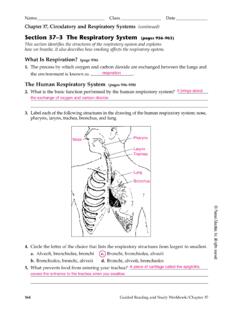
8 Can you reduce the risk for cardiovascular disease? _____Concept Respiratory system exchanges gases between bloodand air. (pp. 667 669)The Respiratory system provides oxygen for cells and removes the waste prod-uct carbon dioxide from the body. When you inhale, air enters the respiratorysystem through the nose and mouth. Air then passes into the pharynx,achamber in the upper throat. A flap of tissue called the epiglottiscovers theair pathway and prevents water or food from entering. From the pharynx, airpasses through the voice box, or larynx. Next, air passes through the trachea,or windpipe. The trachea forks into two bronchi(singular,bronchus), air tubesthat connect the trachea to the lungs. The two lungsare football-sized organsmade of sponge-like tissue.
9 Within each lung, the bronchus branches repeat-edly into smaller tubes called bronchioles. Each bronchiole ends in clusters oftiny air sacs called alveoli(singular,alveolus). Oxygen passes from the alveoliinto the blood, and carbon dioxide passes from the blood into the alveoli. Tiny,hair-like cilia line the Respiratory system and sweep foreign particles uptoward the throat, where they can be air into and out of the body is called breathing. When you inhale,a sheet of muscle called the diaphragmcontracts and the chest expands,causing air to rush into the lungs. When you exhale, the diaphragm relaxesand the chest contracts, causing air to rush out of the lungs. The rate ofbreathing is controlled by the medulla in the brain. When the level of carbondioxide in the blood is too high, the medulla increases the breathing role do the alveoli play in gas exchange?
10 Is the rate of breathing controlled? _____Concept damages the body and shortens life. (pp. 670 671)Smoking exposes the Respiratory system to many harmful substances. Someof the substances destroy cilia, with the result that harmful particles can nolonger be removed from the airways. Smokers have an increased risk fordeveloping lung cancer and other Respiratory a dis-ease that develops when tobacco smoke causes the walls of the alveoli to losetheir flexibility. This makes breathing difficult. Smokers also have anincreased risk for developing some cardiovascular diseases, such as strokeand heart attack. Tobacco products are addictive because they contain nico-tine. Nicotine increases the level of dopamine in the brain, causing feelings ofpleasure.