Transcription of Quantum Theory of Thermoelectric Power (Seebeck …
1 1. IntroductionWhen a metallic bar is subjected to a voltage(V)or a temperature(T)difference, an electriccurrent is generated. For small voltage and temperature gradients we may assume a linearrelation between the electric current densityjand the gradients:j= ( V)+A( T)= E A T,( )whereE Vis the electric field and the conductivity. If the ends of the conducting barare maintained at different temperatures, no electric current flows. Thus from Eq. ( ), weobtain ES A T=0,( )whereESis the field generated by the thermal electromotive force (emf). TheSeebeck coefficient( Thermoelectric Power ) Sis defined throughES=S T,S A/ .( )The conductivity is positive, but the seebeck coefficientScan be positive or negative. Wesee that in Fig. 1, the measured seebeck coefficientSin Al at high temperatures (400 670 C)is negative, while theSin noble metals (Cu, Ag, Au) are positive (Rossiter & Bass, 1994).
2 Based on the classical statistical idea that different temperatures generate different electrondrift velocities, we obtainS= cV3ne,( )wherecVis the heat capacity per unit volume andnthe electron density . A brief derivation ofEq. ( ) is given in Appendix. SettingcVequal to 3nkB/2, we obtain theclassical formulaforthermopower:Sclassical= kB2e= 10 4VK 1= 43 VK 1.( )Observed seebeck coefficients in metals at room temperature are of the order of microvolts perdegree (see Fig. 1), a factor of 10 smaller thanSclassical. If we introduce the Fermi-statistically Quantum Theory of Thermoelectric Power ( seebeck Coefficient) Shigeji Fujita1 and Akira Suzuki2 1 Department of Physics, University at Buffalo, SUNY, Buffalo, NY 2 Department of Physics, Faculty of Science, Tokyo University of Science, Shinjyuku-ku, Tokyo 1 USA 2 Japan 1.
3 High temperature seebeck coefficients above 400 C for Ag, Al, Au, and Cu. The solidand dashed lines represent two experimental data sets. Taken from Ref. (Rossiter & Bass,1994).computed specific heatcV=12 2nkB(T/TF),( )whereTF( F/kB)is the Fermi temperature in Eq. ( ), we obtainSsemi Quantum = 6kBe(kBT F),( )which is often quoted in materials handbook (Rossiter & Bass, 1994). Formula ( )remediesthe difficulty with respect to magnitude. But the correct Theory must explain the two possiblesigns ofSbesides the , Ho and Okamura (Fujita et al., 1989) developed a Quantum Theory of the Seebeckcoefficient. We follow this Theory and explain the sign and theT-dependence of the Seebeckcoefficient. See Section Quantum theoryWe assume that the carriers are conduction electrons ( electron , hole ) with chargeq( efor electron ,+efor hole ) and effective massm.
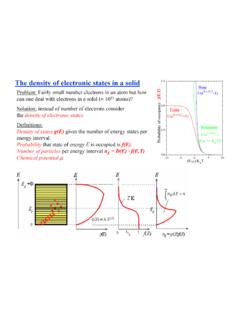
4 Assuming a one-component system, theDrude conductivity is given by =nq2 m ,( )wherenis the carrier density and the mean free time. Note that is always positiveirrespective of whetherq= eor+e. The Fermi distribution functionfisf( ;T, )=1e( )/kBT+1,( )4 Electromotive Force and Measurement in Several Theory of Thermoelectric Power ( seebeck Coef cient)3where is the chemical potential whose value at 0 K equals the Fermi energy difference V=LE,withLbeing the sample length, generates the chemicalpotential difference ,thechangeinf, and consequently, the electric current. Similarly,the temperature difference Tgenerates the change infand the 0 K the Fermi surface is sharp and there are no conduction electrons. At a finiteT, electrons ( holes ) are thermally excited near the Fermi surface if the curvature of thesurface is negative (positive) (see Figs.)
5 2 and 3). We assume a high Fermidegeneracy:TF T.( )Consider first the case of electrons . The number of thermally excited electrons ,Nx,havingenergies greater than the Fermi energy Fis defined and calculated asNx= Fd N( )1e( )/kBT+1=N0 Fd 1e( )/kBT+1= N0(kBT)[ln[1+e ( )/kBT]] F =ln 2kBTN0,N0=N( F),( )Fig. 2. More electrons (dots) are excited at the high temperature end:T2>T1. Electrons diffuse from 2 to 3. More holes (open circles) are excited at the high temperature end:T2>T1. Holes diffuse from 2 to Theory of Thermoelectric Power ( seebeck Coefficient) ( )is the density of states . The excited electron densityn Nx/Vis higher at thehigh-temperature end, and the particle current runs from the high- to the low-temperatureend. This means that the electric current runs towards (away from) the high-temperature endin an electron ( hole )-rich material.
6 After using Eqs. ( ) and ( ), we obtainS<0for electrons ,S>0 for holes .( )The seebeck current arises from the thermal diffusion. We assume Fick s law:j=qjparticle= qD n,( )whereDis thediffusion constant, which is computed from the standard formula:D=1dvl=1dv2F ,v=vF,l=v ,( )where d is the dimension. The density gradient nis generated by the temperature gradient Tand is given by n=ln 2 VdkBN0 T,( )where Eq. ( ) is used. Using the last three equations and Eq. ( ), we obtainA=ln 2 Vqv2 FkBN0 .( )Using Eqs. ( ), ( ), and ( ), we obtainS=A =2ln2d(1qn) FkBN0V.( )The relaxation time cancels out from the numerator and derivation of our formula [Eq. ( )] for the seebeck coefficientSwas based on the ideathat the seebeck emf arises from the thermal diffusion. We used the high Fermi degeneracycondition ( ):TF T. The relative errors due to this approximationanddue to the neglectof theT-dependence of are both of the order(kBT/ F)2.
7 Formula ( ) can be negative orpositive, while the materials handbook formula ( ) has the negative sign. The average speedvfor highly degenerate electrons is equal to the Fermi velocityvF(independent ofT). Hence,semi-classical Equations ( ) through ( ) break down. In Ashcroft and Mermin s (AM)book (Ashcroft & Mermin, 1976), the origin of a positiveSin terms of a mass tensorM={mij}is discussed. This tensorMis real and symmetric, and hence, it can be characterized by theprincipal masses{mj}.FormulaforSobtained by AM [Eq. ( ) in Ref. (Ashcroft & Mermin,1976)] can be positive or negative but is hard to apply in practice. In contrast our formula( ) can be applied straightforwardly. Besides our formula for a one-carrier system isT-independent, while the AM formula is linear ( ) is remarkably similar to the standard formula for the Hall coefficient:RH=(qn) 1.
8 ( )Both seebeck and Hall coefficients are inversely proportional to chargeq, and hence, theygive important information about the carrier charge sign. In fact the measurement of the6 Electromotive Force and Measurement in Several Theory of Thermoelectric Power ( seebeck Coef cient)5thermopower of a semiconductor can be used to see if the conductor is n-type or p-type (withno magnetic measurements). If only one kind of carrier exists in a conductor, then the Seebeckand Hall coefficients must have the same sign as observed in alkali us consider the electric current caused by a voltage difference. The current isgeneratedby the electric force that acts onallelectrons. The electron s response depends on its massm .The density (n)dependence of can be understood by examining the current-carrying steadystate in Fig. 4 (b). The electric fieldEdisplaces the electron distribution by a small amount h 1qE from the equilibrium distribution in Fig.
9 4(a). Since all the conduction electron areFig. 4. Due to the electric fieldEpointed in the negativex-direction, the steady-state electrondistribution in (b) is generated, which is a translation of the equilibrium distribution in (a) bythe amount h 1eE .displaced, the conductivity depends on the particle densityn. The seebeck current is causedby the density difference in the thermally excited electrons near the Fermi surface, and hence,the thermal diffusion coefficientAdepends on the density of states at the Fermi energyN0[see Eq. ( )]. We further note that the diffusion coefficientDdoes not depend onm directly[see Eq. ( )]. Thus, the Ohmic and seebeck currents are fundamentally different in a single-carrier metal such as alkali metal (Na) which forms a body-centered-cubic (bcc)lattice, where only electrons exist, bothRHandSare negative.
10 TheEinstein relationbetweenthe conductivity and the diffusion coefficientDholds: D.( )Using Eqs. ( ) and ( ), we obtainD =v2F /3q2n /m =23 Fq2n,( )which is a material constant. The Einstein relation is valid for a ApplicationsWe consider two-carrier metals (noble metals). Noble metals including copper (Cu),silver(Ag) and gold (Au) form face-centered cubic (fcc) lattices. Each metal contains electrons and holes . The seebeck coefficientSfor these metals are shown in Fig. 1. TheSis positivefor allS>0for Cu, Al, Ag ,( )7 Quantum Theory of Thermoelectric Power ( seebeck Coefficient) that the majority carriers are holes . The Hall coefficientRHis known to benegativeRH<0 for Cu, Al, Ag .( )Clearly the Einstein relation ( ) does not hold since the charge sign is different forSandRH. This complication was explained by Fujita, Ho and Okamura (Fujita et al.)