Transcription of Timer Functions (Page 1 of 2) - documents.rs-components.com
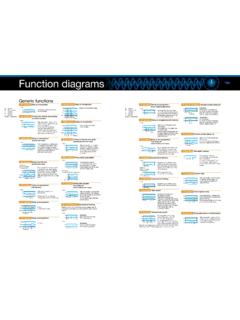
1 , RI_143182, RI_143184, RI_143185, RI_143186, RI_143187, RI_143188, RI_143189, RI_143190, RI_143191, RI_143202, RI_143235, RI_143236, RI_143237, RI_143238, RI_143239,RI_143240, RI_143241, RI_161392RI_143181, RI_143182, RI_143184, RI_143185, RI_143186, RI_143187, RI_143188, RI_143189, RI_143190, RI_143191, RI_143202, RI_143235, RI_143236, RI_143237,RI_143238, RI_143239, RI_143240, RI_143241, RI_161392UK18695814 Nov 200615:00UK Publication - October 06 Process ControlTimers & time Switches Timer DiagramsTimer Functions (Page 1 of 2)Note:The Functions detailed below have no industry standard titles. They may be titled differently by the relay energised LED on (where provided) Timer FunctionCodeTimer FunctionDescriptionDiagram111On DelayThe timing period starts when the supply voltage is applied.
2 After the pre-set time period has elapsed,the output relay R is energised. R Will stay energised until the supply is interrupted, if the supply isinterrupted then R returns to its original of when this occurs the Timer starts fromthe beginning of the cycle all over delay (Control SwitchResettable)The timing period starts when the supply voltage is applied. The output relay R willenergise after this period has elapsed, unless the control switch input S is repeatedlyclosed and then opened. The Timer monitors the leading edges of the controlswitch pulses. Pulse length therefore has to be shorter than that of the Timer period delay (Control SwitchInterruptible) Type 1 The timing period starts when the supply is applied to the Timer with the controlswitch S open.
3 Closing S causes the Timer to pause its timing, without then resumes once S is opened again. Therefore the total time takenfor the output relay R to energise is the preset timing period plus the sum of thetime S was closed. Removal the supply will cause the Timer to reset the timingperiod back to the preset delay (Control SwitchInterruptible) Type 2 The timing period starts when both the supply and control switch are energised. Opening the controlswitch suspends timing but does not reset the time sequence. Therefore, the total time taken beforethe delayed contact changes state is the pre set time plus any time that the control switch is the supply resets the Timer . If the control switch remains closed during and after thereset, timing will resume immediately the supply is delay (Constant Supply)Type 1A permanent supply is required.
4 A control switch S is used to control the timerfunction. The delay period starts once switch S is the preset time periodhas elapsed then output relay R energises. Opening S will cause R to de-energise,and likewise closing it again will start the timing period from the beginning, this actionmay be performed at any point of the timing delay (Constant Supply)Type 2 Timing will commence when the supply is present and switch S is open. After the time period has elapsed, the output relay R will however S is closed then the timing period resets to the beginningof the cycle. Timing will restart only when S has been opened. Thereforethere are 2 methods this Timer can be controlled, either by opening and closing S or with the interruption of the supply voltage to the Timer with switch S delay ( Constant Supply)Type 3A permanent supply is required.
5 The timing period starts when the controlswitch S is closed and will continue irrespective of any further changes to S .After the elapsed time output relay R energises. To reset the Timer , switch S must beopened. This does not de-energise the relay. It is de-energised and thefunction repeated when switch S is reclosed. (ie, the Timer must see a leading edge).161On delay with InstantaneousContactThe timing period starts when the supply voltage is applied. The output relay R 2energises immediately. After the pre-set time period has elapsed, the output relay R 1 R 1 and R 2 will stay energised until the supply is interrupted. If the supply isinterrupted R 1 and R 2 return to their original state. Regardless of when this occursthe Timer starts from the beginning of the cycle all over Off delay (ConstantSupply)A permanent supply is required.
6 Control switch S controls the Timer function. Whenswitch S is closed, the Timer period starts. Once this has elapsed output relay R energises. If switch S is opened the relay remains energised for the same length of timeas the first preset time period. Once this too has elapsed the relay de-energises andremains so until switch S is closed again. Closing switch S and then opening it beforethe time period has elapsed will not cause activation of R .211 Off delay (Constant Supply)Type 1A permanent supply is required. The Timer function is triggered by the use ofcontrol switch S . When S is closed the output relay R will energise timing period will start once S is opened, with R still energised. Once this periodhas elapsed then R will de-energise.
7 Closing S at any time in the cycle willcause R to energise if it is not already and the timing period to start from the delay (Constant Supply)Type 2A permanent supply is required. The Timer function is triggered by the use ofcontrol switch S . When the switch is closed the output relay R will energise thetiming period has started further actions of S will have no effect. However once the timing cycle hasbeen completed the process may be started againby closing S . While the Timer is executing this function the only way to reset the Timer is to interruptthe Off DelayWhen the supply is applied the Timer output relay R will energise. When the supplyis removed R will stay energised for the preset time the supplywill cause R to energise again (if it is not already) and the timing periodstarts when the supply is disconnected again.
8 A point to note is that the Timer needsto store the energy to retain the output relay in the energised state after the supplyhas been removed. This will reflect in the length of time the supply has to be Pulse (ConstantSupply)The timing period starts when the supply is applied to the Timer . After the presethas elapsed the output relay R will energise for the preset pulse reset the Timer the supply has to be interrupted. If this interruption occursduring the pulsed output then the relay will de-energise and the timerwill reset. ( T is the delay duration and t is the pulse duration).412 Delayed Pulse (RemoteTrigger)The timing period will start when control switch S is closed with thesupply connected. After preset time has elapsed the output relay R will energisefor the pre-selected pulse duration.
9 To reset the Timer either control switch S is openor the supply has to interrupted. If this action occurs during the pulsed outputcycle then the relay will de-energise and the Timer will reset. ( T is the delayduration and t is the pulse duration).413 Delayed Pulse (ConstantSupply) Type 1 Supply to the unit must be continuous. On closure of the S the time period t1 starts to of t1 , the relay R energises immediately and the time period t2 starts to run. Oncompletion of t2 the relay R de-energises. The control contact S has no effect until t1 + t2 havecompletely Pulse (ConstantSupply) Type 2 The supply is connected permanently to the Timer . A switch S is used to controlthe Timer function (refer to the timing diagram).
10 The delay time period starts closingAfter elapse of time set the output relay R is energised for a fixed period switch S during time period T has no affect, but re-closing will initiatetiming T once PulseWhen the supply is connected the output relay R energises and the timing function starts. After thepreset Timer period has elapsed R de-energises. Interrupting the supply resets the time period. If thisinterruption occurs before the period has elapsed R will de-energise the timing period Pulse (Control SwitchResettable)/WatchdogOutput relay R will energise as soon as the supply is applied to the Timer ifcontrol switch S closed, and will start to time out unless control switch S opened and then closedrepeatedly within the time period.