Transcription of SUMMARY OF PRODUCT CHARACTERISTICS 1) NAME OF THE ...
1 SUMMARY OF PRODUCT CHARACTERISTICS 1) NAME OF THE MEDICINAL PRODUCT : CUROSURF 80 MG/ML ENDOTRACHEOPULMONARY INSTILLATION SUSPENSION 2) QUALITATIVE AND QUANTITATIVE COMPOSITION: One ml vial contains: Active ingredient: phospholipid fraction from porcine lung 120 mg. One 3 ml vial contains: Active ingredient: phospholipid fraction from porcine lung 240 mg. CUROSURF is a natural surfactant , prepared from porcine lungs, containing almost ex-clusively phospholipids, in particular phosphatidylcholine (about 70% of the total phospho-lipid content) and about 1% of surfactant -specific low molecular weight hydrophobic pro-teins SP-B and SP-C.
2 3) PHARMACEUTICAL FORM Sterile suspension in single-dose vials for endotracheal or endobronchial administration . 4) CLINICAL PARTICULARS Therapeutic indications Treatment of Respiratory Distress Syndrome (RDS) in preterm babies. Prophylactic use in premature infants at risk for RDS. Posology and method of administration Posology CUROSURF should only be administered in hospital by a medical staff trained and experienced in neonatal intensive care for preterm infants, having available suitable equipment for ventilation and monitoring of babies with RDS.
3 Treatment: the recommended dose is 100-200 mg/kg ( ml/kg) of body weight administered as a single bolus dose. It is possible to administer additional doses of 100 mg/kg, each one at about 12-hourly intervals, in infants still requiring assisted ventilation and supplementary oxygen (maximum total dose: 300-400 mg/kg). It is recommended to start treatment as soon as possible after diagnosing RDS. Prophylaxis: 100-200 mg/kg ( ml/kg) of body weight should be administered as soon as possible (within 15 minutes) after birth.
4 Further doses of 100 mg/kg each can be given 6-12 hours after the first dose, and then at 12-hour intervals in case of occurrence of RDS requiring mechanical ventilation (maximum total dose: 300-400 mg/kg). Method of administration CUROSURF is available in ready-to-use vials to be stored at a temperature ranging be-tween +2 and +8 C. The vial should be warmed to room temperature before use, for example by holding it in the hand for a few minutes, and gently turned upside down a few times, without shaking, until the suspension appears homogeneous.
5 The suspension should be withdrawn from the vial by using a sterile needle and syringe, following the instruction described under section CUROSURF can be administered either by: a. Disconnecting the infant from the mechanical ventilator Disconnect the infant momentarily from the ventilator and administer to ml/kg (100-200 mg/kg) of the suspension as a single bolus, directly into the lower trachea via the endotracheal tube. Perform approximately one minute of hand-bagging and then recon-nect the infant to the ventilator at the same settings as before administration .
6 Further dos-es ( ml/kg equal to 100 mg/kg) that may be required can be administered on identical terms; or b. Without disconnecting the infant from the mechanical ventilator Administer to ml/kg (100-200 mg/kg) of the suspension as a single bolus, directly into the lower trachea by passing a catheter through the suction port and into the endotra-cheal tube. Further doses ( ml/kg equal to 100 mg/kg) that may be required can be administered following the same procedure. c) Intubation surfactant Extubation (INSURE) There is a third option of administration , which is intubation of the newborn to administer the surfactant .
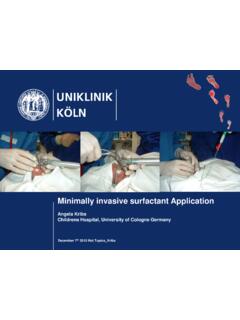
7 Doses are the same indicated for modalities under points a) and b). In this case a bagging technique is used and after surfactant administration and extubation, na-sal CPAP may be applied (Continuous Positive Airway Pressure). d) less invasive surfactant administration with a thin (LISA) or similar catheter Alternatively, in spontaneously breathing preterm infants Curosurf can also be adminis-tered through the less invasive surfactant administration (LISA) technique using a thin catheter.
8 Doses are the same indicated for modalities under points a), b) and c). A small diameter catheter is placed into the trachea of infants on CPAP, ensuring continuous spon-taneous breathing, with direct visualization of the vocal cords by laryngoscopy. Curosurf is instilled by a single bolus over 3 minutes. After Curosurf instillation, the tube is im-mediately removed. CPAP treatment should be continued during the whole procedure. It is recommended to frequently control blood gases whatever administration modality is used as, after administration , an immediate increase in PaO2 or oxygen saturation is gen-erally observed.
9 It is however advisable to continuously monitor transcutaneous PO2 or oxygen saturation to avoid hyperoxia. Special population Renal or Hepatic impairment The safety and efficacy of CUROSURF in patients with renal or hepatic impairment have not been evaluated. Contraindications Hypersensitivity to the active substance or to any of the excipients listed in section No specific contraindications to CUROSURF use are known so far. Special warnings and precautions for use TREATMENT Prior to the treatment start, the infant s general conditions should be stabilized.
10 Correction of acidosis, hypotension, anaemia, hypoglycaemia and hypothermia is also recommended. In the event of reflux, administration of CUROSURF should be stopped and, if necessary, peak inhalation pressure on the ventilator should be increased until clearing of the endo-tracheal tube occurs. Infants whose ventilation parameters become markedly impaired during or shortly after in-stillation may have mucus plugging of the endotracheal tube, particularly if pulmonary se-cretions were prominent prior to drug administration .