Transcription of Home Garden Strawberry Production in New Mexico
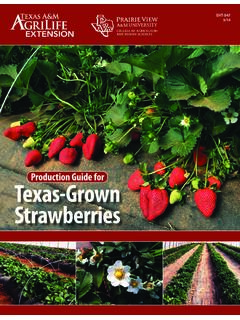
1 To find more resources for your business, home , or family, visit the College of Agricultural, Consumer and Environmental Sciences on the World Wide Web at Garden Strawberry Production in New MexicoGuide H-324 Shengrui Yao and Robert Flynn1 Cooperative Extension Service College of Agricultural, Consumer and Environmental Sciences INTRODUCTIONS trawberries are many people s favorite fruit and are always popular at local farmers markets and roadside stands. They are one of the most common small fruits grown in home gardens and are an easy fruit to grow. strawberries are not only attractive and flavorful but also nutritious. A cup of straw-berries has only 55 calories, but will supply more than the daily recommended require-ment of vitamin C. A bed of 25 50 straw-berry plants will produce enough berries for an average-sized family for fresh eating and some preserves.
2 Strawberry plants grow best with a long growing season of daily maximum tempera-tures of 70 75 F. In the , commercial Strawberry Production is concentrated in Florida and California, where optimal tem-peratures are achieved for several months. In northern New Mexico , the cold winter and high elevation limit the length of the growing season, while in low-elevation areas of southern New Mexico , the high daytime temperatures in summer make growing strawberries a challenge. Some strawberries also do not perform well in high-pH soil. Nevertheless, not all strawber-ries respond the same to high soil pH and elevation. To help people choose the best cultivars for northern New Mexico , a Strawberry cultivar trial was con-ducted at the Alcalde Sustainable Agriculture Science Center from 2011 to 2013. The cultivars differed greatly in their cold hardiness, tolerance to high soil pH, and yield potential.
3 With careful cultivar selec-tion, a good fertilizer program, and some frost pro-tection material/equipment, strawberries can grow well in northern New Mexico . BOTANYS trawberry (Fragaria ananassa) belongs to the rose family (Rosaceae). Its fruit is an aggregate fruit with seeds or achenes embedded on the surface of a swollen receptacle. strawberries generally propagate vegetatively by producing runners (stolons). In June-bearing straw-berries, runners arise from buds at the base (axils) of the leaves in response to longer days (more than 12 hours of sunlight, which occurs from June to August). Day-neutral varieties generally produce fewer runners, so they should be planted closer to-gether in the Respectively, Assistant Professor/Extension Fruit Specialist, Sustainable Agriculture Science Center at Alcalde; and Interim Superintendent/Extension Agronomist, Agricultural Science Center at Artesia, New Mexico State H-324 Page 2 Strawberry TYPES AND CULTIVARST here are three types of strawberries : June-bearing, everbearing, and day-neutral.
4 They differ primarily in their response to day length, which affects both berry and runner June-bearers develop flowers in the early spring from buds initiated the previous fall under short-day con-ditions (less than 10 hours of light per day). During the fall (September November), it is essential that the plants have a full, well-developed leaf canopy to produce sufficient energy for flower bud develop-ment. June-bearers tend to out-produce other types of strawberries , but late frosts in the spring can significantly reduce overall yield. Frost protection is highly June-bearing Strawberry trial with 16 cultivars in two planting systems (matted-row and black plastic-covered) was conducted at NMSU s Alcalde Sustain-able Agriculture Science Center from 2011 2013. To evaluate cultivar tolerance to high soil pH, there was no supplemental iron applied until August of the planting year.
5 Later, chelate iron was applied to manage leaf chlorosis. Among the 16 cultivars tested, Mesabi and Kent were the top two cultivars with the highest yield (Table 1). Wendy had the worst winter damage in the plastic-covered perennial system. Allstar, Chandler, and Darselect were the cultivars most sensitive to the high-pH soil in northern New Mexico . Earliglow had fruit with good flavor, but yields were extremely low during both harvest seasons. Mesabi plants had iron deficien-cy symptoms, but they were not as severe as Allstar and Chandler. Mesabi had good flavor and winter har-diness and was very productive and disease resistant; it is a good cultivar for northern New Mexico . Kent had good flavor, was winter hardy, and produced a good yield. Cabot had big fruit with satisfactory fruit quality. Jewel is a longtime performer in several other states with good flavor and reasonable yield, but it is not very hardy in northern New Mexico .
6 Early culti-vars like Earliglow, Annapolis, Wendy, and Brunswick were more vulnerable to late spring frost. Growers have a better chance at getting a good crop with mid-season cultivars. For late cultivars, they may run into summer heat stress before they reach their yield poten-tial. Please also refer to for detailed cultivar strawberries initiate flower buds under long-day conditions (more than 12 hours of sunlight). They will generally produce two main crops (spring and fall), but the total yield is less than a single spring crop from a June-bearer. Everbearers, however, have the advantage that if the spring crop is lost to frost, the fall crop will still produce. Everbearers produce fewer runners and tend to form multiple crowns. They should be planted closer together than June-bearers. Everbearers do not tolerate heat well, so they should only be grown in the northern part of the strawberries have the unique ability to flower and fruit under any day-length conditions.
7 They will produce fruit from spring through fall, with several peaks throughout the season. Temperatures above 70 F, however, will inhibit flower bud forma-tion. Day-neutrals produce fruit and runners simulta-neously, although runner Production is generally less than that of June-bearers. A drawback of day-neutral cultivars is that they often produce smaller berries than June-bearers. Day-neutrals and everbearers are often used inter-changeably in the industry since the two behave simi-larly in temperate regions. There have been no recent cultivar trials for everbearers in New Mexico . How-ever, here are some general : Large berry with good yields, cold toler-ance, and : Medium-large, short cone- to wedge-shaped, bright red berries; pleasant flavor; good dessert and processing qualities; resistant to red stele root : Medium-sized, symmetrical, short conic, deep red fruit; good dessert and freezing qualities; more sensitive to high soil pH than Tribute.
8 Albion, San Andreas, and Evie 2: These are newer selections with growing popularity in other states; test before planting in SELECTIONS trawberry blossoms are susceptible to late spring frosts. Those early blossoms are primary or sec-ondary flowers and produce the largest berries. Loss of these flowers will reduce yield. Locating Strawberry beds on elevated areas of the Garden with gentle slopes will allow heavy cold air to drain away from the bed, helping to reduce frost Guide H-324 Page 3damage. A northern exposure may help delay bloom in the spring if late frosts are a problem. Earlier Production can be achieved by selecting a southern exposure that warms earlier in the spring, but this will also increase the risk of frost damage. Plants may have to be covered with a straw mulch or frost blanket at night to protect them if frost becomes a problem.
9 Locations next to a house are often warmer due to heat generated from the prefer full sun, although afternoon shade or shade cloth to reduce sunlight intensity may be needed in southern New Mexico . However, shady locations can cause more vegetative plants with fewer berries and more disease planting strawberries after peppers, toma-toes, potatoes, eggplant, or okra, all of which are susceptible to Verticillium wilt, which can remain in the soil and affect strawberries . Strawberry plots following sod may have to be treated to control white grub. Sites should also be free of noxious and perennial PREPARATIONS trawberries grow best in well-drained, sandy loam soils high in organic matter and fertility. Before planting, a soil test for pH and nutrient levels is rec-ommended. Soils should be neutral to slightly acidic (pH ).
10 Plants established on more alkaline soils (pH or greater) tend to exhibit signs of iron de-ficiency (yellowing between leaf veins, or interveinal chlorosis, of younger leaves; see Figure 1). In severe cases, pale leaves become white, turn brown around the edges, and then die. Strawberry plants are also highly sensitive to salts in the irrigation water or soil (salinity). High total salinity causes stunting, mar-ginal leaf scorch, and severe yield reduction. Enough water should be applied to ensure that salts are leached below the root zone. Strawberry cultivars vary in their adaptation to high soil pH. Among the 16 cultivars tested at Al-calde, Allstar, Chandler, and Darselect were the most sensitive cultivars and should be avoided if other choices are available. Wendy was the most tolerant cultivar to high soil pH; however, its winter hardi-ness was poor.