Transcription of QUESTIONS & ANSWERS - Oeko-tex standard
1 QUESTIONS &ANSWERSSTANDARD 100 by Oeko-tex Since 1992, standard 100 by Oeko-tex has been a globally standardised, independent mark of quality for raw, semi-finished and finished textile products from all stages of production and for all accessory materials used in the process. This global certification system assures manufacturers, sourcers, brands, retailers, and consumers around the world that certified products meet the strict limit values for harmful substances of standard 100 and that these substances are not present in critical concentrations.
2 Oeko-tex originally tested for about 100 chemicals like pesticides, carcinogenic colourants and heavy metals but today standard 100 covers a wide array of several hundred harmful substances. This brochure will answer some of the most frequently asked standard 100 QUESTIONS but please contact any of our member institute offices for more information ( ).Georg DienersSecretary General | Oeko-tex AssociationCERTIFICATION SYSTEM 8 Costs of the standard 100 product certification 9 Time required for certification10 Application and application documents11 Certification in five steps 12 Selection and packaging of the test samples 13 Testing in the Oeko-tex member institute14 Test report 15 Declaration of conformity16 standard 100 certificateBASICS 1 The standard 100 by Oeko-tex system 2 Advantages of the standard 100 product certification 3 Test criteria 4 Test methodology 5 Parameters of the standard 100 criteria catalogue 6 Meaning
3 Of the standard 100 product classes 7 Overview of the four product classesQUESTIONS & ANSWERSLABEL USEFURTHER INFORMATION17 Operational quality assurance18 Company audit by Oeko-tex 19 Assurance of product conformity20 Withdrawal of existing certificates21 standard 100 supplements22 standard 100 and REACH23 Labelling of ready-made products 24 Print templates for the standard 100 label25 Advertising use of the standard 100 label26 standard 100 label vs certificate27 Use of the label after expiry of the certificate28 About Oeko-tex 6 What is standard 100 by Oeko-tex ? standard 100 is a worldwide, consistent, independent testing and certification system for raw, semi-finished, and finished textile products at all processing levels, as well as accessory materials aims of the product certification in accordance with standard 100 are:1.
4 To provide the end consumer with a reliable, third-party, independent product label for non-hazardous products that are tested in accordance with the standard 100 criteria catalogue and thereby contribute to effective consumer To support the companies in the textile chain on the basis of a scientific criteria catalogue and neutral laboratory tests in a targeted manner with the implementation of their intended product safety with regard to human ecology. The tests for harmful substances in accordance with standard 100 by Oeko-tex take into account important legal regulations, such as banned azo dyes, formaldehyde, pentachlorophenol, cadmium, nickel, etc.
5 , requirements from the US Consumer Product Safety Improvement Act (CPSIA) regarding lead, numerous harmful chemicals, even if they are not yet legally regulated, and diverse parameters for standard 100 by Oeko-tex system7In its criteria catalogue, standard 100 also considers numerous environmentally relevant substance tests and laboratory tests are exclusively carried out by 16 member institutes of the Oeko-tex Association, each with proven expertise. The concept of the Oeko-tex tests for harmful substances is based on a modular system: certifications are possible at every stage of the textile value chain; certificates from preliminary stages are recognised.
6 A successful test allows for the labelling of respective textiles or materials with the standard 100 mark after the certificate was What advantages does a certification in accordance with standard 100 by Oeko-tex additionally offer for marketing? As a third-party independent label, standard 100 is a helpful marketing tool enabling companies to transparently document their responsibility with respect to the product safety of their articles in terms of human ecology and for their customers along the textile chain, all the way through to brands, retailers and the companies that have their textiles or materials certified in accordance with standard 100 have the opportunity to present their companies and product portfolio free of charge in our online directory (Buying Guide)
7 Under With an average of roughly 5,000 website visits per day and visitors from more than 200 countries around the world, the Oeko-tex website is an ideal advertising platform that attracts international can enter the data for your company presentation in our Buying Guide at any time in our Self-Service Portal at Your assigned Oeko-tex institute will be pleased to send you the access details upon of the standard 100 product certification93 According to which criteria does Oeko-tex test textiles and accessory materials for harmful substances? To contribute to a high and effective product safety for the textiles and materials from a consumer s point of view, the Oeko-tex Association works with an extensive criteria catalogue during its certification catalogue contains numerous test parameters and is binding for all authorised Oeko-tex testing central focus is the development of test criteria, limit values and test methods using a scientific basis.
8 Test criteria and limit values in many cases go far beyond applicable national and international standards. The inclusion of numerous additional potentially harmful substances has documented the pioneering role of standard 100 for many parameters, such as the testing of colour fastness which serves as a precaution, are also part of the Oeko-tex laboratory criteria104 Which test methodology is used as a basis for the Oeko-tex tests for harmful substances? The Oeko-tex test methodology is mainly based on the release of harmful substances from the materials to be tested. According to the opinion of the Oeko-tex Association, this is the most important concern for garments (possible contact with skin and risk of absorption through the skin).
9 Strict methods are selected for the release of harmful substances. Materials for babies and toddlers are additionally tested for colour fastness using a simulation of sucking /nibbling with a synthetic saliva and perspiration solution. Colourants must have a very high colour fastness level at this materials, which are encountered in the area of furnishing materials, are tested additionally for the emission of specific harmful substances into the that are atypical for the materials automatically lead to the exclusion of a certification for all methodology115 Which parameters are part of the Oeko-tex criteria catalogue?
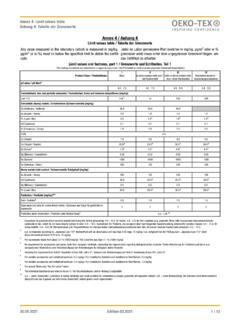
10 The full criteria catalogue with the current limit values for the tests for harmful substances in accordance with standard 100 can be viewed at any time on the Internet at takes place, for example, for banned azo dyes, carcinogenic and allergy-inducing colourants, pesticides for textiles made of natural fibres, polycyclic aromatic hydrocarbons (PAHs), tin organic compounds, chlorinated phenols, phthalates (softeners), PFOS, PFOA, surfactant wetting agent residues (APEOs) and many more. BASICSP arameters of the standard 100 criteria catalogue126 What is the meaning of the four product classes of standard 100 by Oeko-tex ?