Transcription of FEDERAL DEPOSIT INSURANCE CORPORATION DIRECTIVE …
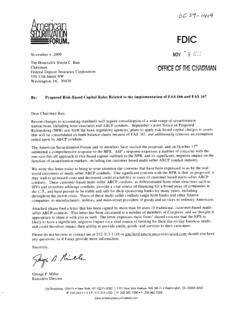
1 FDIC 1212/03 (6-99) TYPE AND NUMBER Circular CONTACT TELEPHONE NUMBER Christopher Farrow (703) 516-5507 DATE April 30, 2007 DATE OF CANCELLATION (Bulletins Only) TO: All Divisions and Offices FROM: Martin D. Henning Acting Chief Information Officer and Chief Privacy Officer Chief Information Officers Organization SUBJECT: Protecting Sensitive Information 1. Purpose To establish FDIC policy on protecting sensitive information collected and maintained by the CORPORATION and to provide guidance for safeguarding the information. 2. Scope The provisions outlined in this circular apply to all employees and contractors as well as any other persons who have access to sensitive information used in the performance of CORPORATION business. This includes data maintained electronically as well as information available in hard copy (paper) format. 3. Background Interim guidance on Protecting Sensitive Information was provided by the Chief Information Officer/Chief Privacy Officer in a global electronic mail (email) message to employees dated August 8, 2006.
2 In general, sensitive information is information that contains an element of confidentiality. It includes information that is exempt from disclosure by the Freedom of Information Act (FOIA) and information whose disclosure is governed by the Privacy Act of 1974 (Privacy Act). Sensitive information requires a high level of protection from loss, misuse, and unauthorized access or modification. Failure to protect sensitive information may cause the CORPORATION to be in violation of the law or may result in avoidable costs or damage to the FDIC s reputation. See paragraph , below for a more detailed definition of sensitive information. In recent years, the increase in the incidence of identity fraud has focused attention on protecting the privacy of individuals by both commercial businesses and government agencies. In the role as an employer and in support of its mission, the CORPORATION collects and maintains information about employees and other individuals as well as information obtained from other sources including insured institutions and the institutions customers.
3 Accordingly, the CORPORATION has a FEDERAL DEPOSIT INSURANCE CORPORATION DIRECTIVE SYSTEM * Pedestrian changes have been made to the DIRECTIVE and appear in blue. 7/27/2015, 5/14/2014, 5/28/2013, and 10/27/2015.) Circular 2 April 30, 2007 Background (cont.) responsibility to protect this personally identifiable information (PII). See paragraph , below for a more detailed definition of PII. PII is also sometimes referred to as information in identifiable form (IIF). Throughout this circular, the term sensitive information applies to the broad range of information requiring protection. 4. Definitions Terms specific to this circular are defined below: a. Information in Identifiable Form (IIF). See Personally Identifiable Information. b. Personally Identifiable Information (PII). Any information about an individual maintained by FDIC which can be used to distinguish or trace that individual s identity, such as their full name, home address, Email address (non-work), telephone numbers (non-work), Social Security Number (SSN), driver s license/state identification number, employee identification number, date and place of birth, mother s maiden name, photograph, biometric records ( , fingerprint, voice print), etc.
4 This also includes, but is not limited to, education, financial information ( , account number, access or security code, password, personal identification number), medical information, investigation report or database, criminal or employment history or information, or any other personal information which is linked or linkable to an individual. c. Sensitive information. Any information, the loss, misuse, or unauthorized access to or modification of which could adversely impact the interests of FDIC in carrying out its programs or the privacy to which individuals are entitled. It includes, but not exclusively, the following: (1) Information that is exempt from disclosure under the Freedom of Information Act (FOIA) such as trade secrets and commercial or financial information, information compiled for law enforcement purposes, personnel and medical files, and information contained in bank examination reports (see FDIC Rules and Regulations, 12 Part 309, for further information); (2) Information under the control of FDIC contained in a Privacy Act system of record that is retrieved using an individual s name or by other criteria that identifies an individual (see FDIC Rules and Regulations, 12 Part 310, for further information); (3) PII about individuals maintained by FDIC that if released for unauthorized use may result in financial or personal damage to the individual to whom such information relates.
5 Sensitive PII, a subset of PII, may be comprised of a single item of information ( , SSN) or a combination of two or more items ( , full name along with, Circular 3 April 30, 2007 Definitions (cont.) financial, medical, criminal, or employment information). Sensitive PII presents the highest risk of being misused for identity theft or fraud; (4) Information about INSURANCE assessments, resolution and receivership activities, as well as enforcement, legal, and contracting activities; and (5) Information related to information technology specific to the FDIC that could be misused by malicious entities ( , firewall rules, encryption and authentication mechanisms, and network architecture pertaining to the FDIC). (6) Except as required in electronic mail, internal IP addresses and server names must be encrypted if they are sent outside of the FDIC. 5. Policy In order to protect sensitive information, it is the policy of the FDIC to: a. Collect and retain sensitive information only when it is necessary to satisfy an FDIC business requirement; b.
6 Identify the existence of sensitive information in both electronic and paper formats by labeling removable electronic media ( , diskettes, CD/DVD, USB flash drives) and paper reports (on the cover page and/or in the footer section) as containing sensitive information; c. Safeguard sensitive information from unauthorized access. Only those individuals who have a legitimate need to access sensitive information in the performance of their duties shall be provided access; d. Store sensitive electronic information only on corporate information technology (IT) equipment. Store paper copies in corporate facilities ( , locked drawers, file cabinets, and file rooms) whenever possible; Note: Sensitive information shall not be removed from the workplace without prior management approval, and if it must be removed, it shall be kept secured at all times. Whether in electronic or paper format, it shall not be left unattended unless properly physically secured. e. Encrypt sensitive information stored on end-user IT equipment ( , laptop and desktop computers) as well as on removable media ( , diskettes, CD/DVD, USB flash drives); f.
7 Remotely access sensitive information stored in electronic format only across a secure connection, such as via remote access services supported by the CORPORATION ; Circular 4 April 30, 2007 Policy (cont.) g. Send sensitive information electronically only when required. Email messages containing sensitive information shall always be encrypted using an FDIC-approved encryption product. See Encryption Guidance on FDICnet for further information. External parties must follow the most current encryption guidance and FEDERAL Information Processing Standards (FIPS) for encryption published by the National Institute of Standards and Technology (NIST). Further, personal email accounts ( , Gmail or Hotmail) should never be used for transmitting or receiving any type of sensitive FDIC business-related information; h. Ship sensitive information by postal service or commercial carrier only when required. The shipment shall be tracked and followed up on in a timely manner to ensure that it arrives intact at its destination.
8 See the Division of Administration (DOA) Express Mail Job Aid on FDICnet for minimum requirements for shipping sensitive materials (paper and/or electronic); i. Properly dispose of electronic media and paper documents containing sensitive information when they are no longer needed (and in accordance with records retention requirements). Electronic media and paper documents shall not be discarded intact in a trash can. Paper documents shall be shred (or placed in a shred bin provided by the CORPORATION ) and electronic storage media shall be destroyed (or placed in an electronic media console provided by the CORPORATION ). See Protecting Sensitive Information in Your Work Area A Guide for the FDIC on FDICnet for further information; and j. Require all employees and contractors to complete annual security and privacy awareness training. In the event that sensitive data is suspected or known to be lost or otherwise compromised, whether in electronic or paper format, report the situation immediately to the FDIC Help Desk/Computer Security Incident Response Team (CSIRT) (877-FDIC-999).
9 Also notify your supervisor/oversight manager and your division/office Information Security Manager at the earliest available opportunity. Search ISM Program on FDICnet for a list of current Information Security Managers. 6. Guidelines Because a significant portion of the FDIC workforce is mobile, safeguarding sensitive information presents an ongoing challenge. The following guidelines provide additional information intended to assist employees and contractors in their continuous efforts to protect sensitive information: a. Maintain physical control over sensitive information stored electronically. Keep portable IT equipment (laptops, personal digital assistants (PDAs), USB flash drives, CDs/DVDs, diskettes, etc.) with you at all times and avoid leaving them unattended. Circular 5 April 30, 2007 Guidelines (cont.) (1) If you must leave portable IT equipment such as a laptop in a vehicle, store it in the trunk or out of sight in the passenger compartment and lock the vehicle.
10 Be aware of others watching you place it in the vehicle. Do not leave IT equipment in a vehicle overnight or for long periods of time keep it with you. (2) Do not leave portable IT equipment unattended when traveling. Monitor it closely while checking in at an airport or hotel counter and while passing through airport security checkpoints. If you must leave IT equipment briefly unattended in a hotel room, store it out of sight, in a room safe if one is provided, or secure it to a desk or table with a cable lock. (Laptop cable locks are available from DIT upon request). (3) When traveling by air, bring the portable IT equipment with you on the airplane as a carry-on. Do not place it in checked luggage. (4) Do not leave portable IT equipment unattended at a conference, convention, or other public event; carry items with you at all times. Alternatively, secure a laptop to a desk or table with a cable lock. (5) Do not leave portable IT equipment unattended in the workplace.