Transcription of PRODUCT INFORMATION Tramedo Tramedo SR - Medicines
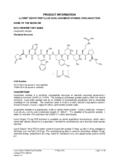
1 PRODUCT INFORMATION . Tramedo Tramedo SR. Tramadol hydrochloride NAME OF THE MEDICINE. Active ingredient : Tramadol hydrochloride Chemical name : (+)-cis-2-[(dimethylamino)methyl]-1-(3-m ethyoxyphenyl)cyclohexanol hydrochloride Structural formula : Molecular formula : Molecular weight : CAS Registry no. : 36282-47-0. DESCRIPTION. Tramadol hydrochloride is an odourless, white to off-white crystalline powder that is readily soluble in both water and ethanol and has a pKa of The water/n-octanol partition coefficient is at pH 7. It belongs to the analgesics class and has an opioid-like activity. Tramedo Tramedo immediate release capsules contain 50 mg tramadol hydrochloride. The capsules also contain the following inactive ingredients: lactose monohydrate, microcrystalline cellulose, maize starch, sodium starch glycollate, magnesium stearate, titanium dioxide, gelatin, sunset yellow FCF CI15985, quinoline yellow CI47005, allura red AC CI16035, TekPrint SW-9008 Black Ink.
2 Tramedo SR. Tramedo SR modified release tablets contain tramadol hydrochloride in the following dose strengths: 100mg, 150mg amd 200mg. The tablets also contain the following inactive ingredients: glyceryl behenate, calcium hydrogen phosphate dihydrate, povidone and colloidal anhydrous silica. PHARMACOLOGY. Pharmacodynamics Tramadol is a centrally-acting synthetic analgesic of the aminocyclohexanol group with opioid-like effects. It is not derived from natural sources, nor is it chemically related to opiates. Although pre-clinical testing has not completely explained the mode of action, at least two complementary mechanisms appear applicable: binding to -opioid receptors and inhibition of re-uptake of noradrenaline and serotonin. The opioid-like activity of Tramedo & Tramedo SR PRODUCT INFORMATION 2. tramadol derives from low affinity binding of the parent compound to -opioid receptors and higher affinity binding of the principal active metabolite, mono O-desmethyltramadol, denoted M1, to -opioid receptors.
3 In animal models, M1 is up to 6 times more potent than tramadol in producing analgesia and 200 times more potent in -opioid binding. The contribution of tramadol to human analgesia, relative to M1, is unknown. Both human and animal studies have shown that antinociception induced by tramadol is only partially antagonised by the opiate antagonist naloxone. In addition, tramadol has been shown to inhibit re-uptake of noradrenaline and serotonin in vitro, as have some other opioid analgesics. These latter mechanisms may contribute independently to the overall analgesic profile of tramadol. The analgesic effect is dose dependent, but the relationship between serum concentrations and analgesic effect varies considerably between individuals. In one study, the median serum concentration of tramadol required for effective post-operative analgesia was 300 nanogram/mL, with individual values ranging from 20 to 990. nanogram/mL. Apart from analgesia, tramadol may produce other symptoms similar to that of opioids including: dizziness, somnolence, nausea, constipation, sweating and pruritus.
4 However, tramadol causes significantly less respiratory depression than morphine. In contrast to morphine, tramadol has not been shown to cause histamine release. At therapeutic doses, tramadol has no clinically significant effect on heart rate, left ventricular function or cardiac index. Orthostatic changes in blood pressure have been observed. Pharmacokinetics Tramadol is administered as a mixture of two stereoisomers; the following INFORMATION refers to the combined concentration of both isomers. Tramadol has a linear pharmacokinetic profile within the therapeutic dosage range. Absorption Tramadol is rapidly and almost completely absorbed after oral administration of 50 mg capsules following a mean absorption delay (t0) of approximately 30 minutes. The absorption half-life (t ) is 23 + 11 minutes. The mean peak Tramedo serum level (Cmax) is reached 1 hour (range 1 to 4 hours) after administration. The mean peak plasma concentration (Cmax) is approximately 360 nanogram/mL after oral administration of two Tramedo capsules.
5 In another study, after oral administration of two 50 mg capsules, the mean absolute bioavailability (f abs) is 68 to 72%. After repeated oral administration of 50 mg and 100 mg tramadol capsules at six hourly intervals, steady state is reached 30 to 36 hours after the first administration and the bioavailability is greater than 90%. The plasma concentrations at steady state exceeded by 52% and 36% those extrapolated from the single dose administration studies with 50 mg and 100 mg capsules, respectively. This can be explained by first pass metabolic saturation. Oral administration of tramadol with food does not significantly affect its rate or extent of absorption. Therefore tramadol can be administered without regard to food. More than 90% of tramadol is absorbed after oral administration of tramadol hydrochloride modified release tablets. After a single dose, the mean absolute bioavailability is approximately 70%, irrespective of the concomitant intake of food.
6 Oral bioavailability increases to 90% after repeated administration. The difference between absorbed and bioavailable tramadol is due to first-pass metabolism (maximum 30%). The administration of tramadol hydrochloride modified release tablets every 12 hours and tramadol hydrochloride immediate release tablets every 6 hours at the same total daily dose, resulted in similar peak and trough serum tramadol concentrations and total tramadol exposure for the two preparations. Tramedo & Tramedo SR PRODUCT INFORMATION 3. Serum tramadol concentrations in young males treated with tramadol hydrochloride modified release tablets (mean sd). Single Dose Single Dose Steady State 100 mg1 200 mg2 200 mg every 12 hours3. Cmax (ng/mL) Tmax (h) AUC0- ( ) - AUC0-t ( ) Cmin (ng/mL) - - 1. Initiated in a study consisting of a single dose of 100mg tramadol at time zero under fasting conditions, consisting of 24. healthy male and female volunteers (Study ZPS- 342). 2. Initiated in a study consisting of a single dose of 200mg tramadol at time zero under fasting conditions, consisting of 23.
7 Healthy male and female volunteers (Study ZPS-277). 3. Initiated in a study consisting of a single dose of 200mg tramadol at time zero under fasting conditions and at steady state, consisting of 24 healthy male and female volunteers (Study ZPS-332). Distribution Tramadol is rapidly distributed in the body, with a volume of distribution of 2 - 3 L/kg in young adults. The volume of distribution is reduced by about 25% in those aged over 75 years. Plasma protein binding is about 20%. and is independent of concentration up to 10 g/mL. Saturation of plasma protein binding occurs only at concentrations outside the clinically relevant range. Tramadol crosses both the placenta and the blood-brain barrier. Very small amounts of tramadol and M1 are found in breast milk ( and respectively of the administered dose). Metabolism Tramadol is extensively metabolised after oral administration. The major metabolic pathways appear to be N- and O-demethylation and glucuronidation or sulfation in the liver.
8 Only O-desmethyltramadol (M1) is pharmacologically active. Production of M1 is dependent on the CYP2D6 isoenzyme of cytochrome P450. Patients who metabolise drugs poorly via CYP2D6 may obtain reduced benefit from tramadol, due to reduced formation of M1. N-demethylation is catalysed by the CYP3A4 isoenzyme of cytochrome P450. The inhibition of one or both types of the isoenzymes CYP3A4 and CYP2D6 involved in the biotransformation of tramadol may affect the plasma concentration of tramadol or its active metabolite. Excretion Tramadol and its metabolites are excreted mainly by the kidneys, with a cumulative renal excretion (tramadol and metabolites) of approximately 95%. In young adults approximately 15 to 19% of an administered dose of tramadol is excreted in the urine as unmetabolised drug. In the elderly, this increases to about 35%. Biliary excretion is of little importance. In young adults, the mean half-life of tramadol is 7-8 hours and the half-life of M1 is 8-9 hours.
9 Total clearance is approximately 430 to 610 mL/min. Patients with Hepatic or Renal Impairment Elimination of tramadol and M1 is impaired in patients with hepatic or renal impairment (see PRECAUTIONS). In patients with hepatic impairment, the mean half-life of tramadol was found to be 13 hours (range up to 19. hours), and the mean half-life of M1 was 19 hours (range up to 36 hours). In patients with severe renal impairment including subjects with a considerably decreased CLCr (creatinine clearance <5 mL/min) the mean half-life of tramadol was 11 hours (range up to 20 hours), and the mean half-life of M1 was 17 hours (range up to 43 hours). Tramedo & Tramedo SR PRODUCT INFORMATION 4. The Elderly In the elderly (age over 75 years), the volume of distribution of tramadol is decreased by 25% and clearance is decreased by 40%. As a result, tramadol Cmax and total exposure are increased by 30% and 50%, respectively, but the half-life of tramadol is only slightly prolonged (by 15%).
10 INDICATIONS. Relief of moderate to severe pain. CONTRAINDICATIONS. Tramadol is contraindicated in: individuals with known hypersensitivity to tramadol or any excipients acute intoxication with alcohol, hypnotics, analgesics, opioids or psychotropic drugs patients who are receiving MAO (monoamine oxidase) inhibitors or who have taken them within the last 14 days known sensitivity to opioids patients with uncontrolled epilepsy or epilepsy not adequately controlled by treatment. Tramadol must not be used for narcotic withdrawal treatment. PRECAUTIONS. Galactose Intolerance. Tramedo capsule contains lactose monohydrate. Patients with rare hereditary problems of galactose intolerance, the Lapp lactase deficiency or glucose-galactose malabsorption should consult a physician before use. Acute Abdominal Conditions. The administration of tramadol may complicate the clinical assessment of patients with acute abdominal conditions. Respiratory Depression. Tramadol should be administered cautiously in patients at risk of respiratory depression.