Example: air traffic controller
More Practice: Energy, Frequency, Wavelength and the ...
More Practice: Energy, Frequency, Wavelength and the Photoelectric Effect. There are two equations you should know: E = h! and c =!!" !=!!!!!∴!!!=!!! E = energy (J) = wavelength (m) ! = frequency (Hz or s-1) h = Planck’s constant, 6.626x10⁻³⁴ J∙s c = the speed of light in a vacuum, 3.00 × 10⁸ m∙s-1
Tags:
Information
Domain:
Source:
Link to this page:
Documents from same domain

LEWIS STRUCTURES PRACTICE WORKSHEET
ch301.cm.utexas.eduLEWIS STRUCTURES PRACTICE WORKSHEET Draw the Lewis Structures for each of the following molecules. If you are not sure if your structure is correct, do a formal charge check. You should consult the Lewis structure rules and a periodic table while doing this exercise. A periodic table will be available for the exam, but the list of rules will ...

Thermodynamics Unit Internal Energy, Work and Heat
ch301.cm.utexas.edu3. The change in internal energy for the combustion of 1.00 mol CH 4(g) in a cylinder according to the reaction CH4(g) + 2 O2(g) CO2 (g) + 2 H20(g) is ‐892.4 kJ. If a piston connected to the cylinder performs 492 kJ of expansion work due to the combustion,

Kinetic Molecular Theory Supplemental Worksheet
ch301.cm.utexas.eduKinetic Molecular Theory – Supplemental Worksheet 1. What assumptions do we make when using the ideal gas laws? Are the assumptions always true? 2. Consider 2 gases, A and B, each in a 1.0 L container with both gases at the same temperature and pressure. ... mole fraction of methane in the mixture is 0.623. Calculate the total kinetic energy ...
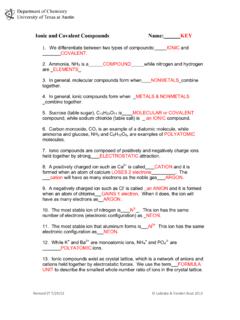
Ionic and Covalent Compounds Name: KEY
ch301.cm.utexas.eduIonic and Covalent Compounds Name: KEY!! 1. We differentiate between two types of compounds: IONIC and COVALENT. ... C12H22O11 is MOLECULAR or COVALENT compound, while sodium chloride (table salt) is _ an IONIC compound. ! 6. Carbon monoxide, CO, is an example of a diatomic molecule, while ammonia and glucose, NH3 and C6H12O6, are examples of ...

IonicBonding!and!Writing!Formulas!Name:!KEY!!! Part A. Use ...
ch301.cm.utexas.edu4. SO3 sulfur trioxide ! 5. N 2O dinitrogen monoxide ! 6. NO nitrogen monoxide ! 7. N2O3 dinitrogen trioxide ! 8. NO2 nitrogen dioxide ! 9. 19.N2O4 2 dinitrogen tetroxide ! 10. N2O5 dinitrogen pentoxide 11. PCl3 phosphorous trichloride ! 12. PCl5 phosphorous pentachloride ! 13. NH3nitrogen trihydride ! 14. SCl6sulfur hexachloride ! 15 ...

University of Texas at Austin
ch301.cm.utexas.eduCOVALENT BONDING Name Covalent bonding occurs when two or more nonmetals share electrons. attempting to attain a stable octet of electrons at least part of the time. For example: Note that hydrogen Is content with 2, not 8. electrons. Show how covalent bonding occurs in each of the following pairs of atoms. Atoms may
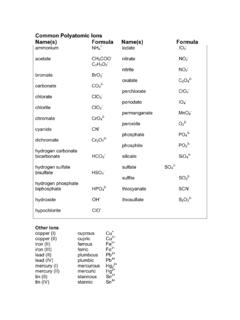
Common Polyatomic Ions Name(s) Formula Name(s) Formula
ch301.cm.utexas.eduCommon Polyatomic Ions Name(s) Formula Name(s) Formula ammonium NH4 + acetate CH3COO-C2H3O2-bromate BrO3-carbonate CO3 2-chlorate ClO3-chlorite ClO2-chromate CrO4 2-cyanide CN-dichromate Cr2O7 2-hydrogen carbonate bicarbonate HCO3-hydrogen sulfate bisulfate HSO4-hydrogen phosphate biphosphate HPO4 2-hydroxide OH-
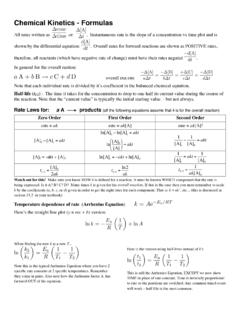
Kinetics formulas copy - Chemistry 301
ch301.cm.utexas.eduHalf-life (t 1/2): The time it takes for the concentration to drop to one half its current value during the course of the reaction. Note that the “current value” is typically the initial starting value - but not always. Rate Laws for: a A products (all the following equations assume that k is for the overall reaction)
Related documents
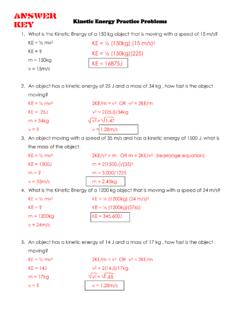
Kinetic Energy Practice Problems
msbclasses.weebly.comKinetic Energy Practice Problems 1. What is the Kinetic Energy of a 150 kg object that is moving with a speed of 15 m/s? KE = ½ mv2 KE = ? m = 150kg v = 15m/s KE = ½ (150kg) (15 m/s)2 KE = ½ (150kg)(225) KE = 16875J 2. An object has a kinetic energy of 25 J and a mass of 34 kg , how fast is the object moving? KE = ½ mv2 KE = 25J m = 34kg v = ?

AND SKILL PRACTICE DIETITIAN Energy Requirements, …
www.ebscohost.com–Energy consumption in the body varies, but BMR changes very little, even over time •PA energy is the amount of energy expended from daily activities and physical exercise ... •In another study that surveyed the practice of estimating energy requirements in …
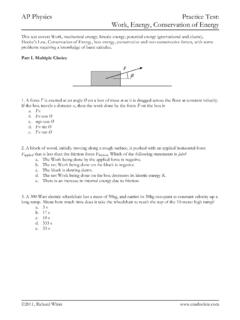
AP Physics Practice Test: Work, Energy, Conservation of Energy
www.crashwhite.comAP Physics Practice Test: Work, Energy, Conservation of Energy ©2011, Richard White www.crashwhite.com Part II. Free Response m 6. A block of mass m rests on a rough surface, and has a light spring of spring constant k and unstretched length d attached to one side as shown, with the other end of the spring attached to an anchor. There is a

Code of Practice for Energy Efficiency of Lighting ...
www.emsd.gov.hkThe set of comprehensive Building Energy Codes cover this Code, the Codes of Practice for Energy Efficiency of Air Conditioning Installations, Electrical Installations, and Lift & Escalator Installations, and the Performance-based Building Energy Code. Amendment to 1998 Edition

Physics Practice Problems: Work and Energy
cpb-us-e1.wpmucdn.comPhysics Practice Problems: Work and Energy Page 1 of 5 Please ignore air resistance, treat all surfaces as frictionless unless otherwise specified or implied. Work and work-energy theorem: 1. A 2kg crate rests on the floor. How much work is required to move it at constant speed ...

AP Physics 1- Work, Energy, & Power Practice Problems ...
www.pedersenscience.comAP Physics 1- Work, Energy, & Power Practice Problems ANSWERS FACT: The amount of work done by a steady force is the amount of force multiplied by the distance an object moves parallel to that force: W = F x cos (θ). The units are N. m, which equal a Joule (J). Positive work is done by a force parallel to an object’s displacement.

Water Meter Measurement and Verification Best Practice
energy.nv.govThis measurement and verification (M&V) best practice provides recommended procedures for energy service companies (ESCOs) to validate the performance of water metering projects that are executed with water providers under energy performance contracts. This document covers metering projects such as

Energy Packet - Union-Endicott Central School District
www.uek12.orgthe energy is transformed from the potential energy (stored energy) to the energy of movement (kinetic energy). The more you pull back on the car, the farther it will travel forward. Because no system is perfect, one-hundred percent of the potential energy is not converted to kinetic energy. Some of the energy is lost to heat and sound.