Transcription of Triton X-100®
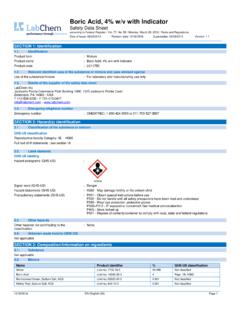
1 Triton X-100 Safety Data Sheet according to Federal Register / Vol. 77, No. 58 / Monday, March 26, 2012 / Rules and Regulations Date of issue: 06/16/2014 Revision date: 05/15/2018 Supersedes: 06/16/2014 Version: 05/15/2018 EN (English US) Page 1 SECTION 1: Identification Identification Product form : Substance Substance name : Triton X-100 CAS-No. : 9036-19-5 Product code : LC26280 Formula : (C2H4O) Synonyms : 2-methyl-2-propenoic acid, polymer with 2-propenoic acid and N-octy-2-propenamide / alpha((1,1,3,3-tetramethylbutyl)phenyl)o mega-hydroxypoly(oxy-1,2-ethanediyl) / ethoxylated octylphenol / octylphenoxypoly(ethoxyethanol) / poly(ethylene oxide)octylphenyl ether / Triton X 100 Recommended use and restrictions on use Use of the substance/mixture : Emulsifier Detergent according to Regulation (EC) No 648/2004 Supplier LabChem Inc Jackson's Pointe Commerce Park Building 1000, 1010 Jackson's Pointe Court Zelienople, PA 16063 - USA T 412-826-5230 - F 724-473-0647 - Emergency telephone number Emergency number : CHEMTREC: 1-800-424-9300 or +1-703-741-5970 SECTION 2.
2 Hazard(s) identification Classification of the substance or mixture GHS-US classification Skin corrosion/irritation Category 2 H315 Causes skin irritation Serious eye damage/eye irritation Category 2A H319 Causes serious eye irritation Full text of H statements : see section 16 GHS Label elements, including precautionary statements GHS-US labeling Hazard pictograms (GHS-US) : GHS07 Signal word (GHS-US) : Warning Hazard statements (GHS-US) : H315 - Causes skin irritation H319 - Causes serious eye irritation Precautionary statements (GHS-US) : P264 - Wash exposed skin thoroughly after handling. P280 - Wear protective gloves, eye protection. P302+P352 - IF ON SKIN: Wash with plenty of soap and water. P305+P351+P338 - If in eyes: Rinse cautiously with water for several minutes. Remove contact lenses, if present and easy to do. Continue rinsing P332+P313 - If skin irritation occurs: Get medical advice/attention.
3 P337+P313 - If eye irritation persists: Get medical advice/attention. P362 - Take off contaminated clothing and wash before reuse. Other hazards which do not result in classification Other hazards not contributing to the classification : None under normal conditions. Unknown acute toxicity (GHS US) Not applicable Triton X-100 Safety Data Sheet according to Federal Register / Vol. 77, No. 58 / Monday, March 26, 2012 / Rules and Regulations 05/15/2018 EN (English US) 2/7 SECTION 3: Composition/Information on ingredients Substances Substance type : Polymer Name Product identifier % GHS-US classification Triton X-100 (Main constituent) (CAS-No.) 9036-19-5 100 Skin Irrit. 2, H315 Eye Irrit. 2A, H319 Full text of hazard classes and H-statements : see section 16 Mixtures Not applicable SECTION 4: First-aid measures Description of first aid measures First-aid measures general : Check the vital functions.
4 Unconscious: maintain adequate airway and respiration. Respiratory arrest: artificial respiration or oxygen. Cardiac arrest: perform resuscitation. Victim conscious with labored breathing: half-seated. Victim in shock: on his back with legs slightly raised. Vomiting: prevent asphyxia/aspiration pneumonia. Prevent cooling by covering the victim (no warming up). Keep watching the victim. Give psychological aid. Keep the victim calm, avoid physical strain. Depending on the victim's condition: doctor/hospital. First-aid measures after inhalation : Remove the victim into fresh air. Respiratory problems: consult a doctor/medical service. First-aid measures after skin contact : Wash immediately with lots of water. Soap may be used. Take victim to a doctor if irritation persists. First-aid measures after eye contact : Rinse immediately with plenty of water. Remove contact lenses, if present and easy to do.
5 Continue rinsing. Do not apply neutralizing agents. Take victim to an ophthalmologist if irritation persists. First-aid measures after ingestion : Rinse mouth with water. Immediately after ingestion: give lots of water to drink. Give activated charcoal. Call Poison Information Centre ( ). Consult a doctor/medical service if you feel unwell. Ingestion of large quantities: immediately to hospital. Most important symptoms and effects (acute and delayed) Symptoms/effects after inhalation : ON CONTINUOUS EXPOSURE/CONTACT: Dry/sore throat. Coughing. Irritation of the respiratory tract. Irritation of the nasal mucous membranes. Symptoms/effects after skin contact : Tingling/irritation of the skin. Symptoms/effects after eye contact : Irritation of the eye tissue. ON CONTINUOUS EXPOSURE/CONTACT: Inflammation/damage of the eye tissue. Symptoms/effects after ingestion : Gastrointestinal complaints.
6 Immediate medical attention and special treatment, if necessary No additional information available SECTION 5: Fire-fighting measures Suitable (and unsuitable) extinguishing media Suitable extinguishing media : Quick-acting ABC powder extinguisher. Quick-acting BC powder extinguisher. Quick-acting class B foam extinguisher. Quick-acting CO2 extinguisher. Class B foam (alcohol-resistant). Water spray if puddle cannot expand. Unsuitable extinguishing media : Water (quick-acting extinguisher, reel); risk of puddle expansion. Water; risk of puddle expansion. Specific hazards arising from the chemical Fire hazard : DIRECT FIRE HAZARD. Non-flammable. INDIRECT FIRE HAZARD. Heating increases the fire hazard. Special protective equipment and precautions for fire-fighters Precautionary measures fire : Exposure to fire/ heat : keep upwind. Exposure to fire/ heat : seal off low-lying areas.
7 Exposure to fire/ heat : have neighbourhood close doors and windows. Firefighting instructions : Cool tanks/drums with water spray/remove them into safety. Protection during firefighting : heat /fire exposure: compressed air/oxygen apparatus. SECTION 6: Accidental release measures Personal precautions, protective equipment and emergency procedures For non-emergency personnel Protective equipment : Gloves. Face-shield. Protective clothing. Triton X-100 Safety Data Sheet according to Federal Register / Vol. 77, No. 58 / Monday, March 26, 2012 / Rules and Regulations 05/15/2018 EN (English US) 3/7 Emergency procedures : Mark the danger area. No naked flames. Wash contaminated clothes. For emergency responders Protective equipment : Equip cleanup crew with proper protection. Emergency procedures : Ventilate area. Environmental precautions Prevent entry to sewers and public waters.
8 Notify authorities if liquid enters sewers or public waters. Methods and material for containment and cleaning up For containment : Contain released substance, pump into suitable containers. Plug the leak, cut off the supply. Methods for cleaning up : Take up liquid spill into absorbent material sand/earth. Scoop absorbed substance into closing containers. Clean contaminated surfaces with an excess of water. Wash clothing and equipment after handling. Reference to other sections See Heading 8. Exposure controls and personal protection. SECTION 7: Handling and storage Precautions for safe handling Precautions for safe handling : Keep away from naked flames/ heat . In finely divided state: use spark-/explosionproof appliances. Finely divided: keep away from ignition sources/sparks. Carry operations in the open/under local exhaust/ventilation or with respiratory protection.
9 Comply with the legal requirements. Clean contaminated clothing. Thoroughly clean/dry the installation before use. Hygiene measures : Observe normal hygiene standards. Keep container tightly closed. Conditions for safe storage, including any incompatibilities Storage conditions : Keep container closed when not in use. Incompatible products : Strong bases. Strong oxidizers. Strong reducing agents. Incompatible materials : Sources of ignition. Direct sunlight. heat -ignition : KEEP SUBSTANCE AWAY FROM: heat sources. Prohibitions on mixed storage : KEEP SUBSTANCE AWAY FROM: oxidizing agents. reducing agents. (strong) bases. water/moisture. Storage area : Store in a cool area. Store in a dry area. Store in a dark area. Ventilation at floor level. May be stored under argon. Meet the legal requirements. Special rules on packaging : SPECIAL REQUIREMENTS: closing.
10 Dry. correctly labelled. meet the legal requirements. Secure fragile packagings in solid containers. Packaging materials : SUITABLE MATERIAL: steel with plastic inner lining. SECTION 8: Exposure controls/personal protection Control parameters No additional information available Appropriate engineering controls Appropriate engineering controls : Emergency eye wash fountains should be available in the immediate vicinity of any potential exposure. Individual protection measures/Personal protective equipment Personal protective equipment: Safety glasses. Gloves. Materials for protective clothing: GIVE GOOD RESISTANCE: rubber. plastics Hand protection: Triton X-100 Safety Data Sheet according to Federal Register / Vol. 77, No. 58 / Monday, March 26, 2012 / Rules and Regulations 05/15/2018 EN (English US) 4/7 Gloves Eye protection: Face shield Skin and body protection: Protective clothing Respiratory protection: Mist formation: aerosol mask Other information: Do not eat, drink or smoke during use.