Example: dental hygienist
MAKING POLICY BETTER - The Institute for Government
increasingly inappropriate in a world of decentralised services and complex policy problems. In the face of these challenges, we need to give a more realistic account of what good policy making should look like – and then ensure the surrounding system increases its resilience to the inevitable pressures to depart from good practice.
Tags:
Information
Domain:
Source:
Link to this page:
Documents from same domain
InSTITuTE FOR GOvERnmEnT The civil service …
www.instituteforgovernment.org.uk54 InSTITuTE FOR GOvERnmEnT The civil service workforce The number of civil servants has been cut by more than 70,000 since the Spending Review in 2010, meaning the Civil Service

Implementing the London Challenge
www.instituteforgovernment.org.uk2 Summary This case study looks at the implementation of the London Challenge, a secondary school improvement programme that ran in the capital …

The Ban on Smoking in Public Places (2007)
www.instituteforgovernment.org.uk100 London hospitals, which confirmed the link between smoking and lung cancer for the first time. In a follow up report, published in December 1952, they concluded that “the association between smoking and carcinoma of the lung is real”.4 Despite growing medical evidence about the dangers of smoking, the government was reluctant to intrude into what was perceived as an issue of personal

Has Devolution Worked? - The Institute for Government
www.instituteforgovernment.org.ukdividend’, as some call it. Within that, our authors also look at devolution’s success in acting as a ‘policy laboratory’, testing and showcasing policies in one area for the benefit of the rest.3 A third measure of success might be what devolution has done for the unity of the UK and for the clarity of its constitutional arrangements.

Parliamentary Scrutiny of Government
www.instituteforgovernment.org.ukscrutiny is an active process, ‘accountability’ describes a formal relationship, and ‘transparency’ a state of affairs. Plenty of scrutiny does not involve accountability but some forms of scrutiny do take place in the context of formal accountability relationships: that is,

Going with the grain: influencing behaviour through public ...
www.instituteforgovernment.org.ukPaul has advised various UK government departments and he is currently chief academic adviser on economic appraisal for the Government Economic Service. Michael Hallsworth is a Senior Researcher at the Institute for Government. He has conducted cross-government research into organisational behaviour,

The cost of Covid-19 - The Institute for Government
www.instituteforgovernment.org.ukcost of Covid to the UK government – in the form of increased public borrowing – will be £317.4 billion in 2020/21 alone. This paper analyses the impact that the pandemic has had on the UK’s public finances in the current financial year. We calculate the cost of …

Understanding the economic impact of Brexit
www.instituteforgovernment.org.ukBrexit will reduce economic growth – although the ... 2 UNDERSTANDING THE ECONOMIC IMPACT OF BREXIT 5. From here to there: the economic implications of adapting to a new relationship 57 ... regional inequalities. At least one study …

Timeline of UK coronavirus lockdowns, March 2020 to March …
www.instituteforgovernment.org.uk19 March PM says the UK can “turn tide of coronavirus” in 12 weeks 23 March PM announces the ˜ rst lockdown in the UK, ordering people to “stay at home” 26 March Lockdown measures legally come into force 25 March Coronavirus Act 2020 gets Royal Assent 16 March PM says “now is the time for everyone to stop non-essential contact and ...

The UK Shared Prosperity Fund
www.instituteforgovernment.org.ukreplace EU structural funds with a new UK Shared Prosperity Fund. It assesses how this fund will interact with the devolution arrangements in Scotland, Wales and Northern Ireland, how the devolved governments could and should be involved in its operation, and what role the new fund plays in the UK government’s strategy to strengthen the union.
Related documents
Module 1 - Administrative information application form
www.ema.europa.euThe procedure number is the Mutual Recognition Procedure number allocated by the RMS. “First Use” means the first Mutual Recognition Procedure. All the concerned Member states should be indicated. “Repeat use” means a new use (“wave”) of the same mutual recognition or decentralised procedure made to include new concerned member ...
VOLUME 2A Procedures for marketing authorisation CHAPTER …
ec.europa.eudecentralised procedure (hereafter “the coordination group”). The applicant cannot stop this procedure by subsequently withdrawing the application in the referring Member State. If no agreement can be reached in this group the matter is referred for arbitration to the EMEA. Any matter dealt with by the coordination group in a
Practical user guide for electronic Application Forms (eAF ...
esubmission.ema.europa.euA Decentralised Procedure..... 56 1.1.4. A National Procedure ..... 57 1.2. Is this an application for a change to your existing marketing authorisation leading to an extension as referred to in Annex I of Regulation (EC) NO 1234/2008, or any national ...

VOLUME 2B Module 1.2: Administrative information ...
ec.europa.euA DECENTRALISED PROCEDURE (according to Article 28(3) of Directive 2001/83/EC ) Reference Member State: Procedure number: Concerned Member State(s) (specify): AT BE BG CY CZ DE DK EE EL ES FI FR HR HU IE IS IT LI LT …

EU CENTRALISED PROCEDURE Key steps and considerations …
www.topra.orgdecentralised procedure is possible as long as a suitable justification can be given that it would represent a significant therapeutic, scientific or technical innovation, or that its authorisation would be in the interest of patients at a community level. The CP assessment process
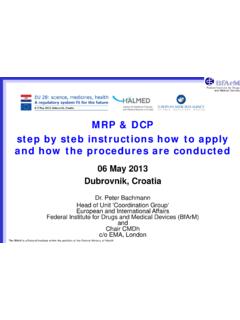
MRP & DCP step by steb instructions how to apply and how ...
www.ema.europa.euaccepted via the Decentralised Procedure, provided that the same Reference Member State is used. The BfArM is a Federal Institute within the portfolio of the Federal Ministry of Health Federal Institute for Drugs and Medical Devices DCP/MRP BAH- WiDi 22. 03. 2011 18
eCTD Guidance Document - Europa
esubmission.ema.europa.euProcedure A Community registration procedure for the authorisation of medicinal products in the European Community. There are 4 types of procedure that ope–rate within the EC Centralised, Decentralised, Mutual Recognition and National. Submission or Sequence A single set of information and/or electronic documents

Design and Analysis of a 1MW Grid- Connected Solar PV ...
media.africaportal.orgstandard procedure developed was validated in the design of a 1MW grid-connected solar ... Decentralised grid-connected PV applications include rooftop . PV generators, where the PV systems are mounted on rooftops of buildings and incorporated into the building’s integrated system (DGS, 2008). ...
Packaging ‘blue-box’ requirements and additional ...
www.hma.eumutual recognition, decentralised or centralised procedures . Additional information on labelling/package leaflet that may be required or permitted nationally in accordance with Articles 58 and 64 of Directive 2001/82/EC, as amended, is outlined below. Index
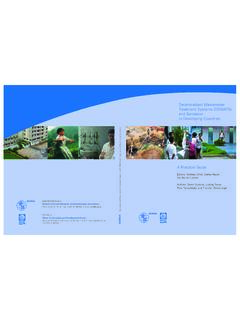
Decentralised Wastewater Treatment Systems (DEWATS) …
sswm.infoDecentralised Wastewater Treatment Systems (DEWATS) and Sanitation in Developing Countries. Decentralised Wastewater Treatment Systems (DEWATS) ... 6 CBS Programme – detailed procedure for implementation 100 6.1 First planning activities 100 6.2 The pilot project 103 6.3 Preparation phase 105