Example: bankruptcy
HAMILTON’S PRINCIPLE AND HAMILTON’S FORMULATION
Classical Mechanics Page No. 158 1 0 0 t t δ δI T W dt= + =∫ for actual path. • Hamilton’s Principle (for conservative system) : “Of all possible paths between two points along which a dynamical system may move from one point to another within a given time interval from t0 to t1, the actual path followed by the system is the one which minimizes the line integral of
Tags:
Information
Domain:
Source:
Link to this page:
Documents from same domain
Bachelor of Commerce - Shivaji University
www.unishivaji.ac.inSHIVAJI UNIVERSITY, KOLHAPUR B. Com. Part – II Sem-III & Sem-IV Sr. No. Semester III Sr. No. Semester IV 1 English for Business Communication - Paper –III
( B.E. Mechanical Engineering Sem –VII & VIII )
www.unishivaji.ac.inSHIVAJI UNIVERSITY KOLHAPUR Page 4 10 Air Distribution System: 04 Re-circulated air, Ventilation air, Duct work, Use of friction loss & rectangular equivalent of

SHIVAJI UNIVERSITY, KOLHAPUR ELECTRICAL …
www.unishivaji.ac.in1 SHIVAJI UNIVERSITY, KOLHAPUR ELECTRICAL ENGINEERING REVISED SYLLABUS S.E. ( Electrical )-Part-I ( SEM- III ) Sr. Teaching Scheme Examination Scheme No. Name of Subject
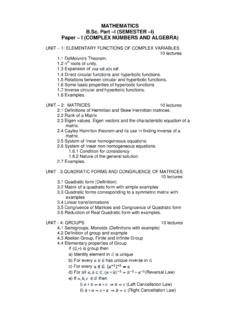
B.Sc. Part I Semester I and II Mathematics Syllabus
www.unishivaji.ac.inmathematics b.sc. part –i (semester –i) paper – i (complex numbers and algebra) unit – 1: elementary functions of complex variables 10 lectures
SHIVAJI UNIVERSITY DEPARTMENT OF …
www.unishivaji.ac.inM.Sc. (Stat) Acad Flexib. Pg No. Shivaji University, Kolhapur 1 SHIVAJI UNIVERSITY DEPARTMENT OF STATISTICS KOLHAPUR M.Sc. (Statistics) syllabus (Revised) to be effective from the Academic Year 2006-2007.

Syllabus For B.Com. Part-I Sem-I & Sem-II - Shivaji …
www.unishivaji.ac.inB (2009) Accredited By AAC Syllabus For B.Com. Part-I Sem-I & Sem-II Introduced from June 2013 and Onwards (Subject to the modifications will be made from time to time)
Post Graduate Diploma in Economics - Shivaji …
www.unishivaji.ac.in1 SHIVAJI UNIVERSITY, KOLHAPUR Department of Economics Revised Syllabus of Post Graduate Diploma in Economics to be Introduced from June 2015

www.unishivaji.ac.in
www.unishivaji.ac.inShivaji University, Kolhapur Regulations for M.Phil./ Ph.D. Programme Grants (Minimum Standards and for of M.Phil_,' Ph.D Degreesl Regulations, 2016 : dated May 2016)

STUDENTS FACILITATION CENTRE - Shivaji University
www.unishivaji.ac.in3 | Page 3. Duplicate Mark Sheet • Download the application form from www.unishivaji.ac.in → Examinations → Download Forms or obtain it from the Shivaji University Consumers Store.

M.A. I ECONOMICS Syllabus - Shivaji University
www.unishivaji.ac.in2 Shivaji University, Kolhapur. M.A. Part-I Economics Revised syllabus (from June 2010) Group- C. Compulsory Paper-I MICRO ECONOMIC ANALYSIS PREAMBLE:
Related documents

8.09(F14) Chapter 4: Canonical Transformations, Hamilton ...
ocw.mit.eduChapter 4 Canonical Transformations, Hamilton-Jacobi Equations, and ... Recall the the Euler-Lagrange equations are invariant when: 60. CHAPTER 4. CANONICAL TRANSFORMATIONS, HAMILTON-JACOBI ... where the Hamilton’s equations for the evolution of the canonical variables (q;p) are satis ed: @H q_ i= @H and p_ i = @p. i
Chapter 2 Lagrange’s and Hamilton’s Equations
www.physics.rutgers.eduChapter 2 Lagrange’s and Hamilton’s Equations In this chapter, we consider two reformulations of Newtonian mechanics, the Lagrangian and the Hamiltonian formalism. The rst is naturally associated with con guration space, extended by time, while the latter is the natural description for working in phase space.

Chapter7 Lagrangian and Hamiltonian Mechanics
bcas.du.ac.inequations of motion for small angle oscillations using Lagrange’s equations. Fig. 7.1 7.13 Use Hamilton’s equations to obtain the equations of motion of a uniform heavy rod of mass M and length 2a turning about one end which isfixed. 7.14 A one-dimensional harmonic oscillator has Hamiltonian H = 1 2 p 2 + 1 2ω 2q2. Write down Hamiltonian ...

A Student’s Guide to Lagrangians and Hamiltonians
ppc.inr.ac.ruequations 70 3.2 Hamilton’s principle 73 3.3 Derivation of Lagrange’s equations 75 3.4 Generalization to many coordinates 75 3.5 Constraints and Lagrange’s λ-method 77 3.6 Non-holonomic constraints 81 3.7 Virtual work 83 3.7.1 Physical interpretation of the Lagrange multipliers 84 3.8 The invariance of the Lagrange equations 86 3.9 ...
Chapter 4. Lagrangian Dynamics
physics.uwo.caHamilton’s Principle, from which the equations of motion will be derived. These equations are called Lagrange’s equations. Although the method based on Hamilton’s Principle does not constitute in itself a new physical theory, it is probably justified to say that it is more fundamental that Newton’s equations.

Chapter 7 Hamilton's Principle - Lagrangian and ...
teacher.pas.rochester.eduPhysics 235 Chapter 7 - 4 - When we use the Lagrange's equations to describe the evolution of a system, we must recognize that these equations are only correct of the following conditions are met: 1. the force acting on the system, except the forces of constraint, must be derivable from one or more potentials.
Lagrangian Mechanics - Physics Courses
courses.physics.ucsd.edu2 CHAPTER 6. LAGRANGIAN MECHANICS 6.2 Hamilton’s Principle The equations of motion of classical mechanics are embodied in a variational principle, called Hamilton’s principle. Hamilton’s principle states that the motion of a system is such that the action functional S q(t) = Zt2 t1 dtL(q,q,t˙ ) (6.2) is an extremum, i.e. δS = 0.

CHAPTER 2. LAGRANGIAN QUANTUM FIELD THEORY 2.1 …
physics.purdue.edube treated as independent. The dynamical equations for the time evolution of the fields, the so called field equations or equations of motion, will be assumed to be derivable from Hamilton’s variational principle for the action S(Ω) = Z Ω d4xL(φ,∂µφr)(2.1.1) where Ω is an arbitrary volume in space-time and L is the Langrangian density

Introduction to Lagrangian and Hamiltonian Mechanics
image.diku.dk3 Principle of Least Action Remark 3.1 The most general formulation of the laws governing the motion of mechanical systems is the ”Principle of Least Action” or ”Hamilton’s Principle”,

AN INTRODUCTION TO LAGRANGIAN MECHANICS - Saint Michael's ...
academics.smcvt.eduAN INTRODUCTION TO LAGRANGIAN MECHANICS Alain J. Brizard Department of Chemistry and Physics Saint Michael’s College, Colchester, VT 05439 July 7, 2007
Related search queries
Chapter 4: Canonical Transformations, Hamilton, Chapter 4 Canonical Transformations, Hamilton-Jacobi Equations, and, Lagrange equations, CHAPTER 4. CANONICAL TRANSFORMATIONS, HAMILTON, Hamilton, S equations, Chapter 2 Lagrange’s and Hamilton’s Equations, Chapter, Equations, Lagrange, 2 Hamilton, 2 CHAPTER, CHAPTER 2, Introduction to Lagrangian and Hamiltonian Mechanics, LAGRANGIAN MECHANICS