Transcription of Grief Among Individuals with Developmental Disabilities
1 Continuum of Care 2350 Alamo Avenue SE, Suite 155 Albuquerque, NM 87106 Fax Grief Among Individuals with Developmental Disabilities Prepared by Alejandro Moralez, LISW ---------------------------------------- ---------------------------------------- Introduction Grief is an experience that occurs after a person suffers a significant loss, when the individual is separated from another person with whom strong feelings of closeness and love have developed over time. People with Developmental Disabilities develop close ties to other Individuals and will experience loss at various times during their life. Like other Individuals , they may experience the death of a loved one. They may also experience loss due to separations as a result of moving away from their families. In addition, it is not unusual for Individuals with Developmental Disabilities to form attachments with their care providers, only to be separated from them by a change in the care provider s job situation.
2 (Deutch 85) Any of these experiences can cause feelings of loss that leads to a period of mourning. Unfortunately, Individuals with Developmental Disabilities are frequently unprepared for dealing with their Grief , and usually receive little or no assistance through the mourning process. They may be at risk for long-lasting behavioral and emotional problems as a result of the Grief experience. (Wadsworth, Harper and Fowler, 1991) It is very important to understand and help Individuals with Developmental Disabilities to go through the grieving process because they often have a hard time showing and dealing with their Grief . People with Developmental Disabilities are kept from dealing with their Grief by well-intentioned care providers, guardians and/or family members who wish to protect Individuals from "upsetting events" (Seltzer). Care providers often assume that Individuals with Developmental Disabilities have little or no awareness associated with this grieving process as it relates to the issue of "final" loss.
3 Displays of Grief often are misunderstood and thus discouraged, particularly when the emotional and behavioral expressions of Grief are intense or very disruptive (Carder, 1987; Lipe-Goodson and Goebel, 1983). There are those who believe that it would be easier for Individuals with Developmental Disabilities to accept the death of a loved one if that information were shared with them over a long period of time. It is also not uncommon for Grief reactions to be mislabeled or disregarded because of the assumed lack of awareness of such issues in Individuals with moderate to severe mental retardation. All of these rationalizations make life easier for the care provider, but much more difficult for the individual with Developmental Disabilities . Inadequate or incomplete mourning may have several consequences, including denial of the reality of the loved one s death, the idealization of the loved one, a decrease in self-esteem, and feelings of guilt. If the individual does not progress through the task of mourning, these feelings of alienation, loneliness, and depression may continue, for years after the death of loved one (Deutch, 1985).
4 Grief refers to the multifaceted, intense internal and external responses (emotional, behavioral, psychological, and physiological) to perceived and observed losses, such as a death of close friend (Bowlby, 1950). Grief reactions may be felt in response to physical losses (for example, a death) or in response to symbolic or social losses (for example, divorce or loss of a job), Grief may be experienced as a mental, physical, social, or emotional reaction. Mental reactions can include anger, guilt, anxiety, sadness and despair. Social reactions can include feelings about taking care of others in the family, seeing family friends, or returning to work. Physical reactions can include sleeping problems, changes in appetite, physical problems, or illness. The loss of a loved one is life s most stressful event and can cause a major emotional crisis. After the death of someone you love, you experience bereavement, which literally means, "to be deprived by death.
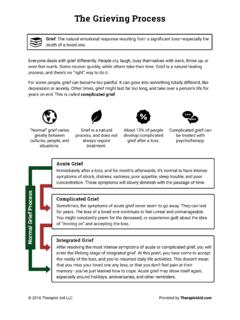
5 " Bereavement includes the process of coping and experiencing a response to a significant loss or separation. Bereavement becomes Continuum of Care 2350 Alamo Avenue SE, Suite 155 Albuquerque, NM 87106 Fax apparent when the individual displays behavior that implies they are "upset" over the separation from a person, pet, object or situation (Harper and Wadsworth, 1993, p. 314). Mourning is the natural process one goes through to accept a major loss. Mourning consists of the conscious, unconscious, and cultural reactions to loss. Mourning includes the process of adjusting the experience of loss into ongoing life. Mourning is also influenced by cultural customs, rituals, and society s rules for coping with loss. Stages of Grief Each person s pattern of mourning reflects his or her unique way of viewing and dealing with that loss. Normally most people pass through five distinct stages of Grief , according to Elizabeth Kubler-Ross (an expert on death and dying).
6 These stages are: 1. Denial ("This is not happening to me.") 2. Anger ("How could she leave me like that? I hate her!") 3. Bargaining ("I ll be a better daughter/son ") 4. Depression ("I don t feel like doing anything or seeing anyone.") 5. Acceptance. ("I have to get on with my life.") Some people experience these stages in this order, but many do not. And some people grieve for different periods of time. Furthermore, Developmental impairments complicate the grieving process because the individual may experience greater difficulties in expressing emotions, adapting to changes in relationships, and understanding the difference between life and death (Vredveld, R., 1985). The manner in which Developmental Disabilities impair the individual s understanding of death and the grieving is not well understood. Assumptions that equate "understanding" the finality of death with the ability to feel or experience Grief and bereavement have only recently been questioned.
7 The Tasks of Mourning Worden (1982) identified four tasks that need to be resolved in order for an individual to successfully complete the mourning process. Task I. To accept the reality of the loss At first, there is a natural tendency to deny the reality of the loss to protect the individual from the emotional impact of the loss. If the denial continues over time it may become pathological, and prevent the individual from returning to a normal level of functioning. Thus, the first task of mourning is to realize that the person is dead or gone and will never return. Task II. To experience the pain of Grief The emotional pain of Grief is present once the reality of death or loss is accepted. People resist feeling pain and may go through great lengths to avoid it. Eventually people realize that no matter what distractions they create they do not escape the pain and only succeed in prolonging the mourning process. It is important that Individuals with mental retardation be allowed to express their Grief and be encouraged to talk about their loss (given their ability to talk).
8 Task III. To adjust to an environment in which a loved one is missing After the death of a loved one, tasks that were performed by him/her must be assumed by others. Individuals will need to adjust to the loss of companionship, the emotional support and even the loss of activities that the loved one Continuum of Care 2350 Alamo Avenue SE, Suite 155 Albuquerque, NM 87106 Fax performed for the individual. Accepting the reality that other people may need to assume important roles in their lives may be very difficult for many Individuals with Developmental Disabilities . Task IV. To withdraw emotional energy and reinvest it in another relationship. A key issue during the final task of grieving is for a person to move on with their lives. This can be very difficult task because at first they may feel they are dishonoring their loved one. They will need to trust that they will not forget the ones who died and will remain in their hearts and minds forever.
9 Individuals with Developmental Disabilities may need to be reassured that many other Individuals care about them and are willing to be supportive of their needs. In order for people to heal from a loss, each person will accomplish these four tasks in their own way. If persons do not accomplish these they run the risk of becoming "stuck" in Grief . Unresolved Grief can resurface later in life and be a significant cause of distress in their lives as well as to others close to them. Some people do not receive the help they need to heal from their losses. Individuals with Developmental Disabilities could benefit greatly from assistance that caregivers could offer them when they are experiencing a significant loss in their lives. Caregivers need to be aware that there are certain circumstances that are found Among Individuals with Developmental Disabilities . Again, people are individually different; that is, not all Individuals with Developmental Disabilities will exhibit all of these characteristics nor have all of these experiences.
10 Luchterhand and Murphy have summarized some ways in which Individuals with Developmental Disabilities may differ from their peers in the general population. They include the following: Difficulties in learning or understanding (cognitive difficulties) Difficulty in learning or understanding is one of the major reasons why some family members and professionals do not talk about death to Individuals with mental retardation. The cognitive abilities of Individuals with Developmental Disabilities vary greatly from person to person. For example, it may very difficult to know how someone who has severe to profound mental retardation is experiencing loss. However, most Individuals with mental retardation have mild to moderate cognitive Disabilities . They will have emotions about a death and have the ability to understand and talk about this issue. They will benefit from assistance in learning about death, loss and the grieving process. It is also critical for care providers to realize that Individuals with mental retardation do not have to understand the concept of death in order to feel loss.