Transcription of Health Savings Plan Tip Sheet Medical Coordination of ...
1 Health Savings plan Coordination of benefits What is Coordination of Benefits? Coordination of Benefits (COB) is a process where individuals, couples, or families who are covered under more than one Health plan combine their coverage to maximize their benefits. One plan becomes the primary plan and pays benefits first while the other plan becomes the secondary plan and pays the balance for eligible expenses, subject to its plan benefits and limitations. Examples of COB include: A Microsoft employee covered under the Health Savings Planand another qualified high deductible Health plan (HDHP) The spouse or domestic partner of a Microsoft employeecovered under his or her own group insurance plan and theMicrosoft Health Savings plan Children covered under both parents plan , such as Microsoftand another company s Health planIf I am on the Health Savings plan can I coordinate benefits?
2 If you are enrolled in the Microsoft Health Savings plan and you wish to enroll your spouse or domestic partner as a dependent with the Microsoft plan as the secondary plan , then you may coordinate benefits with no impact to your Health Savings Account (HSA) eligibility. However, if you wish to open and contribute to an HSA, you may not be covered as a dependent on your spouse or domestic partner s Health plan unless that plan is also a qualified high deductible Health plan (HDHP). This also applies if your spouse has a Health Care Flexible Spending Account. How does Coordination of Benefits work? One plan pays eligible benefits first and becomes the primary plan , while the other plan pays second and becomes the secondary plan . Once benefits are paid by the primary plan , the secondary plan pays its share of the remaining balance for eligible expenses, subject to the plan s benefits and limitations.
3 Using in-network providers with both the primary and secondary plans maximizes the benefits received. Your spouse or domestic partner should ask their provider to submit claims to both plans. If the provider will only bill the primary plan , your spouse or domestic partner can submit a claim to the secondary plan (the Microsoft Health Savings plan ) directly with copies of the itemized bill or receipt and the primary plan s Explanation of Benefits (EOB). Please note that a copy of the primary plan s EOB is required for Premera to coordinate benefits. 025061 (10-17-2018) Which plan pays first? See the examples below to determine which plan pays first (the primary plan ) and which plan pays second (the secondary plan ). Microsoft Employees Your Microsoft Health Savings plan will be primary. For spouses and domestic partners Your spouse s or domestic partner s plan is considered primary for his or her own claims.
4 He or she should submit claims to this plan first. Next, send the outstanding balance to the secondary plan (the Microsoft Health Savings plan ) for additional reimbursement of eligible expenses if applicable. For married couples with dependent children If you choose to cover your child on your spouse s or domestic partner s plan in addition to covering him or her on your Microsoft Health Savings plan , your child s primary coverage will be based on the birthday rule. This means that the insurance of the parent whose birthday (excluding year of birth) occurs first in the calendar year will become primary coverage for the child. Note: A child of two Microsoft employees can only be covered on one Microsoft Medical and dental plan . If this applies to your situation, you will need to determine which of you will cover the dependent. If you are separated or divorced, please refer to the COB rules for covering a child in the Summary plan Description for more information.
5 What other important information should I know? Premera will pay benefits based on the Premera network status (in or out of network) of the provider. To receive the maximum benefit level, you should choose a provider that is in network for both plans. Your spouse or domestic partner must always follow the rules of his or her primary plan in order for the Microsoft Health Savings plan to consider paying as secondary. Example If the primary plan requires your spouse or domestic partner to obtain pre-approval for a procedure or see an in-network provider to receive coverage and he or she fails to do so, the Microsoft Health Savings plan will pay nothing for that expense, regardless of whether it is a covered service under the plan . Any visit limits that apply to a plan will be counted toward the limit of both plans, regardless of which plan pays. Example If both the primary and secondary plans cover two routine dental cleanings per year, the maximum number of dental cleanings allowed for each person covered under the two plans would still be two dental cleanings total.
6 Having coverage under the secondary plan would not allow an additional two dental cleanings per year. The Microsoft plan will not pay an amount greater than the Premera allowed amount it would have paid if this plan were the primary plan . Example The cost of the service received by your spouse or domestic partner is $150 and the allowed amount for the Microsoft Health Savings plan is $100. If the primary plan paid $100, the Microsoft Health Savings plan will not pay any additional amount over what the primary plan paid. Secondary claims are processed based on the covered services of the Microsoft Health Savings plan , regardless if the service was covered by the primary plan . Example If your spouse or domestic partner receives a service under his or her primary Health plan that is not a covered service by your Microsoft Premera plan as secondary coverage, there will be no reimbursement for the claim under your plan .
7 Coordination of Benefits scenarios The examples below are for illustrative purposes only. Please call the Microsoft-dedicated customer service team at 800-676-1411, 5 to 8 Monday through Friday with any questions you may have about your specific Coordination of Benefits plan . Scenario #1: Employee +1 The primary plan s $500 deductible was met as a result of this service. The spouse or domestic partner has a balance of $500 owing to the provider if his or her provider accepted the primary plan s allowed amount. While the secondary coverage (Microsoft Health Savings plan ) did not pay anything additional for this service, the full Premera allowed amount of $1,400 for the claim was applied toward the spouse s or domestic partner s secondary coverage Health Savings plan deductible of $3,000, leaving a balance of $1,600 left to satisfy for the year.
8 plan BILLED AMOUNT ALLOWED AMOUNT AMOUNT ELIGIBLE FOR BENEFITS AMOUNT APPLIED TO deductible COINSURANCE AMOUNT PAID BY plan BALANCE Primary plan $2,500 $1,200 $1,200 $500 100% $700 (B) $500 (C) Secondary plan (Microsoft Health Savings plan ) N/A $1,400 (A) $700 (A-B) $1,400 90% $0 (D) $500 (C-D) Total Paid by primary and secondary $700 Remaining Health Savings plan deductible $1,600 Remaining Health Savings plan coinsurance maximum $2,000 Balance owed by spouse or domestic partner $500 Scenario #2: Employee +1 The primary and secondary plan s deductibles have already been met. After applying both primary and secondary coverage, the spouse or domestic partner has a balance of $1,100 owing to the provider. After $100 in coinsurance has been applied to the secondary coverage Health Savings plan coinsurance max of $2,000, it leaves a balance of $1,900 left to satisfy before the plan begins to pay 100 percent for covered services.
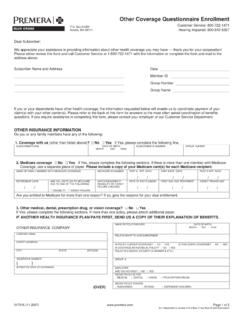
9 plan BILLED AMOUNT ALLOWED AMOUNT AMOUNT ELIGIBLE FOR BENEFITS AMOUNT APPLIED TO deductible COINSURANCE AMOUNT PAID BY plan BALANCE Primary plan $10,000 $10,000 $10,000 N/A (met) 80% $8,000 (B) $2,000 (C) Secondary plan (Microsoft Health Savings plan ) N/A $9,000 (A) $1,000 (A-B) N/A (met) 90% $900 (D) $1,100 (C-D) Total Paid by primary and secondary $8,900 Remaining Health Savings plan deductible $0 Remaining Health Savings plan coinsurance maximum $1,900 Balance owed by spouse or domestic partner $1,100 How are secondary claims submitted to Premera? Your spouse or domestic partner should ask his or her provider to submit claims to both primary and secondary coverage. If his or her provider will not submit secondary claims, your spouse or domestic partner will need to submit these directly to Premera by doing the following: For Medical , Vision or Dental claims Go to and selectMedical, Vision or Dental in the Health & Fitness menu, then chooseFind a Claim Form.
10 Complete the form and send a copy of the providers bill along with theExplanation of Benefits (EOB) from the primary plan . For Pharmacy claims Go to and select Prescription inthe Health & Fitness menu, then choose Find a Claim Form. Complete the form and submit it along with the pharmacy receipt (notthe register receipt) that includes the drug name, National Drug Code (NDC), and payment information. All secondary claims should be sent to: Premera Blue CrossPO Box 91059 Seattle, WA 98111-9159 Or fax to 800-676-1477 Discrimination is Against the Law Premera Blue Cross complies with applicable Federal civil rights laws and does not discriminate on the basis of race, color, national origin, age, disability, or sex.